Mathematical Curiosities
1729
The smallest number expressible as the sum of two cubes in two different ways. Hardy called it "rather dull". Ramanujan disagreed immediately.
Open exhibitThe number that starts arguments
Write a zero, a decimal point, and then a nine.
Then another nine. And another. And never, ever stop.
0.999…
Here is a sentence that has started more online arguments than almost any other in mathematics:
0.999… is exactly equal to 1.
Not nearly. Not "as good as". Exactly.
If your first reaction is "no, it isn't" - you are in very good company.
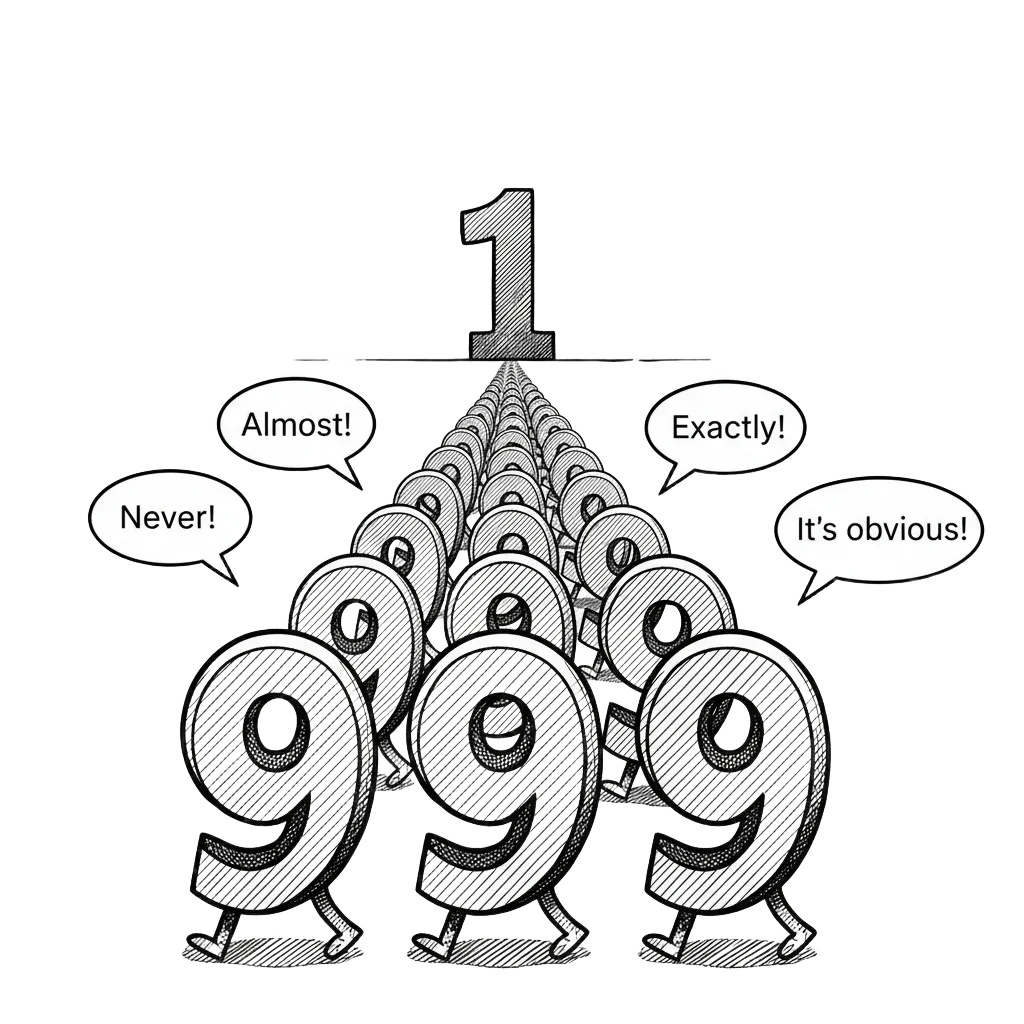
Exhibit - Section I
In the late 1990s and early 2000s, the online forums of the video game company Blizzard Entertainment - makers of Diablo, StarCraft and Warcraft - were full of players discussing monsters, strategies and spells.
And, for some reason, 0.999…
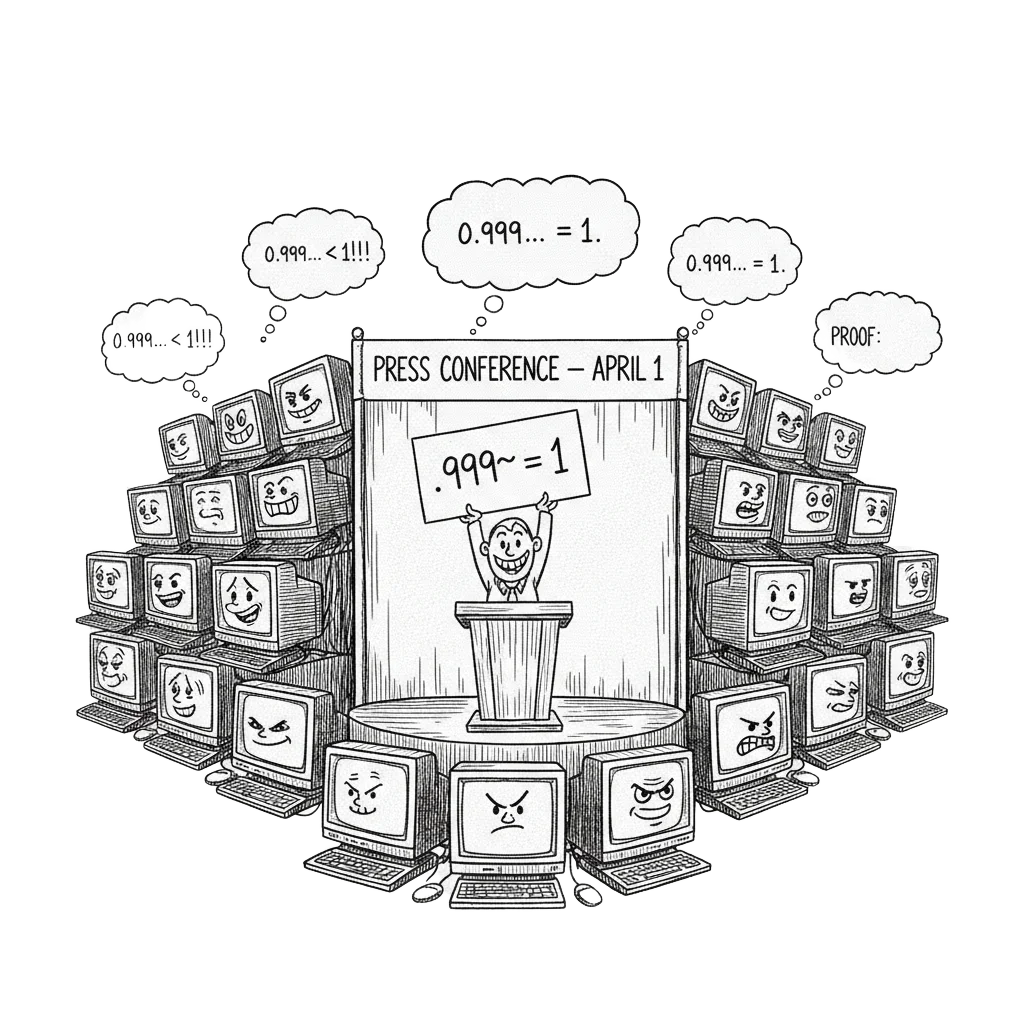
Thread after thread, year after year, players argued about whether 0.999… really equals 1. People posted proofs. Other people posted counter-proofs. Nobody backed down.
Then, on 1 April 2004, Blizzard published a press release for April Fool's Day. It announced, with great ceremony, that ".999~ does in fact equal 1", and noted that "for seven and a half years, enthusiastic forum-goers have fervently debated the issue".
It was a joke, of course. A games company had settled a maths argument by press release.
The funny thing is that the joke was true.
It's not just gamers
In the 1990s, arguing about 0.999… became a popular sport on the mathematics discussion group sci.math, one of the internet's earliest maths communities. Years later, Wikipedia's article on 0.999… attracted so many objections that editors set up a whole separate discussion page just for people who wanted to argue about it.
Exhibit - Section II
It isn't only people on the internet who feel uneasy.
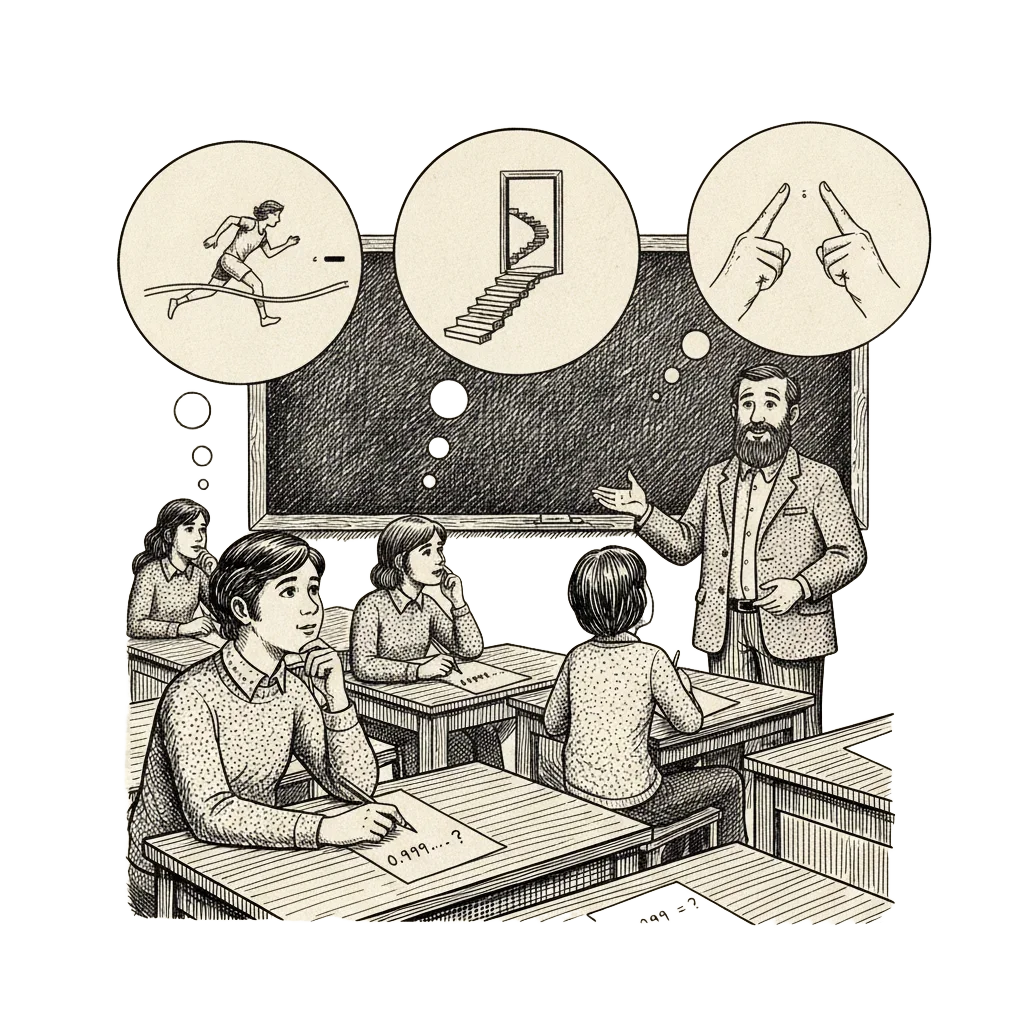
In 1978, two mathematics educators in England, David Tall and Rolph Schwarzenberger, asked students a simple question: what is 0.999… ?
Most of them said it was less than one.
Their answers were thoughtful. One described it as "just less than one, but it is the nearest you can get to one without actually saying it is one."
Another said it was "just less than one, but the difference between it and one is infinitely small."
These were not careless answers. They were honest attempts to make sense of something strange. And later teachers and researchers have found the same unease again and again, in classrooms all over the world.
So if 0.999… feels wrong to you, that feeling is not a mistake. It is one of the most common and natural feelings in all of mathematics.
"Just less than one, but the difference between it and one is infinitely small."
Exhibit - Section III
Here is the gentlest way to see what's going on. You probably already believe it, without knowing.
Divide 1 by 3 on a calculator, and you get:
1/3 = 0.333…
threes, forever
Most people are perfectly happy with that. A third is a third, and in decimals it just happens to be written with endless threes. Now multiply both sides by 3:
3 × 1/3 = 1
3 × 0.333… = 0.999…
Three thirds make a whole. So 0.999… and 1 are the same thing, written two different ways.
The same trick works with ninths. 1/9 = 0.111…, 2/9 = 0.222…, all the way up to 8/9 = 0.888…
So what should 9/9 be? The pattern says 0.999… . But 9/9 is simply 1.
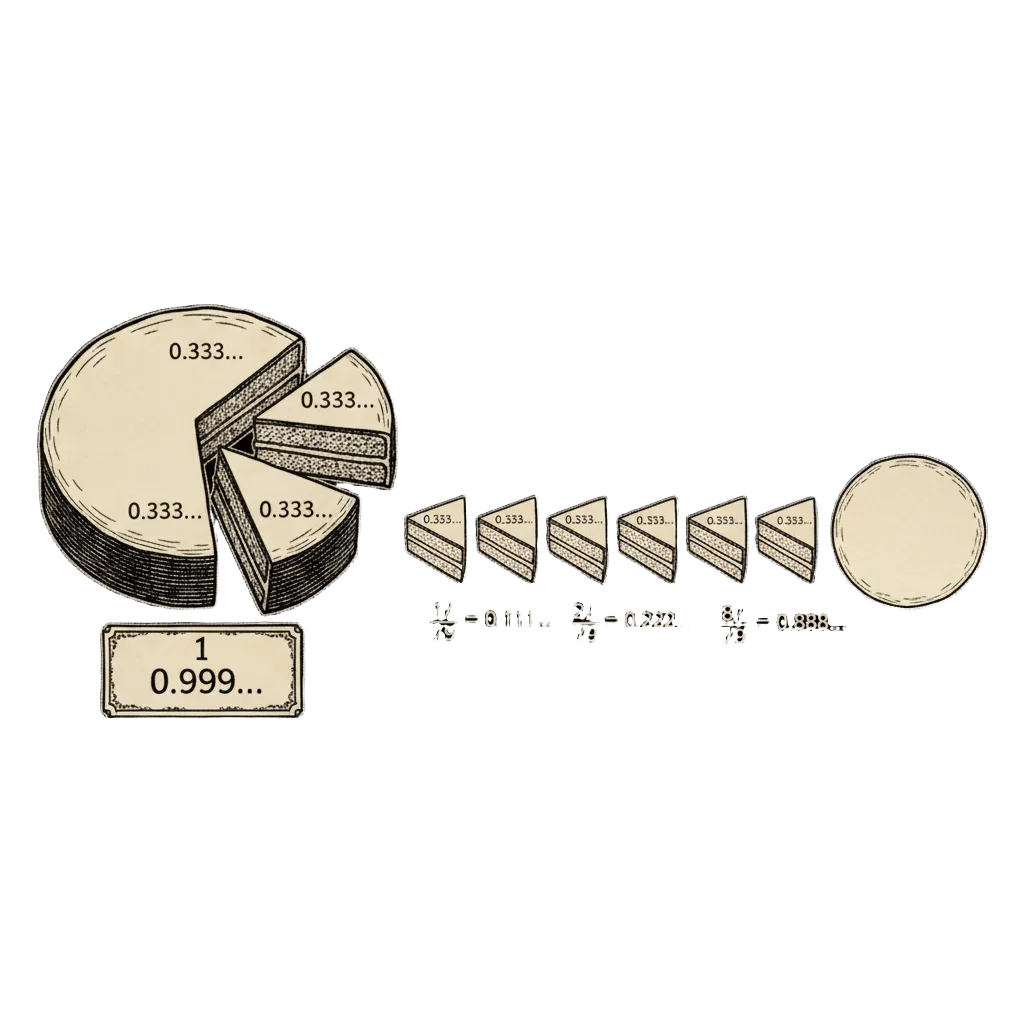
Exhibit - Section IV
Here is a second argument, and it is a lovely one.
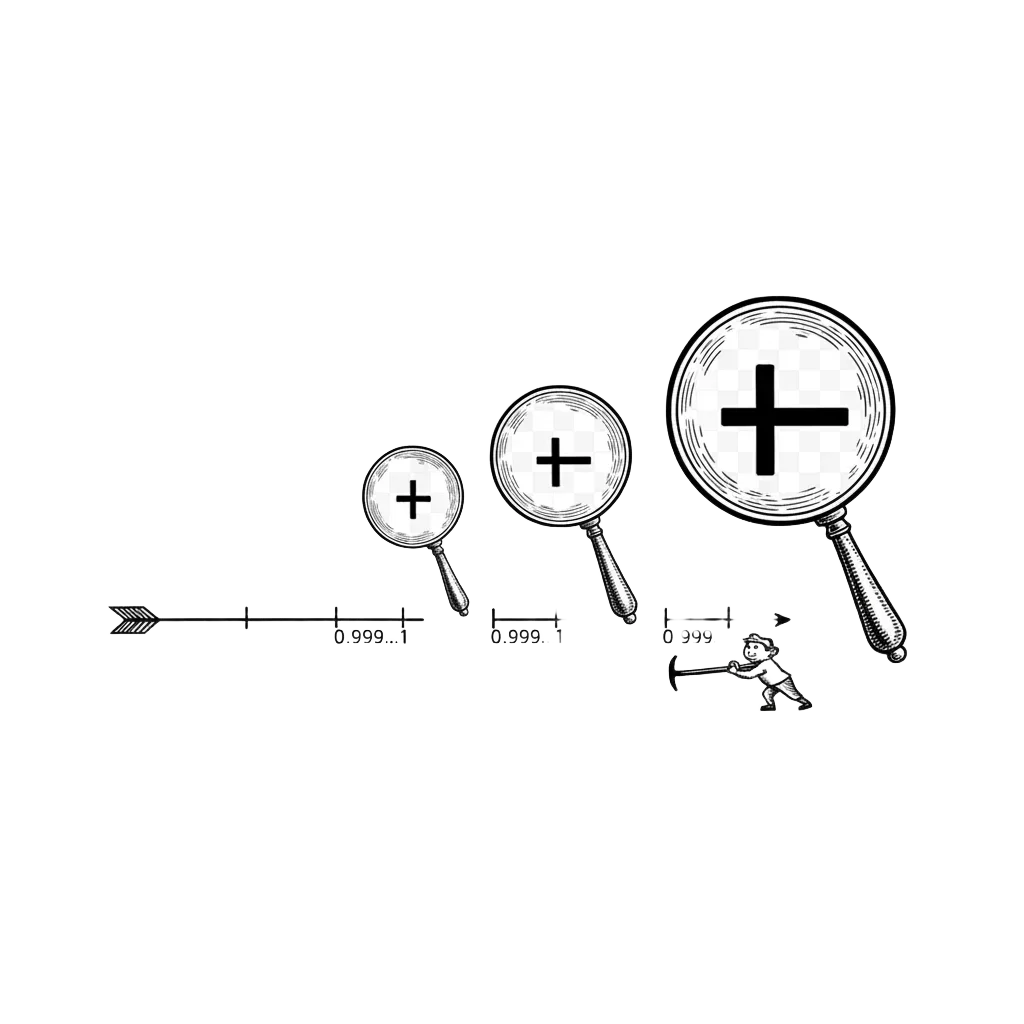
Pick any two different numbers - say, 0.5 and 0.6. There is always another number squeezed between them: 0.55, for example. Between 0.5 and 0.55 is 0.525. However close two different numbers are, you can always fit something in the gap.
So try it. Find a number that is bigger than 0.999… but smaller than 1.
It would need to be bigger than 0.9, and bigger than 0.99, and bigger than 0.999, and so on forever - so every one of its decimal places would have to be a 9. But then it would be 0.999… . There is no room left for anything else.
Look at the gap another way:
1 − 0.9 = 0.1
1 − 0.99 = 0.01
1 − 0.999 = 0.001
Every new 9 shrinks the gap ten times. With nines that never stop, the gap reaches zero.
Two numbers with nothing between them, and nothing separating them, are not two numbers at all. They are one.
One more for the doubters
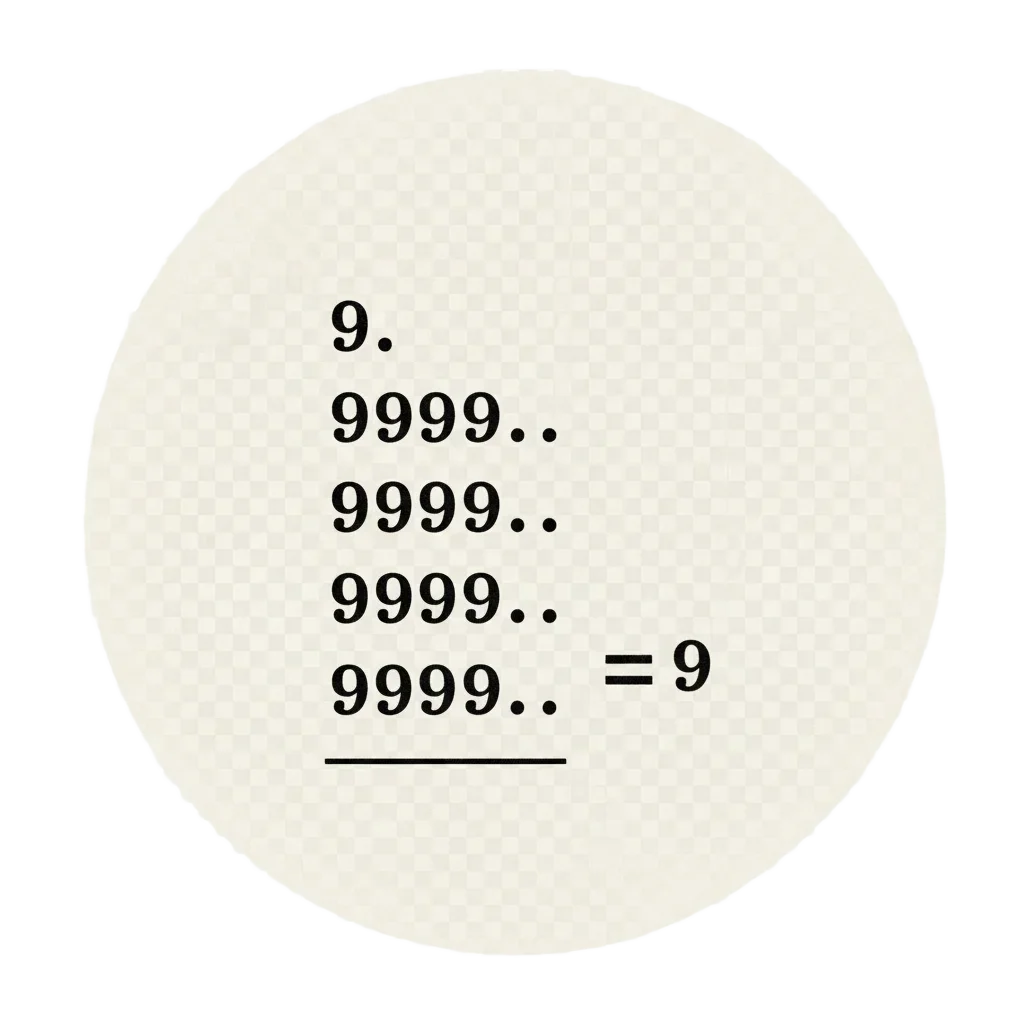
Call the number x, so x = 0.999…
Multiply by 10: 10x = 9.999…
Subtract the first from the second. All the endless nines cancel:
9x = 9
So x = 1.
Exhibit - Section V
If the arguments are this simple, why do smart people keep fighting about it?
Because our intuition is trained on things that happen, one step at a time.
When we picture 0.999…, we imagine someone writing nines - one, then another, then another - getting closer and closer to 1 but never quite arriving. A journey that never ends.
But 0.999… is not a journey. It is not someone still busy writing. The dots mean that all the nines are already there, every single one, at once.
It is the difference between a runner who is still running, and the finish line itself.
People have been tangled up in this for a very long time. About 2,500 years ago, the Greek philosopher Zeno of Elea argued that you can never cross a room: first you must walk half-way, then half of what's left, then half again, forever. Surely you never arrive?
And yet, every day, we walk across rooms.
Infinitely many steps can add up to a finite, ordinary, arrived-at number. 0.999… is exactly that: infinitely many nines that add up to exactly 1.
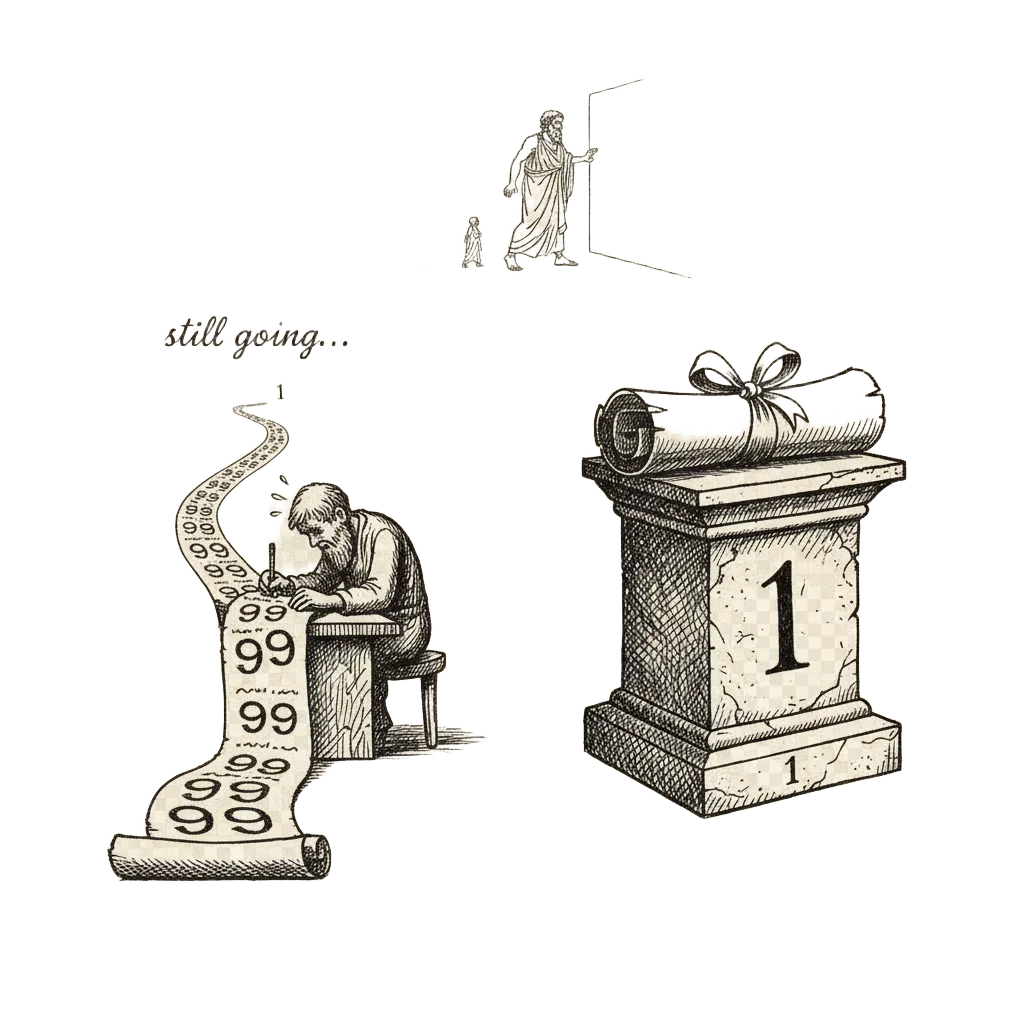
Exhibit - Section VI
Here is the real secret: this isn't a strange fact about 0.999… . It's a strange fact about decimals.
Some numbers can be written in two ways:
1 is also 0.999…
0.5 is also 0.4999…
2.3 is also 2.2999…
Every number that stops neatly in decimals has an endless twin ending in nines.
It isn't a special rule for base ten, either. In the binary code computers use, 0.111… equals 1. In base three, 0.222… equals 1.
We already know that one thing can have many names. Half, 1/2, 2/4 and 0.5 are all the same amount. Nobody argues about that.
0.999… is just one more name for 1 - an unusual one, a long one, a name that happens never to end.
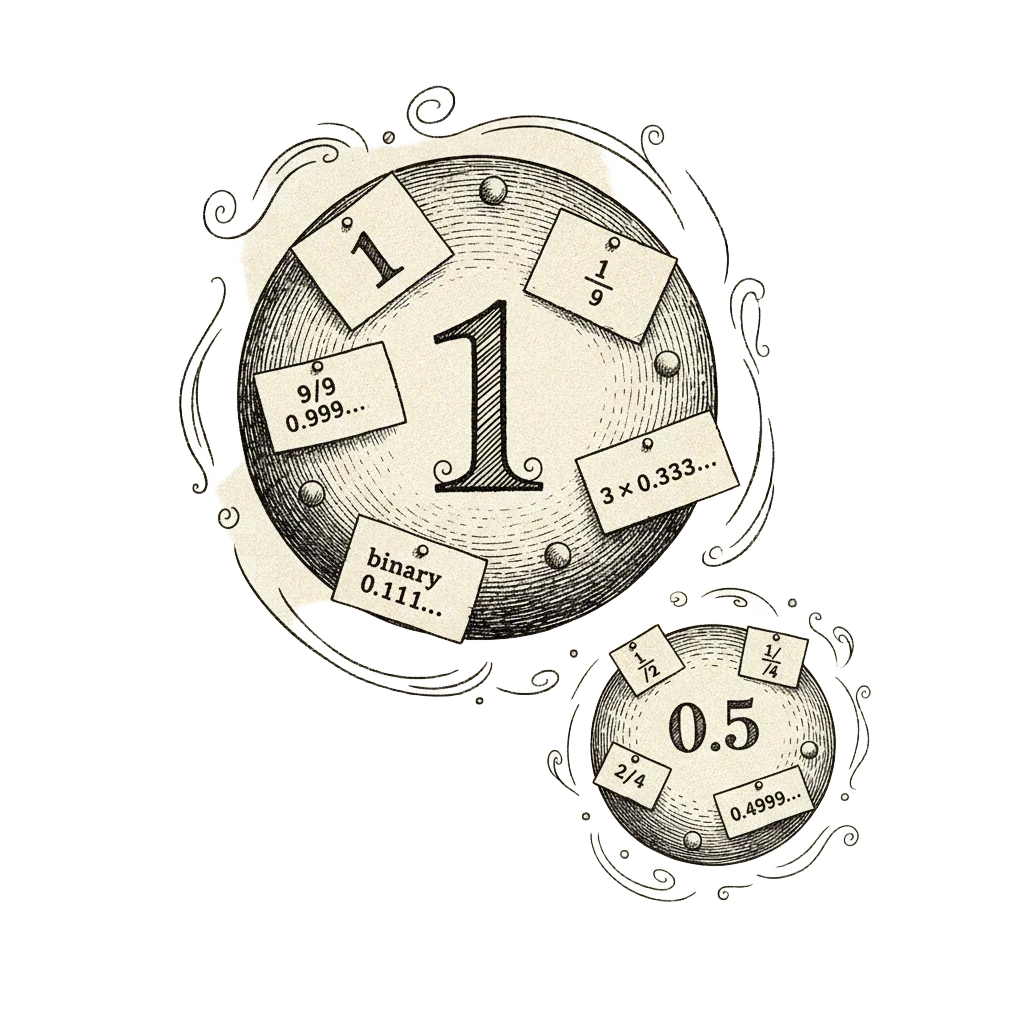
Exhibit - Section VII
0.999… is famous not because it is useful - nobody needs it to pay a bill - but because of what it teaches.
Our intuition is brilliant at everyday things: catching a ball, sharing a pizza, judging a distance. But it was never built for infinity.
When intuition and careful reasoning disagree, mathematics does not take a vote. It asks: what exactly do we mean? What do those three little dots promise? And once we answer that honestly, the argument settles itself.
That is why 0.999… keeps coming back, on forums, in classrooms, and at dinner tables. It is the smallest possible doorway into one of the biggest ideas in mathematics:
The infinite can be reasoned about - carefully, precisely, and correctly - even when it feels impossible.
And every time someone new walks through that doorway, the argument starts all over again.
Exhibit Label
Here is why 0.999… matters:
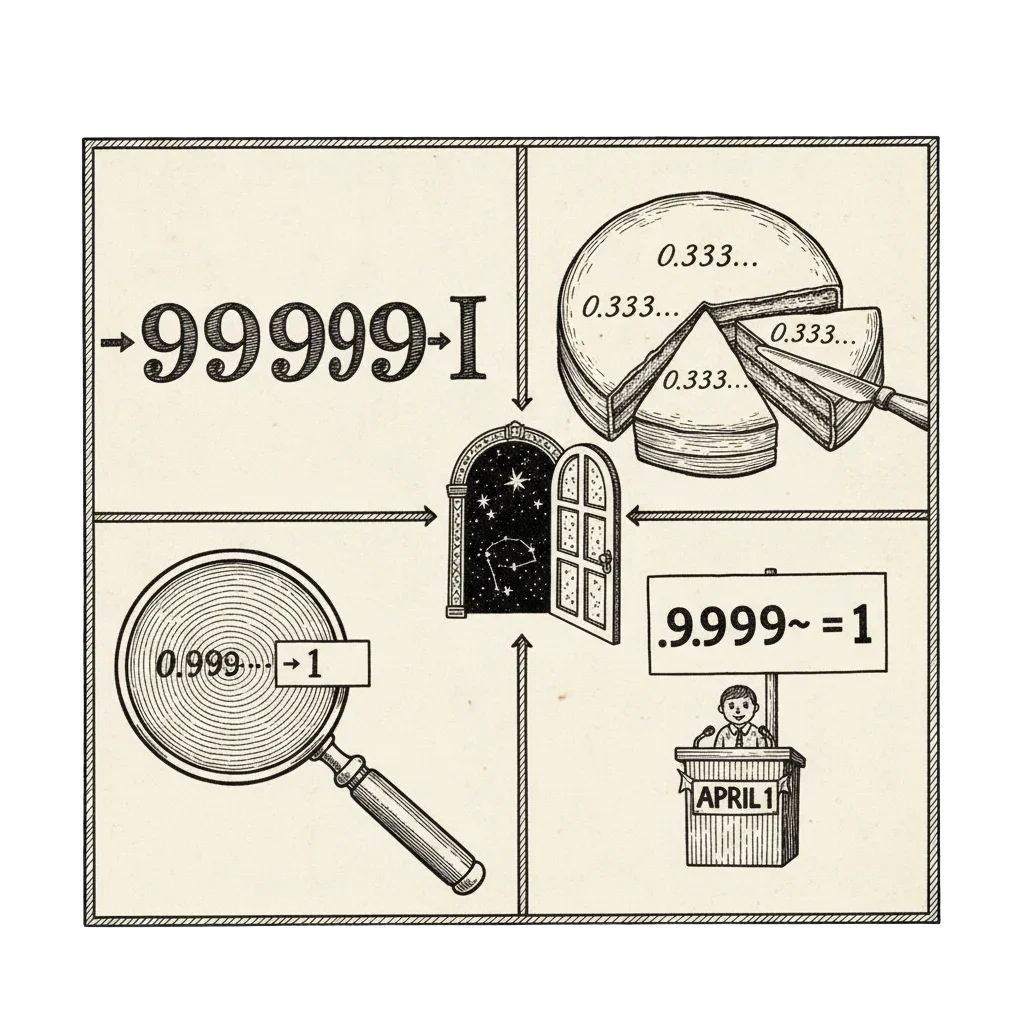
0.999… means a zero, a decimal point, and nines that never stop.
It is exactly equal to 1 - not approximately.
Since 1/3 = 0.333…, three thirds give 0.999… - and three thirds make 1.
There is no number in between 0.999… and 1, so they must be the same number.
It feels wrong because we imagine the nines being written one by one; in fact they are all already there.
Many decimals have two names: 0.5 = 0.4999… too.
People have argued about it on game forums, maths newsgroups and Wikipedia - and in 2004, Blizzard jokingly "announced" the answer.
It never stops. It never falls short.
0.999… is just 1, wearing an infinitely long disguise.
- The Oddly Specific Numbers Desk
No syllabus. No signup. Just exhibits. Pull open a drawer, read a label, follow whichever footnote looks most suspicious, and let the collection take you somewhere you did not plan to go.
Powered by DollarPageClub