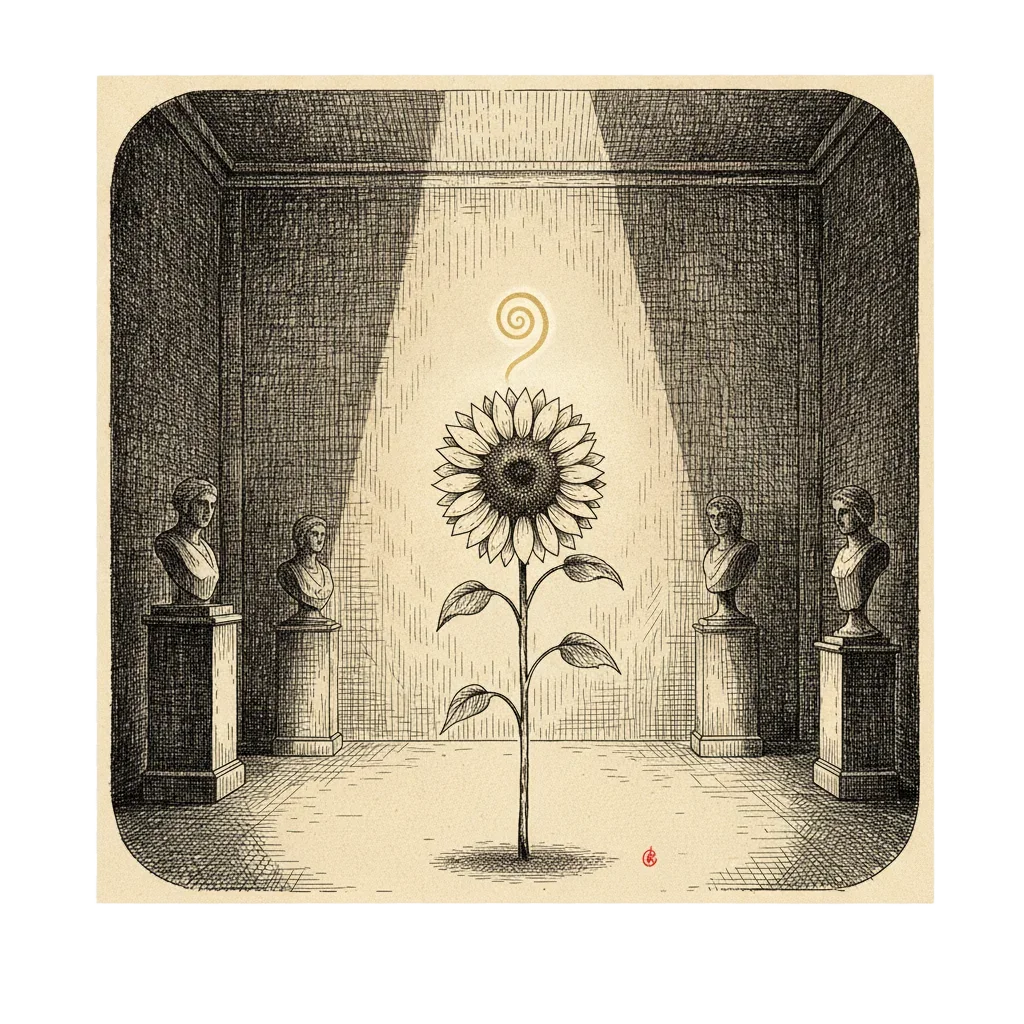
The most over-hyped number in history
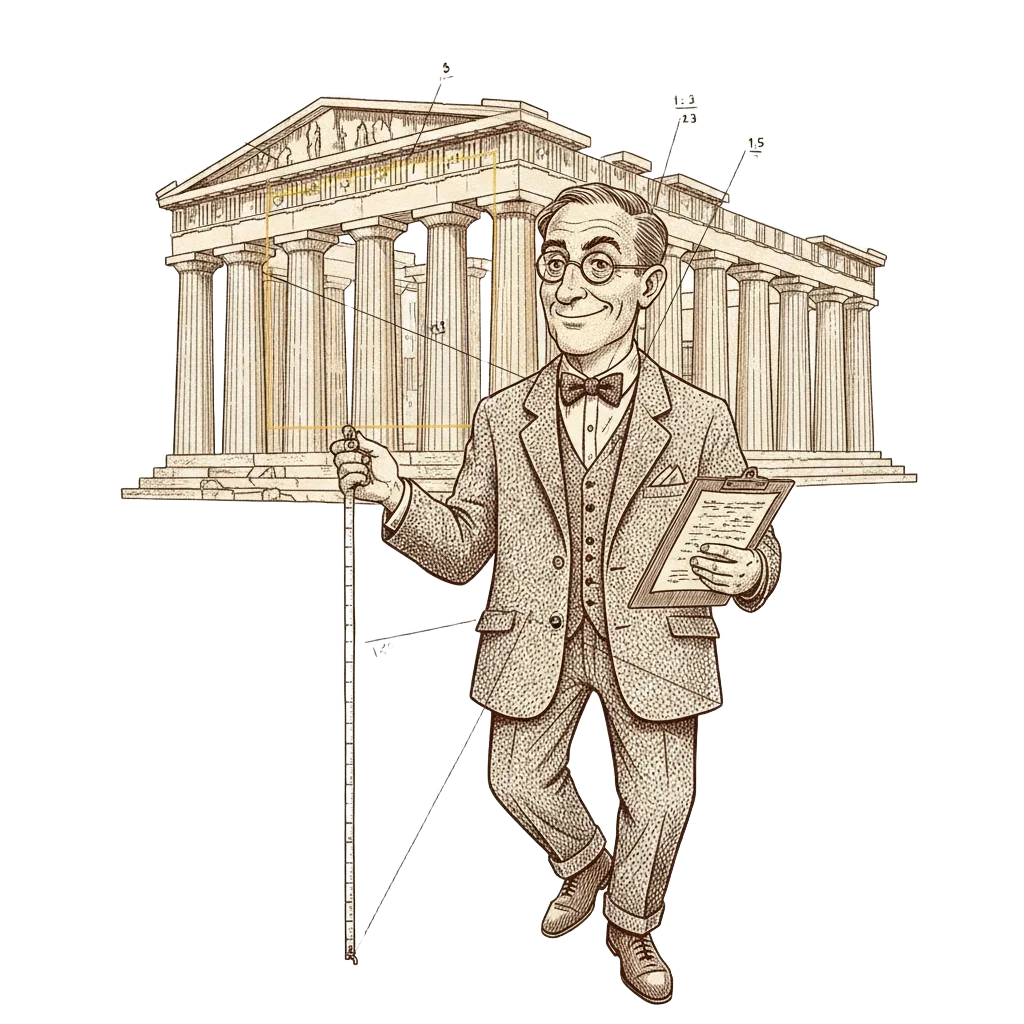
You may have heard that this number is hidden in the Parthenon. In the Mona Lisa. In the perfect human face. In the swirl of every seashell.
It has been called divine. Golden. The secret code of beauty.
Most of that is not true.
And yet 1.618… really is one of the most remarkable numbers there is - just not for the reasons you have been told.
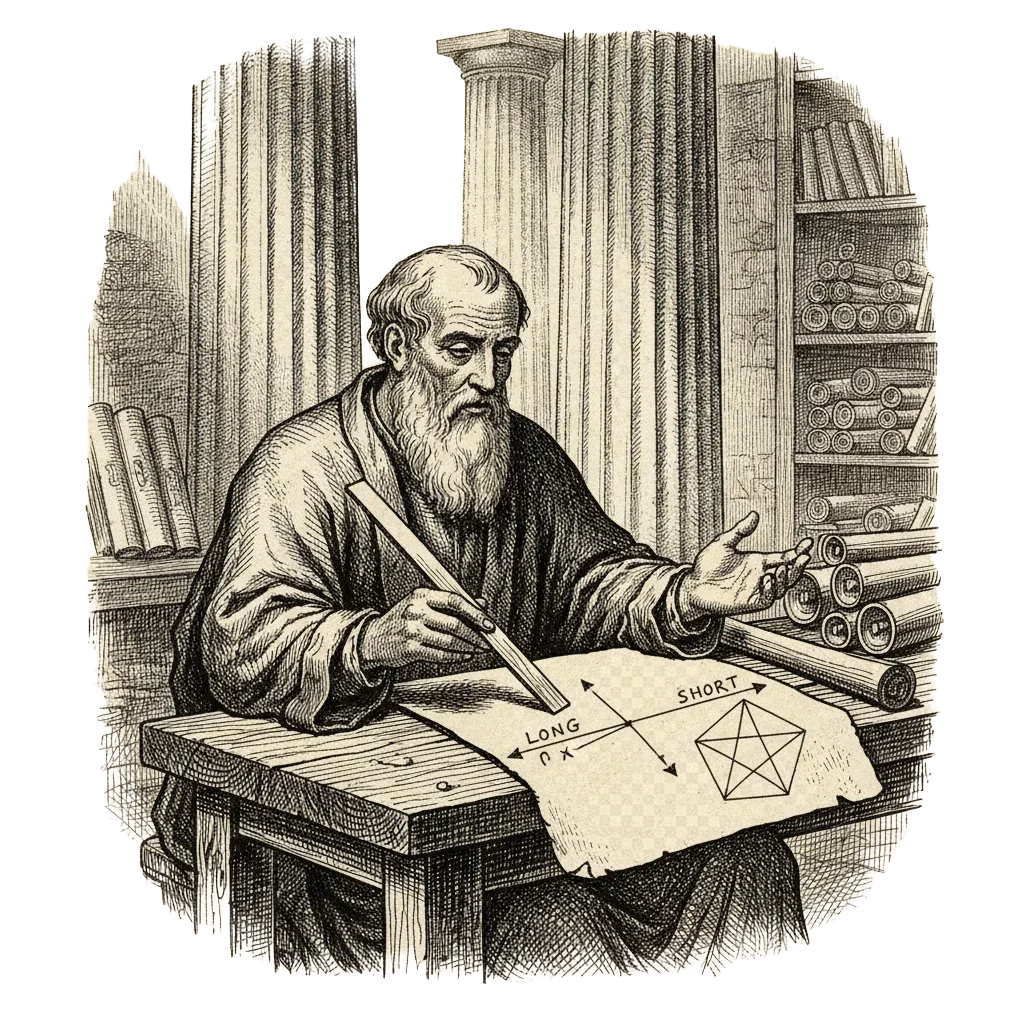
The story begins around 300 BC, in the Greek city of Alexandria, with a mathematician named Euclid.
In his great book, the Elements, Euclid describes a special way to cut a line into two pieces. He called it cutting a line in "extreme and mean ratio". In a standard English translation, his definition reads:
"A straight line is said to have been cut in extreme and mean ratio when, as the whole line is to the greater segment, so is the greater to the less."
In plain words: cut a stick into a long piece and a short piece, so that the whole stick compared to the long piece is exactly the same as the long piece compared to the short piece.
There is only one way to do it. And when you do, that ratio is:
↳ written as (1 + √5) ÷ 2
The digits never end and never repeat. Written the way mathematicians write it, it is (1 + √5) ÷ 2.
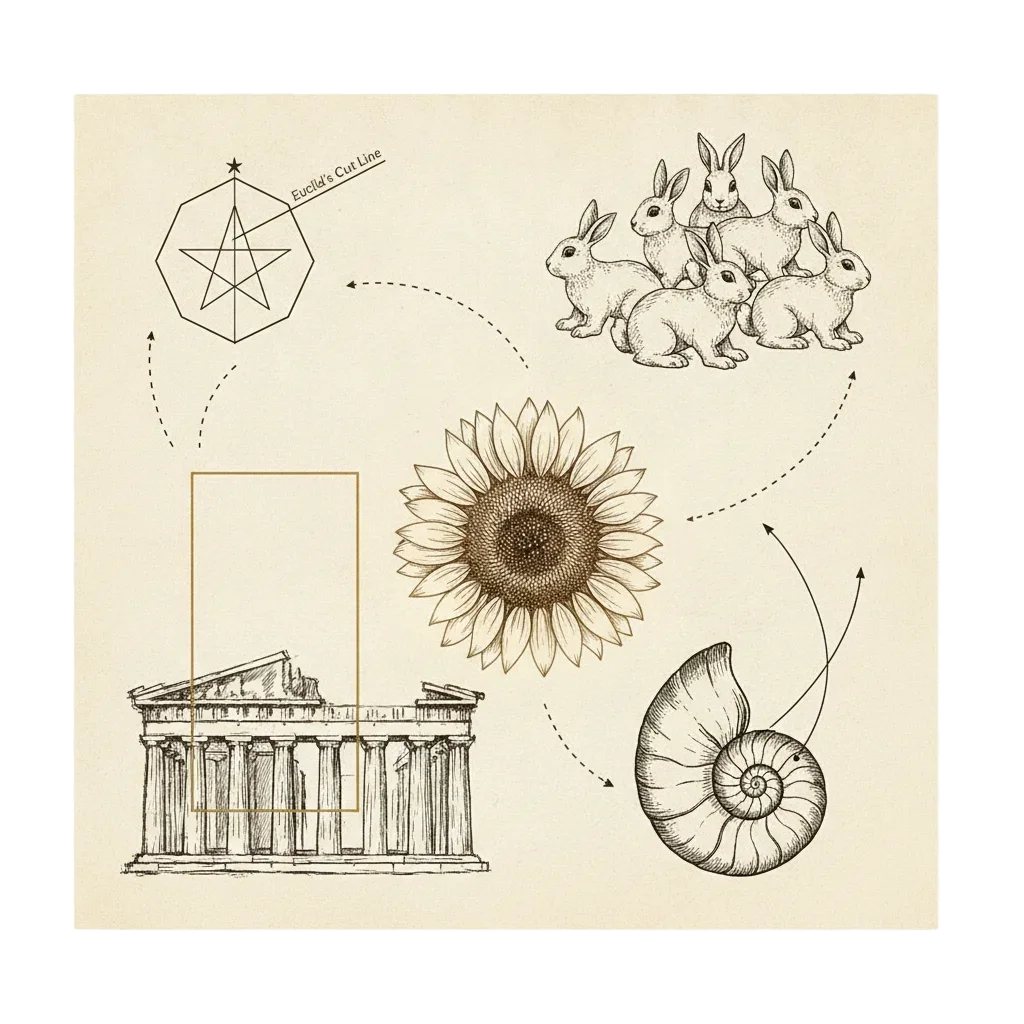
Euclid needed it for geometry - especially for drawing perfect five-pointed stars and pentagons, where it turns up again and again. He never called it golden. He never said it was beautiful. It was simply a useful tool.
Did you know
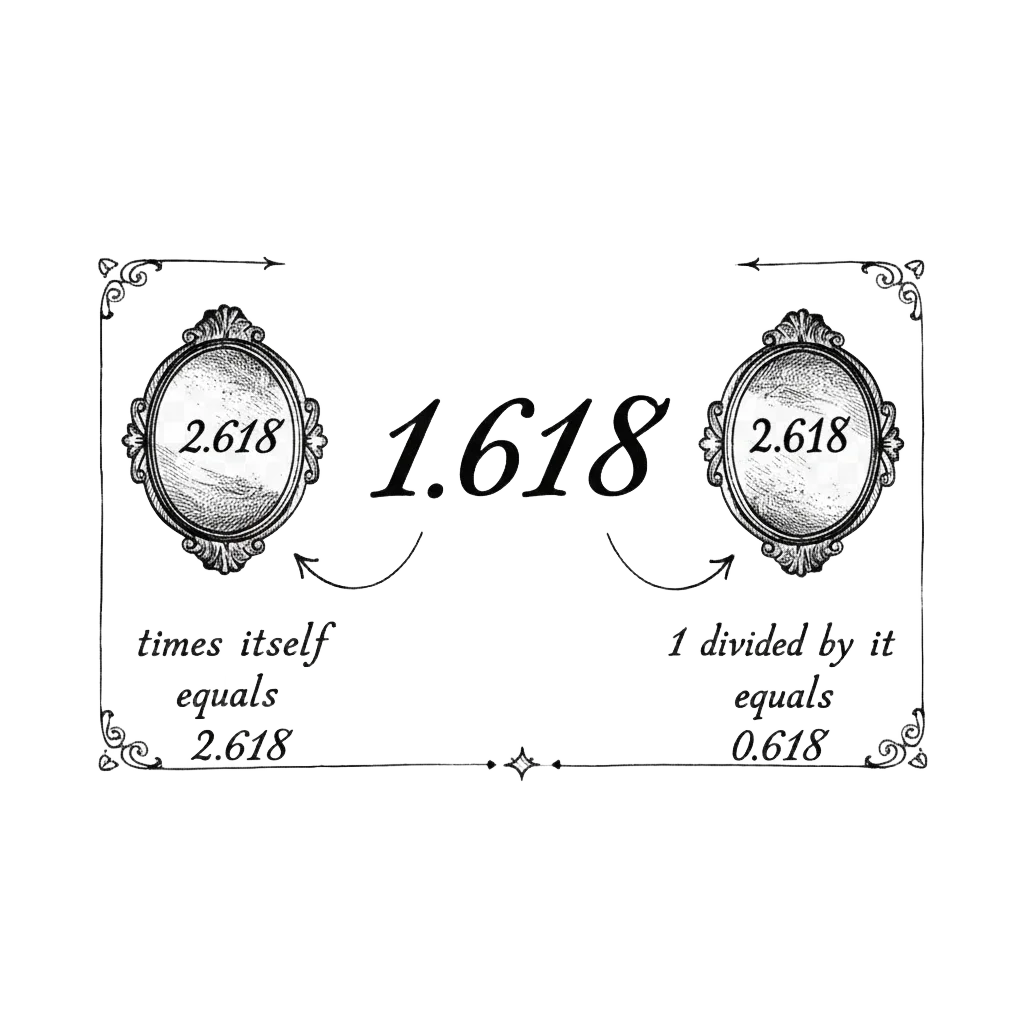
Square 1.618… and you get 2.618… - the same digits, plus one.
Divide 1 by 1.618… and you get 0.618… - the same digits, minus one.
No other positive number behaves like this.
Fifteen centuries later, in 1202, an Italian merchant's son named Leonardo of Pisa - known today as Fibonacci - published a book of arithmetic.
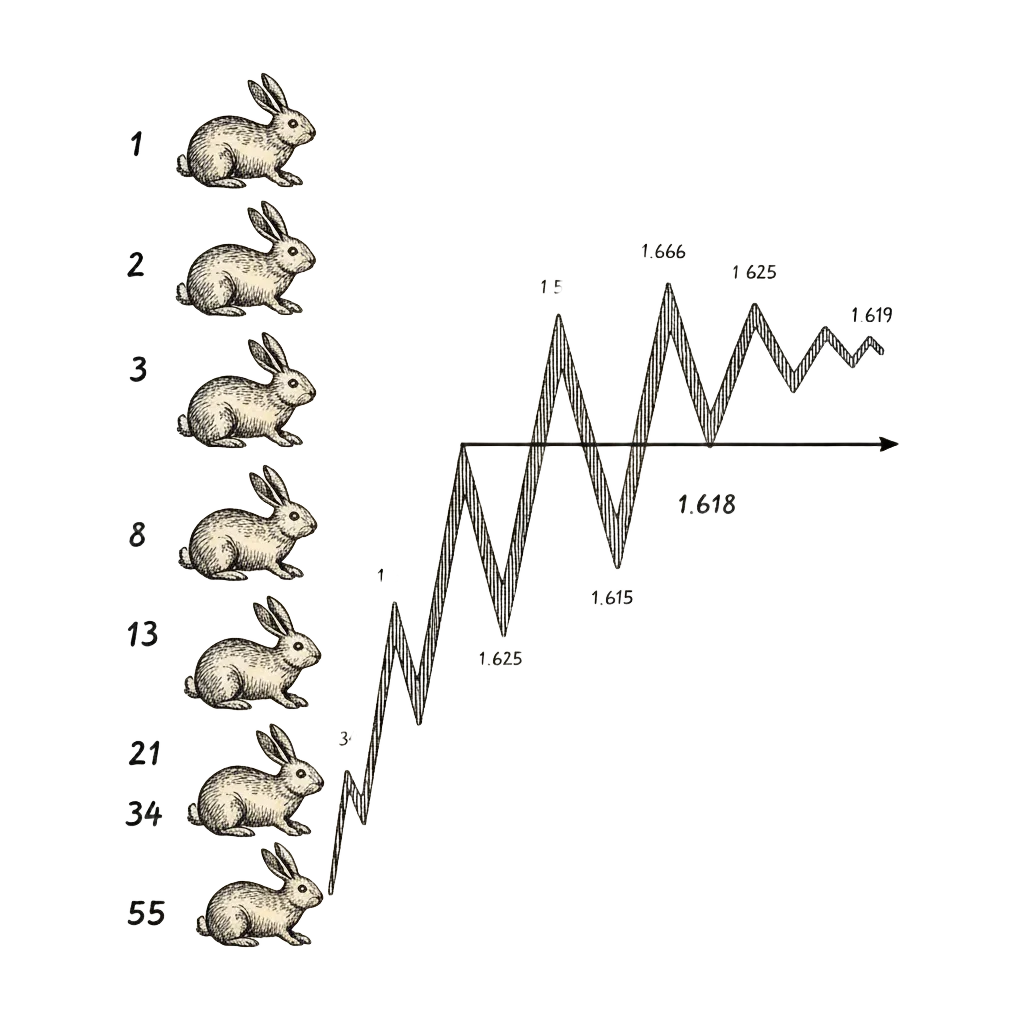
In it, he posed a puzzle about breeding rabbits. The answer grows in a famous pattern, where each number is the sum of the two before it:
1, 1, 2, 3, 5, 8, 13, 21, 34, 55, 89, 144…
Nobody in Fibonacci's time noticed what was hiding in it.
Divide each number by the one before, and watch:
The answers swing above and below, closer and closer, homing in on one number: 1.618…
Euclid's line and Fibonacci's rabbits, separated by fifteen hundred years, turn out to be the same idea.
For most of history, this was just a handy piece of geometry.
Then it got a publicist.
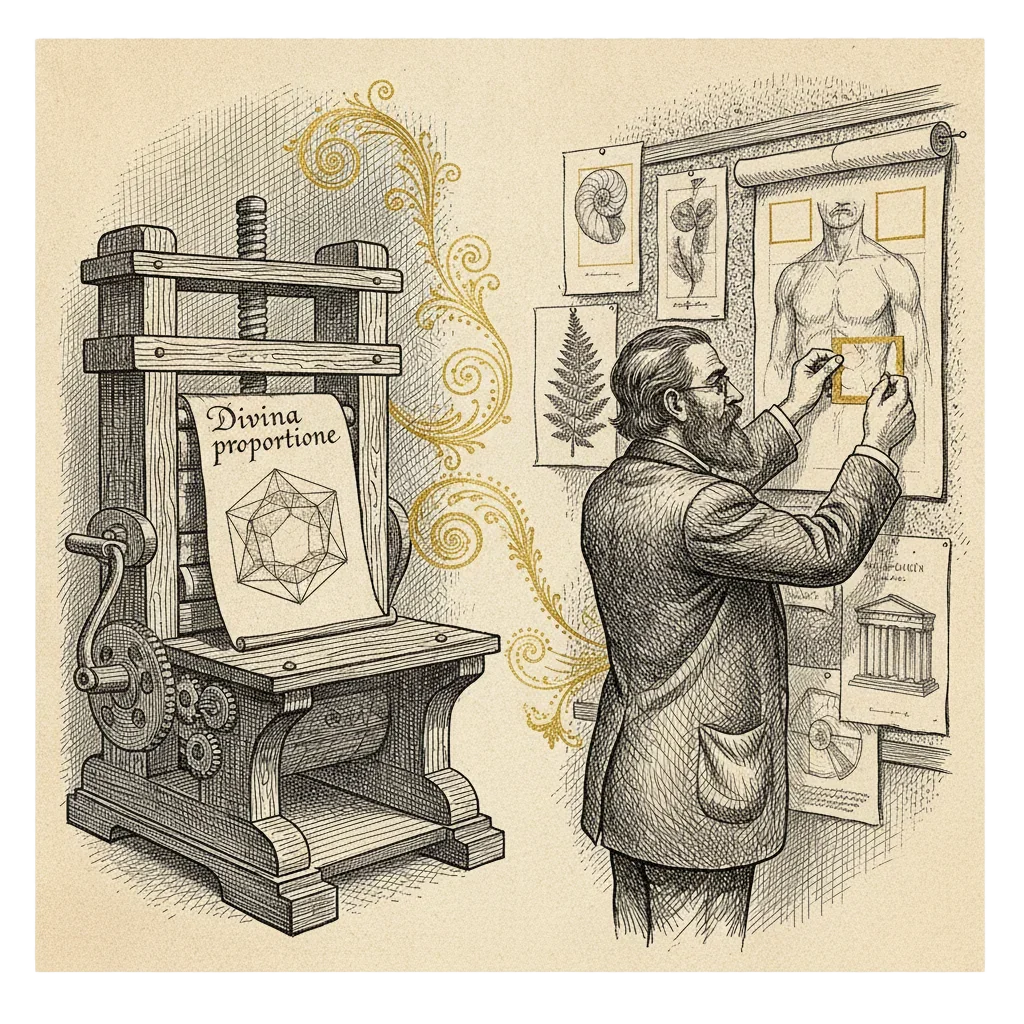
In 1509, the Italian friar and mathematician Luca Pacioli published a book called Divina proportione - The Divine Proportion - with illustrations of geometric solids drawn by his friend Leonardo da Vinci. Pacioli praised the ratio in almost religious terms.
In 1835, a German textbook by Martin Ohm gave it the name it still carries: the golden section.
And in 1854, the German writer Adolf Zeising went much further. He claimed the golden ratio was a universal law of beauty, hidden in the human body, in plants, in animals, in crystals, and in great art and architecture.
After that, the hunt was on. People began finding 1.618 everywhere they looked.
The trouble is, they were looking very hard.
Some years ago, George Markowsky, a computer scientist at the University of Maine, was asked to give a talk about the golden ratio to the university's Classics Club.
He expected to repeat the famous facts. Instead, when he went to check them, many of them fell apart.
In 1992, he published what he had found in a paper with a blunt title: "Misconceptions about the Golden Ratio."
The maths of the golden ratio, he wrote, is usually stated correctly. But many of the claims about it in art, architecture, and the human body are false or seriously misleading.
His central point was simple and powerful. A building, a painting, or a body has hundreds of possible measurements. Measure from here to there, or from there to somewhere else, and - with enough patience - some pair will come out close to 1.6. Then you draw a golden rectangle around it, and ignore everything that sticks out.
It is not that the golden ratio is hidden everywhere. It is that you can find almost anything, if you are free to choose what to measure.
Here are some of the most famous golden-ratio claims, and what the evidence actually says.
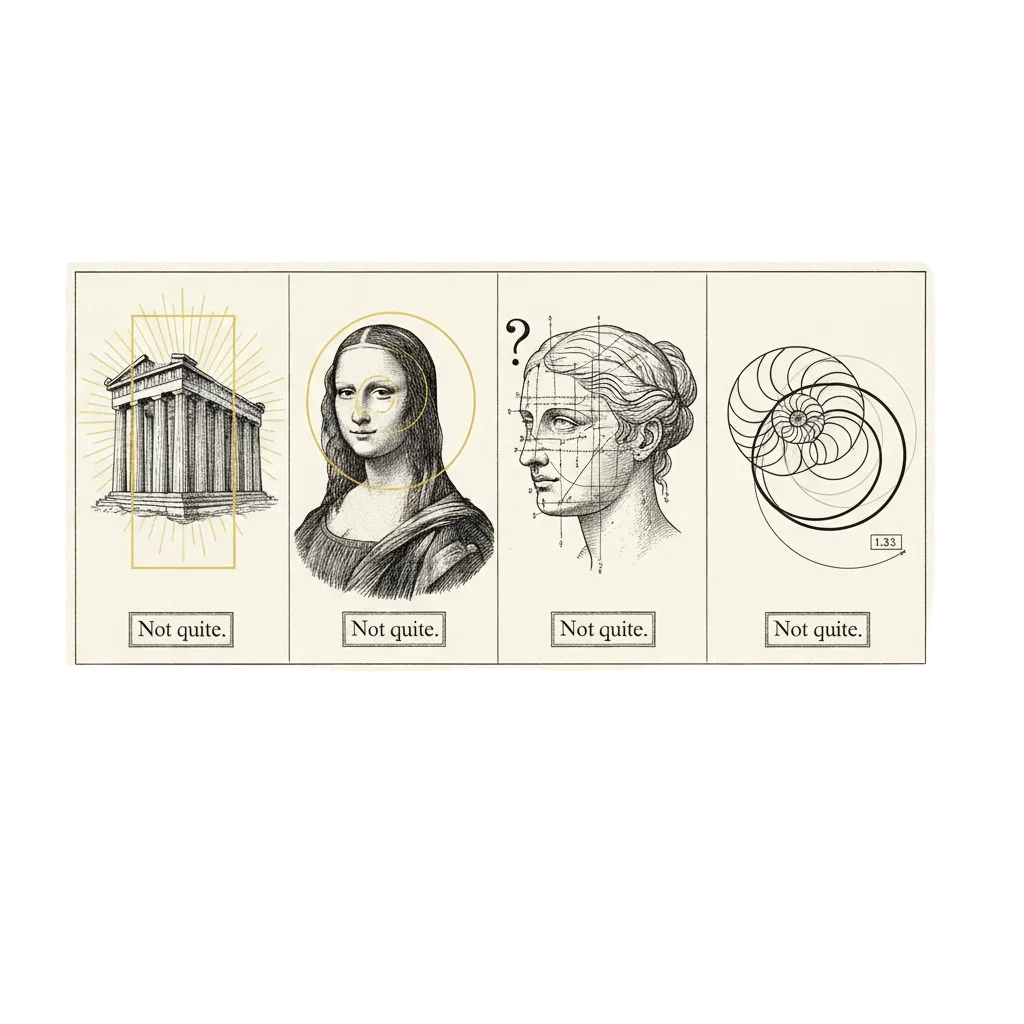
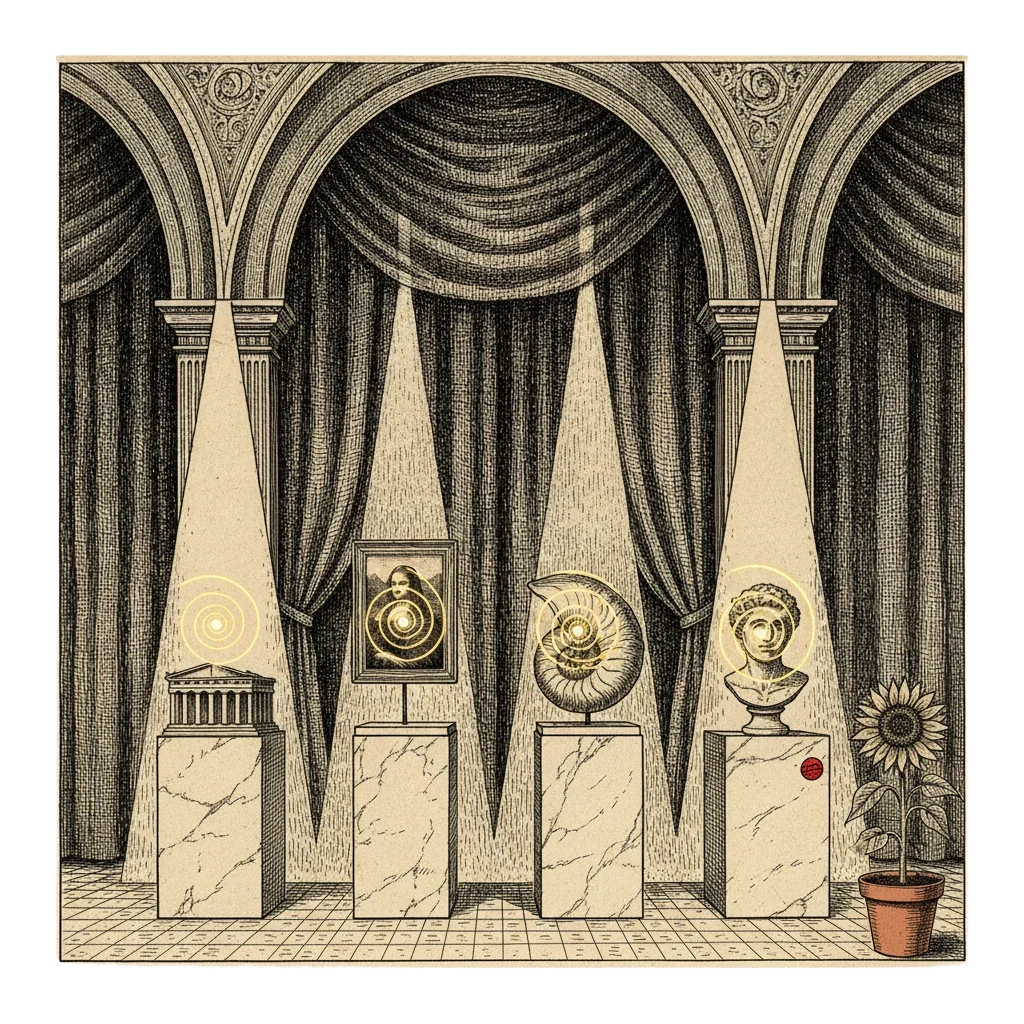
The temple in Athens is often shown inside a perfect golden rectangle. But there is no evidence the ancient Greek builders designed it that way, and the rectangles usually only fit if you ignore parts of the building.
Golden spirals are often drawn across Leonardo's painting. There is no record that Leonardo used the golden ratio to plan it - and a spiral can be drawn across almost any face.
There is little good evidence that faces built around 1.618 are judged more attractive than faces with other, similar proportions.
This is the most famous "golden spiral" in nature - and it is not one. When the mathematician Clement Falbo measured real nautilus shells in a museum collection, their spirals fit a ratio of about 1.33, not 1.618. None came close.
None of this means golden ratio fans are fools. It means that 1.6 is a very easy number to find by accident.
Close, but not golden
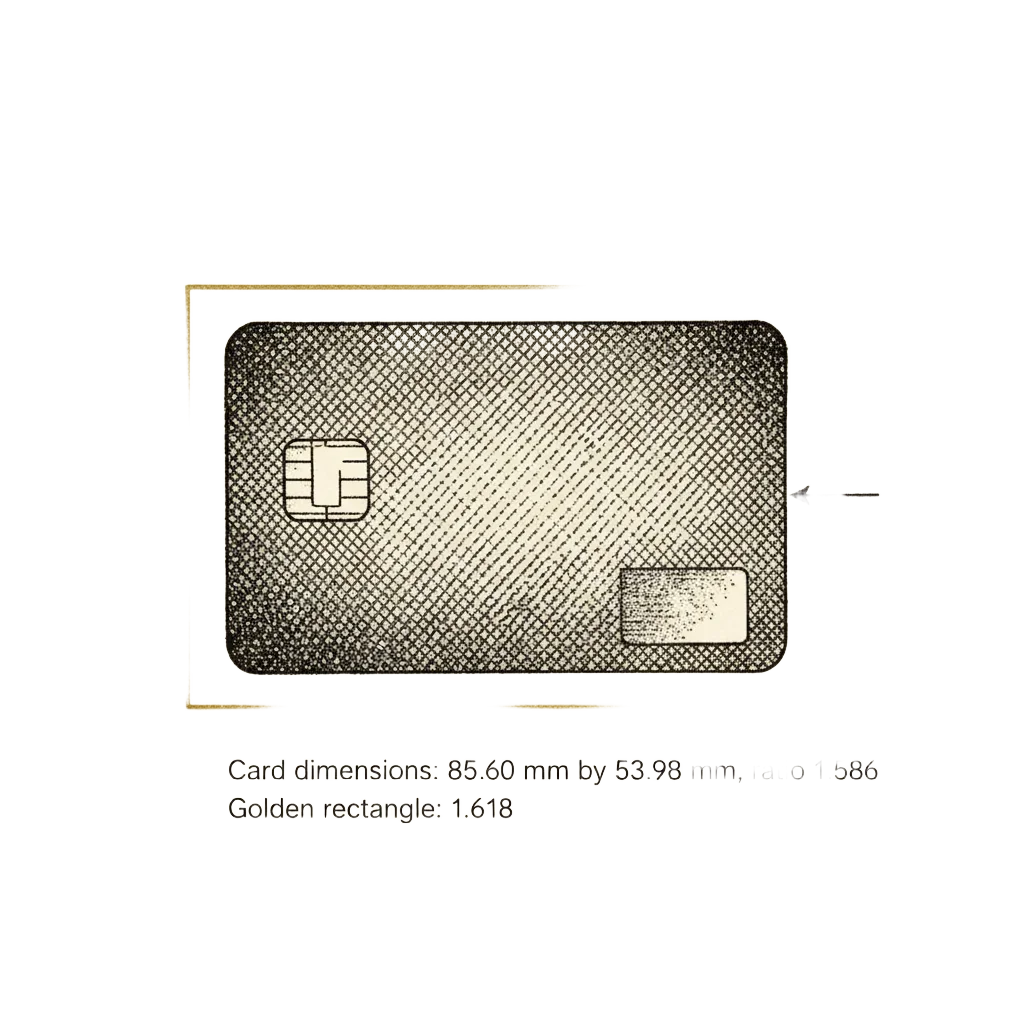
A bank card is often said to be a golden rectangle. It is 85.60 mm by 53.98 mm. That makes its ratio about 1.586 - close to 1.618, but not the same. Close enough to fool the eye. Not close enough to be golden.
So is the golden ratio just a myth?
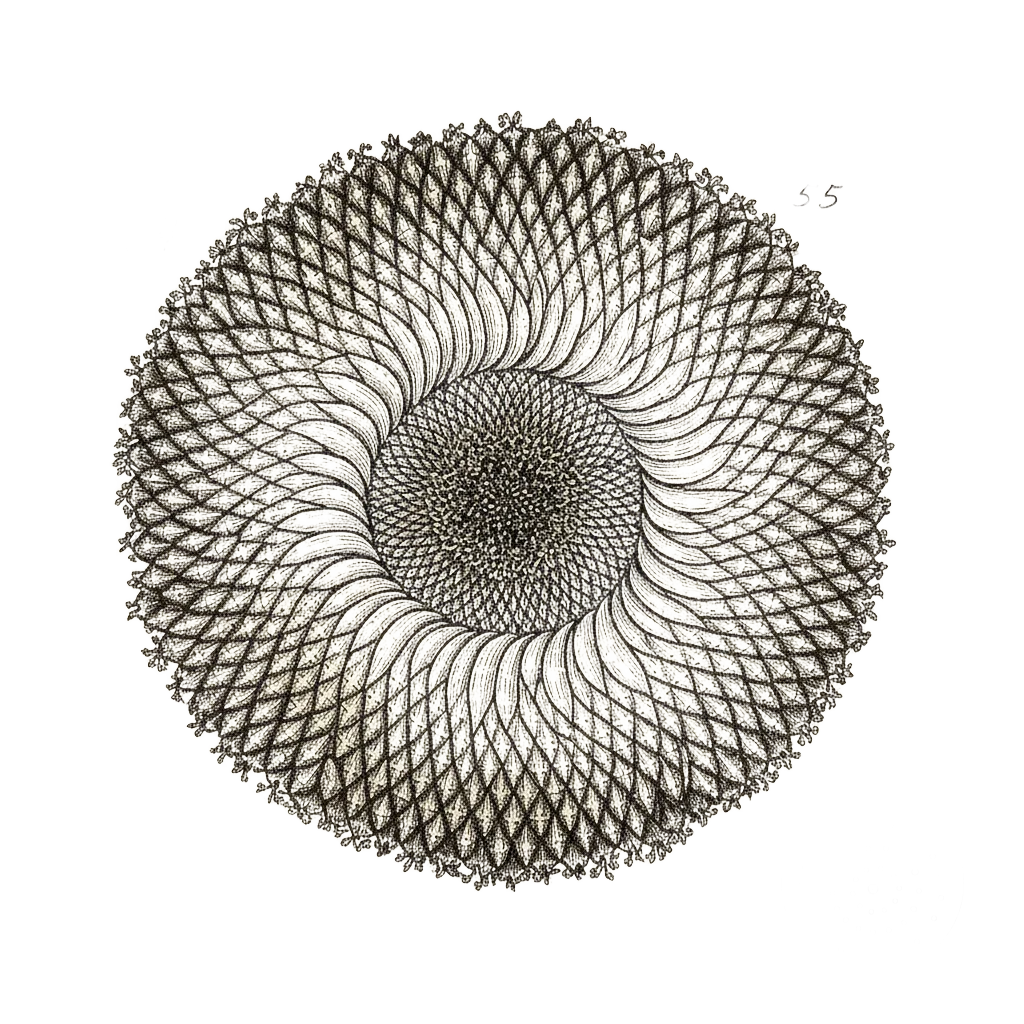
No. Look closely at the face of a sunflower.
Its seeds are packed in spirals - some curling clockwise, some anticlockwise. Count them, and you very often find two neighbouring Fibonacci numbers: 34 and 55, or 55 and 89.
The same thing happens in pine cones, pineapples, and the scales of many plants.
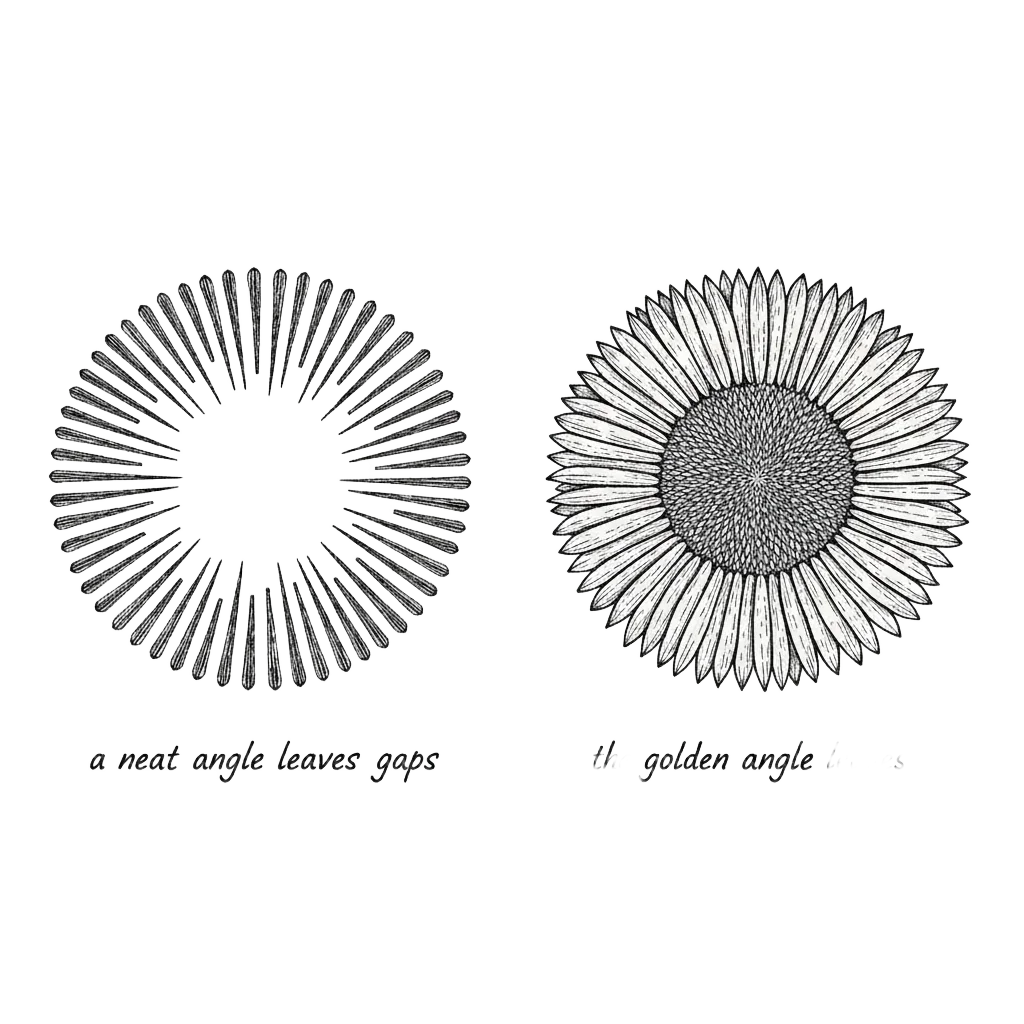
The reason is how the plant grows. Each new seed forms at the centre and is pushed out, turned by a fixed angle from the one before. In many plants, that angle is about 137.5 degrees - the golden angle, which divides a full circle in the golden ratio.
Turn by that angle, over and over, and the seeds never line up in rows. They spread out evenly, filling the space with no gaps and no waste. The spirals and the Fibonacci numbers appear by themselves.
137.5°
the golden angle
divides a full circle in the golden ratio
And unlike the myths, this has been tested. In 2012, a citizen-science project inspired by Alan Turing, who had studied sunflower spirals himself, invited the public to grow sunflowers and count their spirals. The results, published in 2016, covered 657 sunflowers. Most of the spiral counts were Fibonacci numbers - but about one sunflower in five did not fit the pattern neatly. Nature is golden often, not always.
Why would a plant "choose" this particular angle?
Because the golden ratio has one genuinely extraordinary property: it is the number that is hardest to approximate with simple fractions.
Numbers like 1.5 or 1.25 are neat fractions - turn a seed by an angle like that and, after a few turns, the seeds line up in straight rows and leave gaps.
Even π, famous for never ending, has a very good near-miss fraction: 22/7.
The golden ratio has no good near-misses. The best fractions you can use are the Fibonacci ratios themselves - 8/5, 13/8, 21/13 - and, as you saw, they close in on it more slowly than the best fractions for almost any other number.
Mathematicians sometimes call it "the most irrational number."
That is the real magic. Not a secret code of beauty, but a number that refuses, better than any other, to settle into a pattern. And a growing plant, trying to pack its seeds without leaving gaps, benefits from exactly that refusal.
The golden ratio has been oversold for nearly two hundred years - on posters, in design books, in claims about faces and temples and shells.
But the real story is better than the myth.
It is the number where Euclid's geometry and Fibonacci's rabbits meet.
It is the number a sunflower uses, not because it is beautiful, but because it is stubborn - the number that never lines up.
And it is a lesson worth keeping: when a claim sounds too perfect, get out the tape measure.
Artists and architects are free to use it, and some famous ones, like the architect Le Corbusier, deliberately did. But the golden ratio does not need to be hidden in every masterpiece to be worth admiring.
Here is why 1.618… matters:
It is the golden ratio: cut a line so that the whole is to the long piece as the long piece is to the short piece.
Euclid described it around 300 BC as the "extreme and mean ratio."
It equals (1 + √5) ÷ 2 = 1.6180339887…, and its digits never end.
Divide neighbouring Fibonacci numbers - 89 ÷ 55, 144 ÷ 89 - and you close in on it.
The names "divine" and "golden" came much later, in 1509 and 1835.
Many famous claims - the Parthenon, the Mona Lisa, the perfect face, the nautilus shell - are myths or exaggerations, as George Markowsky showed in 1992.
It genuinely appears in the spirals of sunflowers and other plants, through the golden angle of about 137.5°.
It is the hardest number to approximate with fractions - which is exactly why plants find it useful.
Strip away the legends, and something golden is still there.
1.618 doesn't need the myths.
The truth was always strange enough.
Powered by DollarPageClub