The taxicab number
The smallest number expressible as the sum of two cubes in two different ways - spotted in a hospital bed.
ReadThe fraction with a secret inside
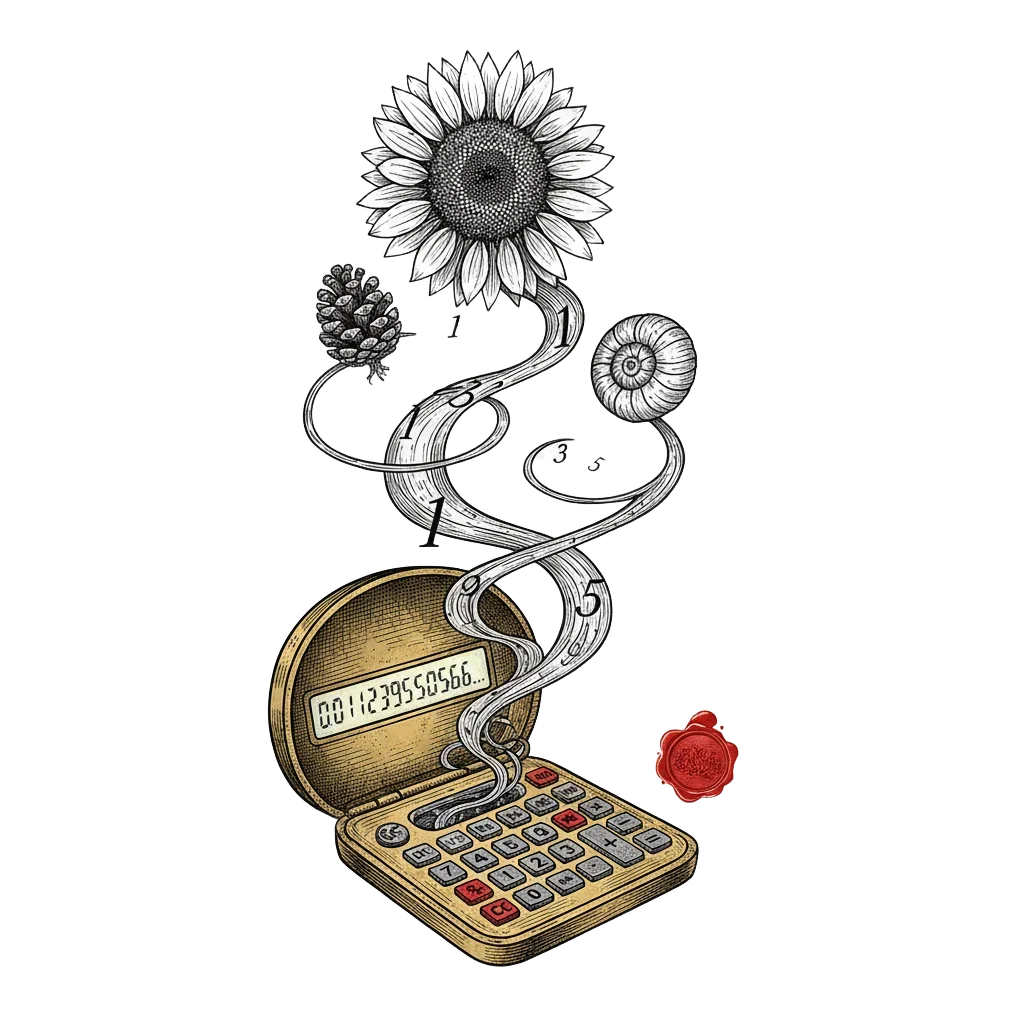
Type 1 ÷ 89 into a calculator.
You get this:
0.011235955056…
It looks like a random jumble of digits.
But read the start slowly: 0, 1, 1, 2, 3, 5…
Those are the first numbers of the most famous sequence in mathematics - the one that shows up in sunflowers, pine cones and seashells.
Somehow, it is hiding inside a fraction.
The story begins
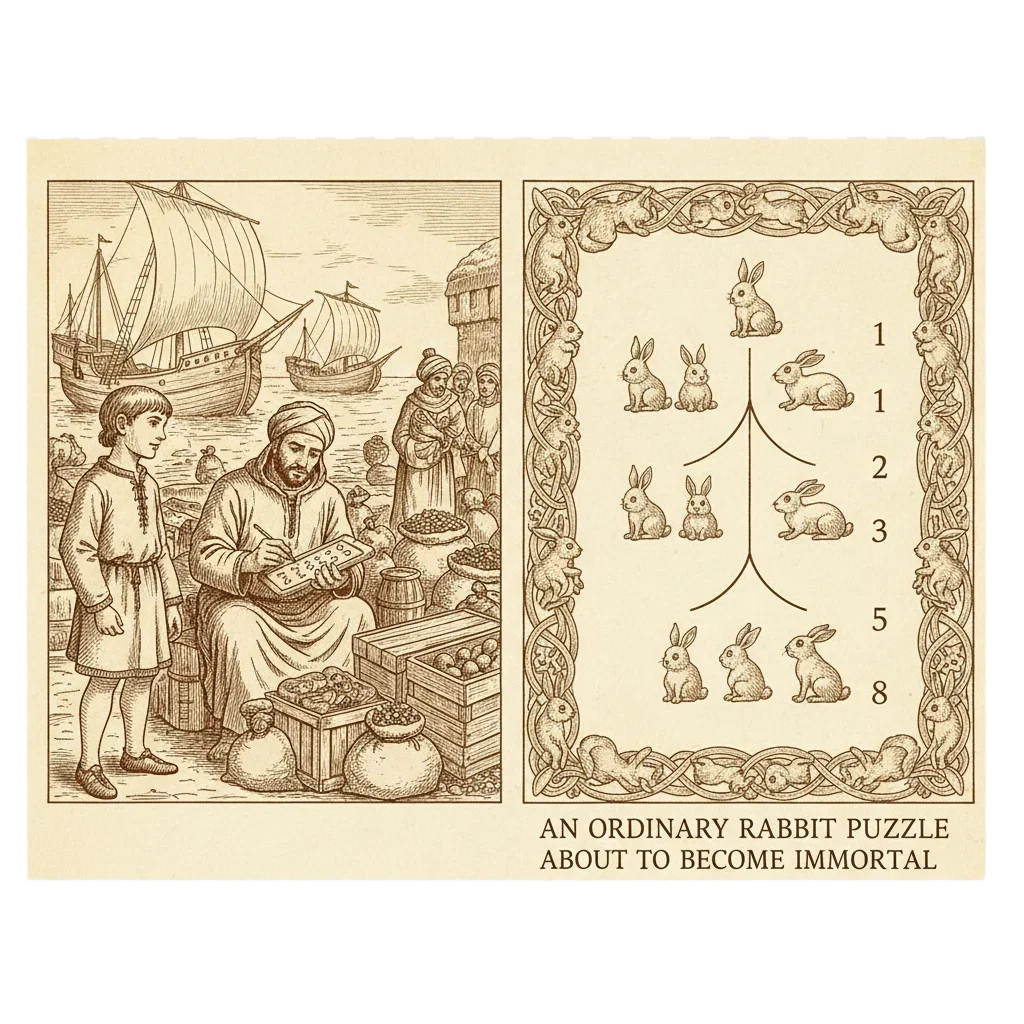
The sequence comes from Leonardo of Pisa, born in Italy around 1170. As a boy, he travelled to Bugia - today Béjaïa, in Algeria - where his father ran a trading post for the merchants of Pisa. There, Leonardo learned a new way of writing numbers from Arab and Indian mathematics: the ten digits 0 to 9, the same ones you use today.
Back in Italy, in 1202, he wrote a book called Liber Abaci, the Book of Calculation, to show Europe how much easier these new numbers made arithmetic.
In the middle of the book is a puzzle about rabbits.
Start with one young pair of rabbits. Every month, each grown-up pair produces a new pair, and new pairs grow up after a month. How many pairs will there be as the months go by?
The answer grows like this:
Each number is simply the two before it added together. 1 + 1 = 2. 1 + 2 = 3. 2 + 3 = 5. And on forever.
Today we call Leonardo by a nickname that historians gave him centuries later: Fibonacci. And these are the Fibonacci numbers.
A lovely irony.
Fibonacci is one of the people who helped bring decimal digits to Europe. And it is only because we write numbers in decimals that his sequence can hide inside 1/89 at all.
A recurring discovery
Nobody knows who first noticed Fibonacci numbers in 1/89. It is the kind of secret that seems to be discovered over and over again.
The writer W. J. Reichmann described it in his popular book The Spell of Mathematics, first published in 1967.
In 1981, a journal devoted entirely to these numbers - The Fibonacci Quarterly - ran an article called "The Decimal Expansion of 1/89 and Related Results".
And in the autumn of 1994, a student at the University of Oklahoma named Cody Birsner, working on a term paper about Fibonacci numbers, noticed it all by himself. His discovery was proudly written up on a university web page called "The Remarkable Number 1/89".
It had been found before. That didn't matter. The pleasure of seeing it for yourself is the same every time.
How it works
Here is how the secret works. It is an addition sum - just a very tall one.
Take the Fibonacci numbers and write each one one step further to the right than the one before, like a staircase:
0.01
0.001
0.0002
0.00003
0.000005
0.0000008
0.00000013
0.000000021
0.0000000034
0.00000000055
0.000000000089
0.0000000000144
   …and so on, forever
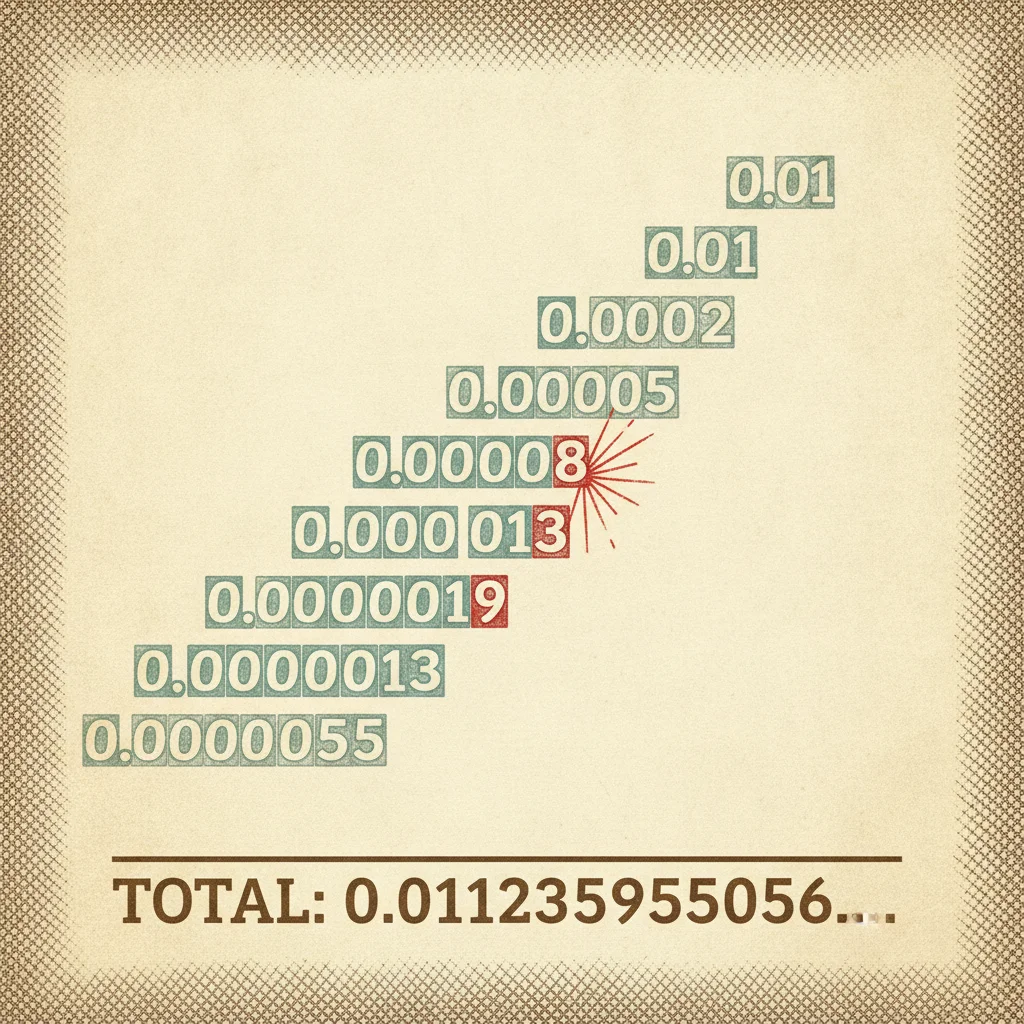
Now add up the whole staircase.
The answer is exactly 0.011235955056… - which is 1/89.
At the top of the staircase, the numbers are small and stay neatly in their own columns. That is why you can read 0, 1, 1, 2, 3, 5 straight off the calculator.
But the numbers keep growing. When 13 arrives, it has two digits, and its first digit spills into the column next door - right on top of the 8.
So the 8 becomes a 9. That is why the calculator shows 0.0112359… and not 0.0112358.
After that, bigger and bigger numbers keep spilling over, and the pattern is hidden under the carries. But it is still there, holding up every single digit.
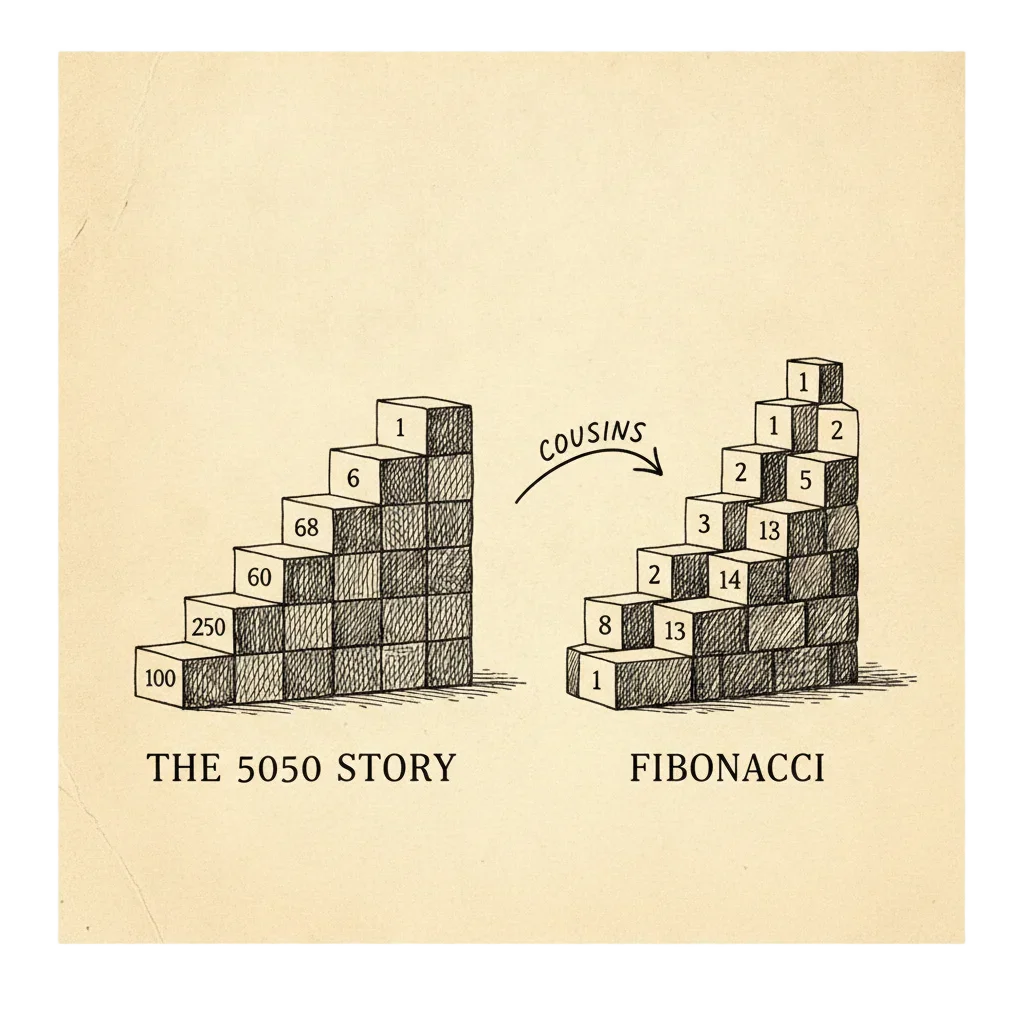
Another staircase in the museum.
On the /5050 page, a staircase of blocks explains the sum of 1 to 100. Here, a staircase of Fibonacci numbers builds a fraction. Mathematics seems to love staircases.
The deeper reason
Out of all the numbers you could divide 1 by, why does 89 hold the secret?
The answer lies in the rule itself: each Fibonacci number is the two before it added together.
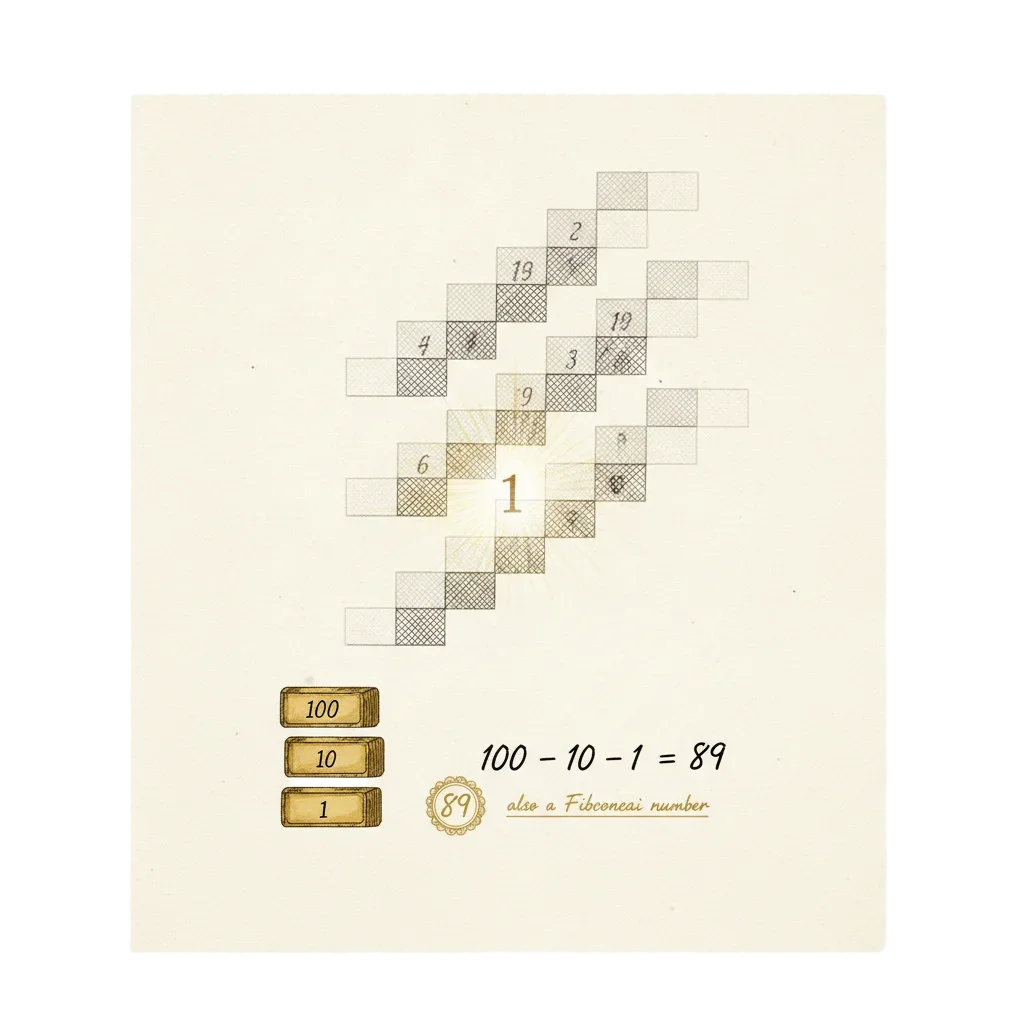
Imagine taking the whole staircase and making copies of it: one shifted one step, one shifted two steps. Because every step is the sum of the two steps before it, the copies line up and cancel each other out almost completely - leaving behind just a single 1.
When you work out what number could behave like that, the answer is 1 divided by:
The 100 and the 10 come from shifting the staircase one and two places in our base-ten number system. The 1 comes from the staircase itself.
So 89 is not a coincidence. It is what the Fibonacci rule looks like when you write it in decimals.
And here is a small wink from the universe: 89 is itself a Fibonacci number. It sits in the sequence, right after 55.
The pattern, extended
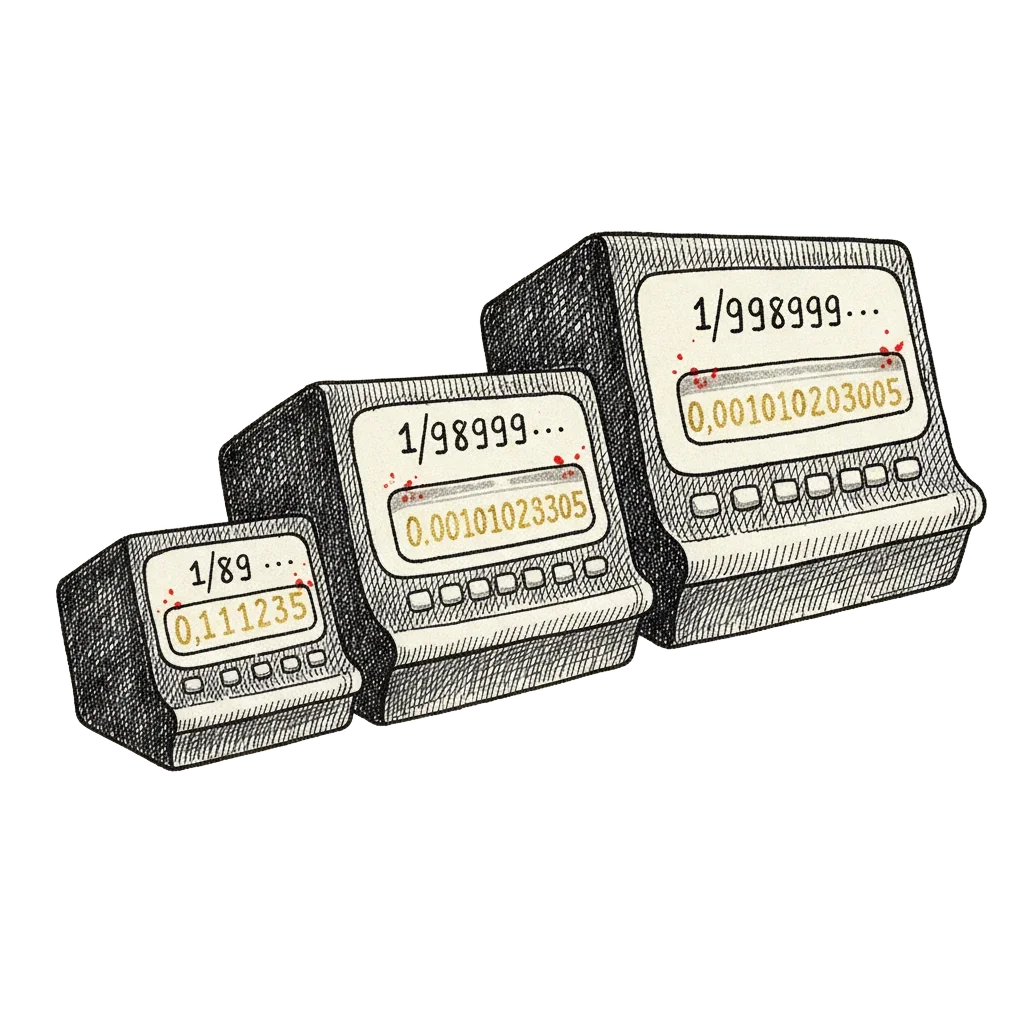
If carrying digits is what hides the pattern, what if we gave each Fibonacci number more room - two columns each, instead of one?
Then the magic number changes from 89 to 9899 - which is 10,000 − 100 − 1, the same recipe with bigger steps.
And look what happens:
1/9899 = 0.0001 01 02 03 05 08 13 21 34 55 90…
Read it two digits at a time: 01, 01, 02, 03, 05, 08, 13, 21, 34, 55 - ten Fibonacci numbers in a row, before the three-digit 144 finally spills over and turns 89 into 90.
Give them three columns each, and use 998999:
1/998999 = 0.000001 001 002 003 005 008 013 021 034 055 089 144 233 377 610 988…
Now fifteen Fibonacci numbers appear, clean and in order - up to 610 - before 987 is bumped up to 988.
The more room you give the sequence, the longer it can hide in plain sight.
A hidden cycle
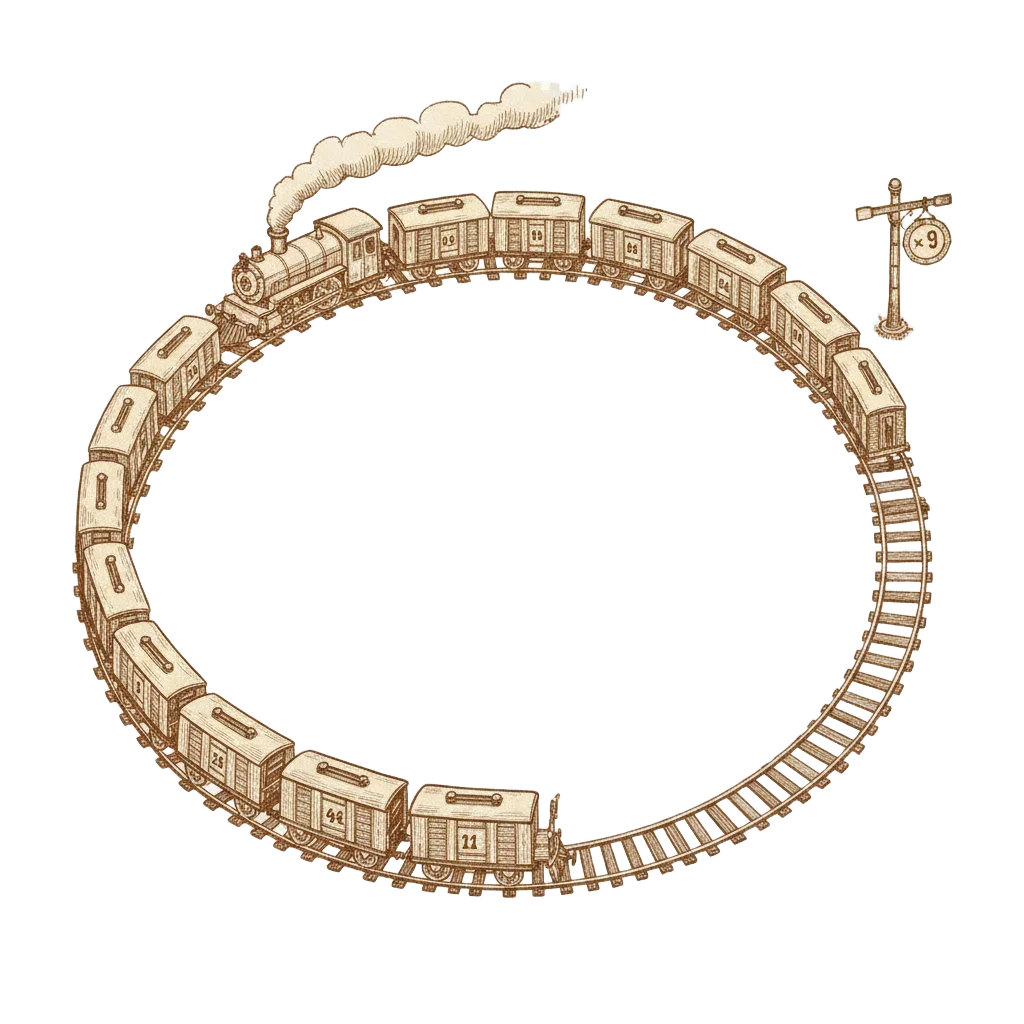
Like every fraction, 1/89 eventually repeats itself. Its digits run for 44 places, and then the whole block starts over again, forever:
0.01123595505617977528089887640449438202247191 01123595505617977528…
Those 44 digits hide one more party trick.
Take that 44-digit block and move its last digit, a 1, round to the front. You get:
10112359550561797752808988764044943820224719
Now do it once more - move the last digit, a 9, to the front. You get:
91011235955056179775280898876404494382022471
This new number is exactly 9 times the one before it.
The whole story, briefly
One divided by eighty-nine.
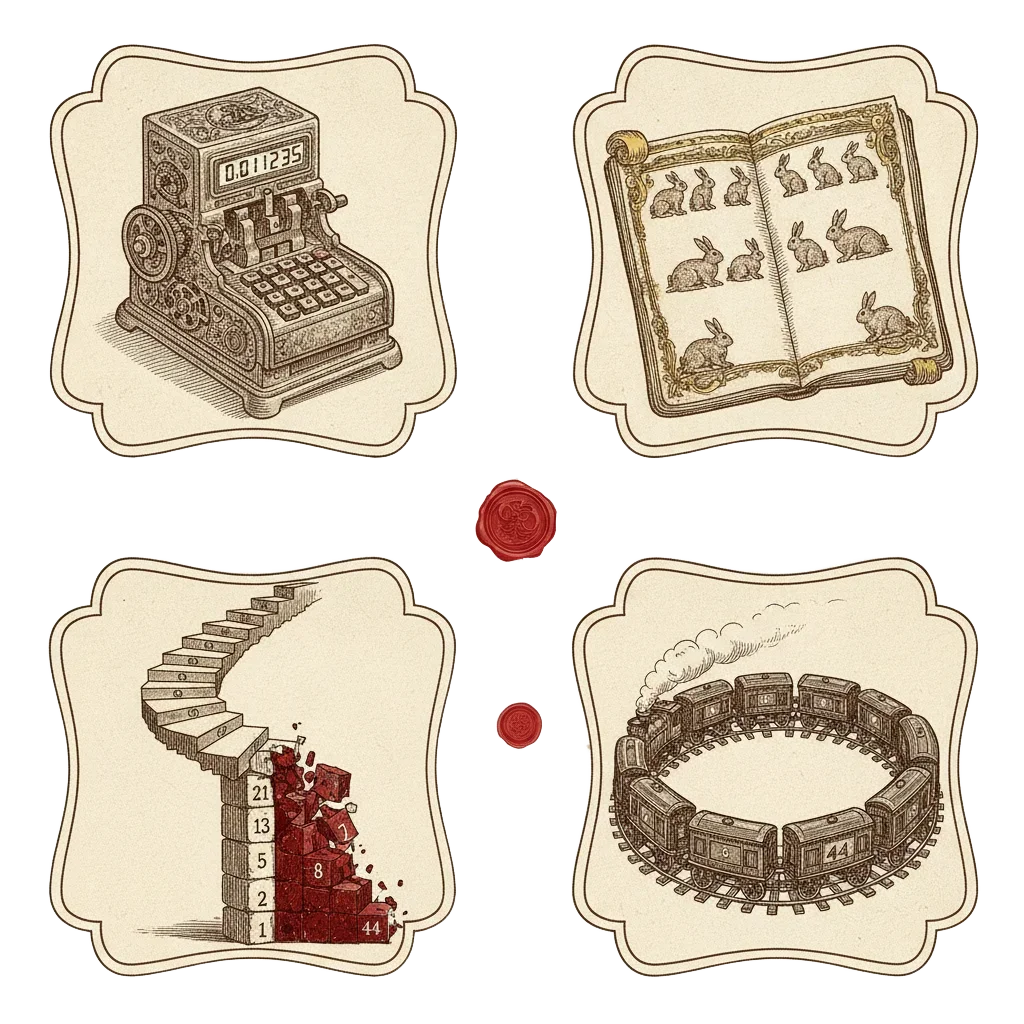
A fraction that looks like noise, and turns out to be a rabbit puzzle eight hundred years old.
Powered by DollarPageClub