Mathematical Curiosities
The number that goes round in circles
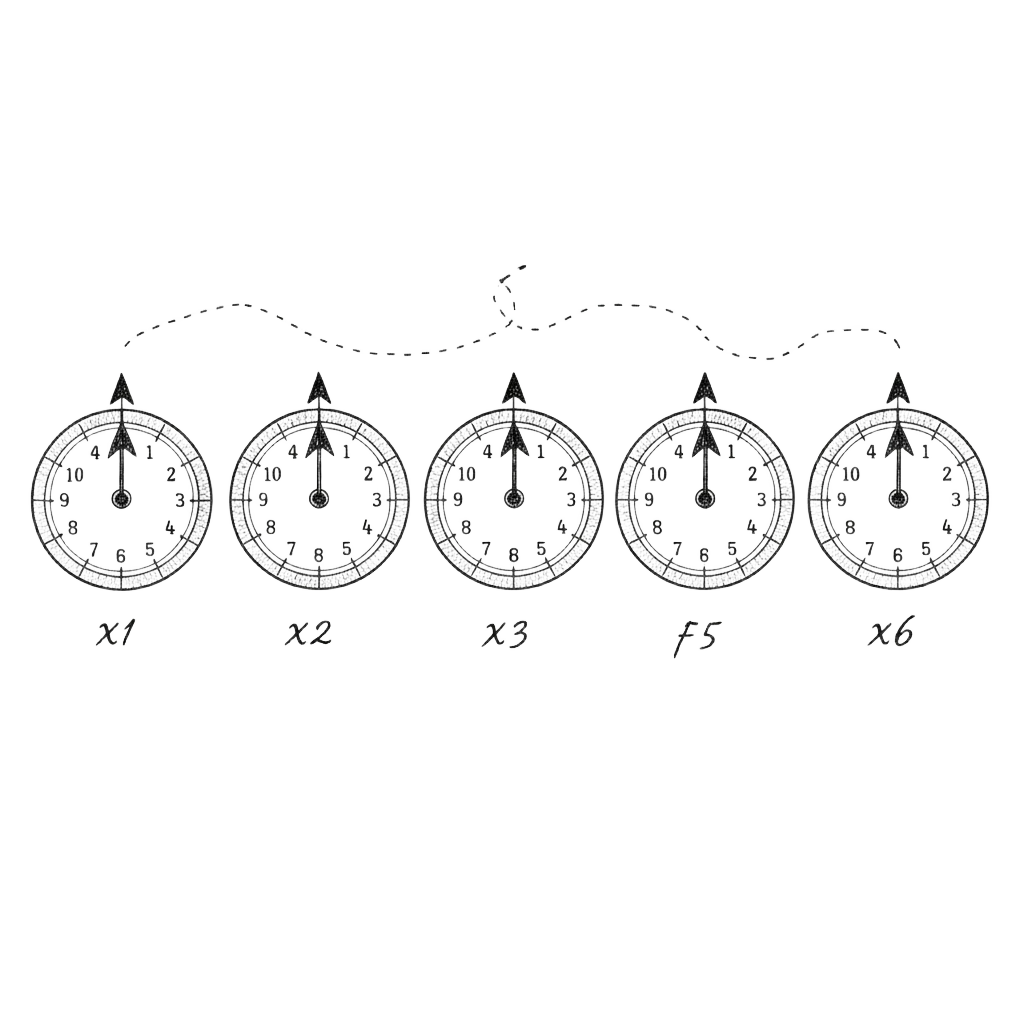
Double it, and the same six digits come back in a new order.
Triple it - the same six digits again.
Keep going all the way to six, and the number simply keeps turning, like a wheel.
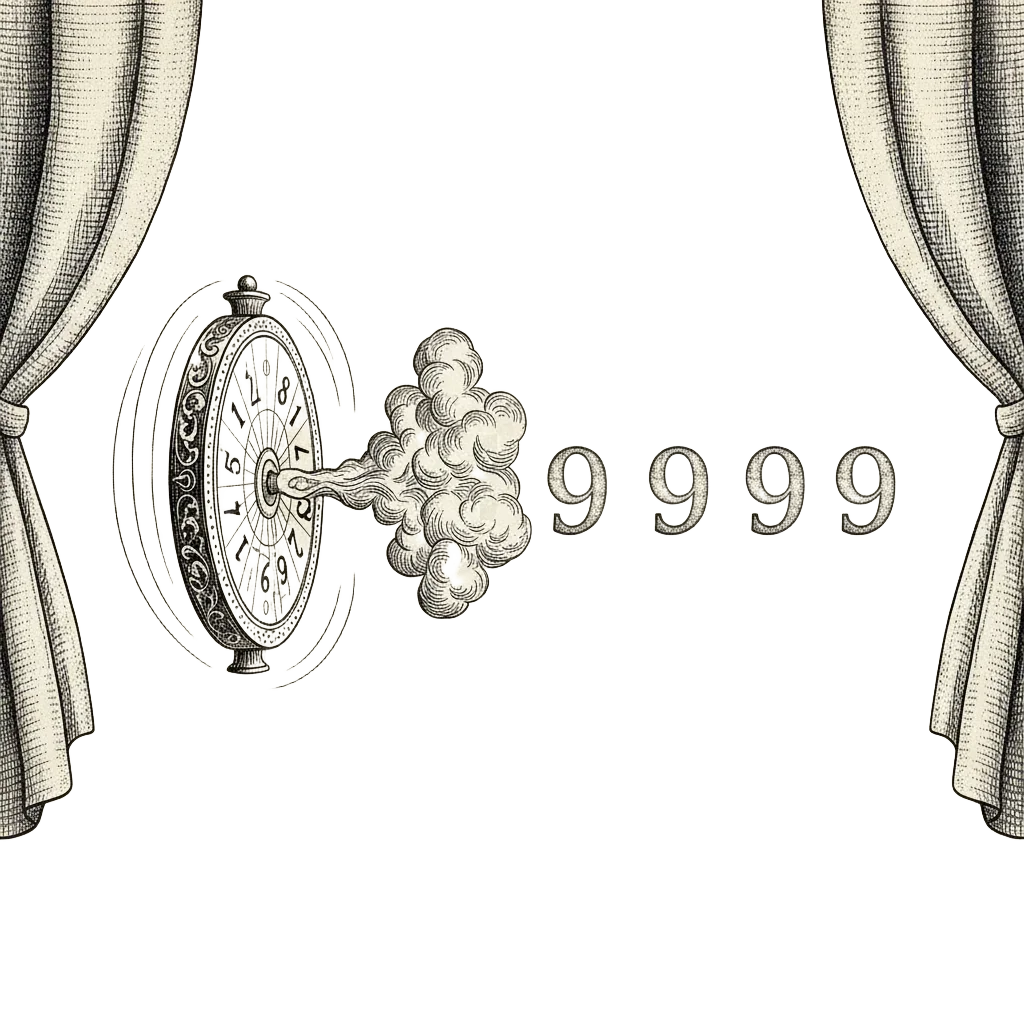
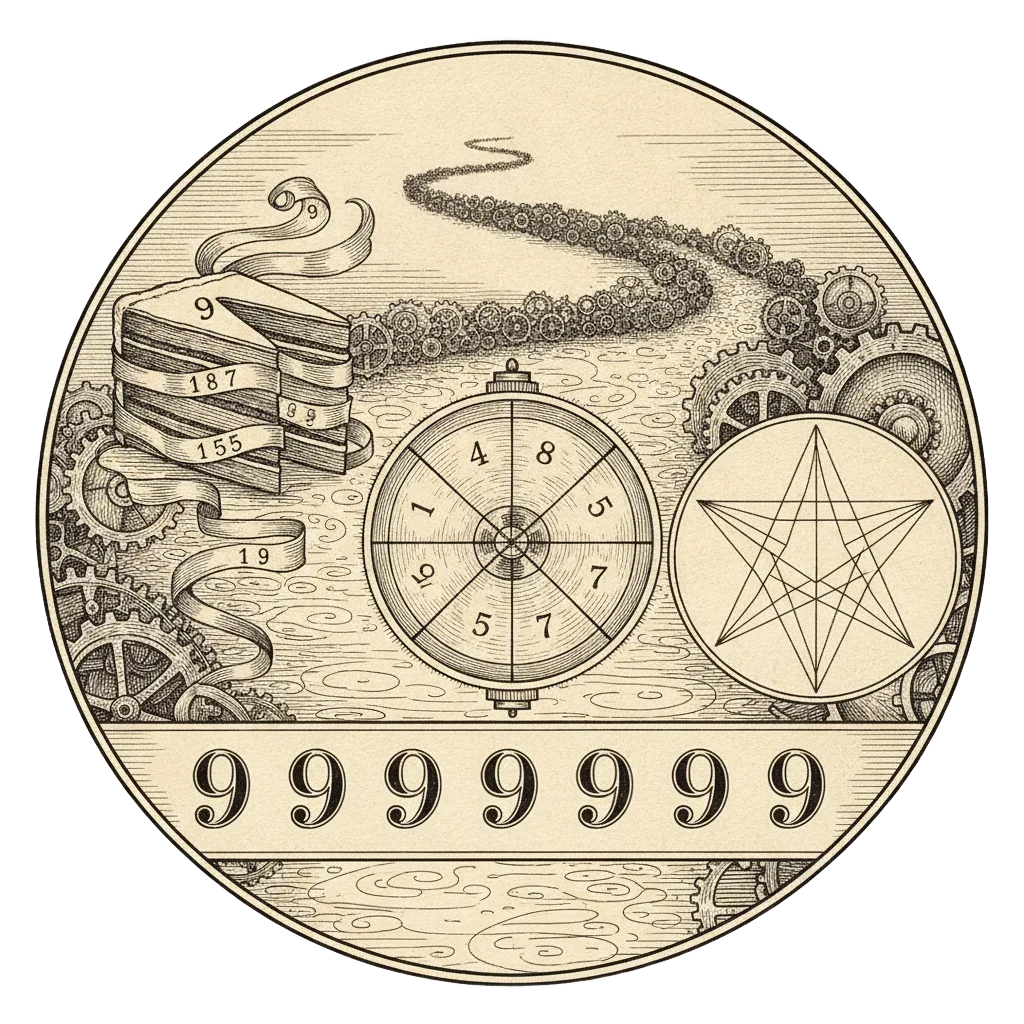
Then multiply it by seven, and the wheel vanishes into a row of nines.
Meet 142857 - a number that has been hiding in plain sight inside one of the simplest fractions there is.

Section one
Watch what happens when you multiply 142857 by the numbers 1 to 6:
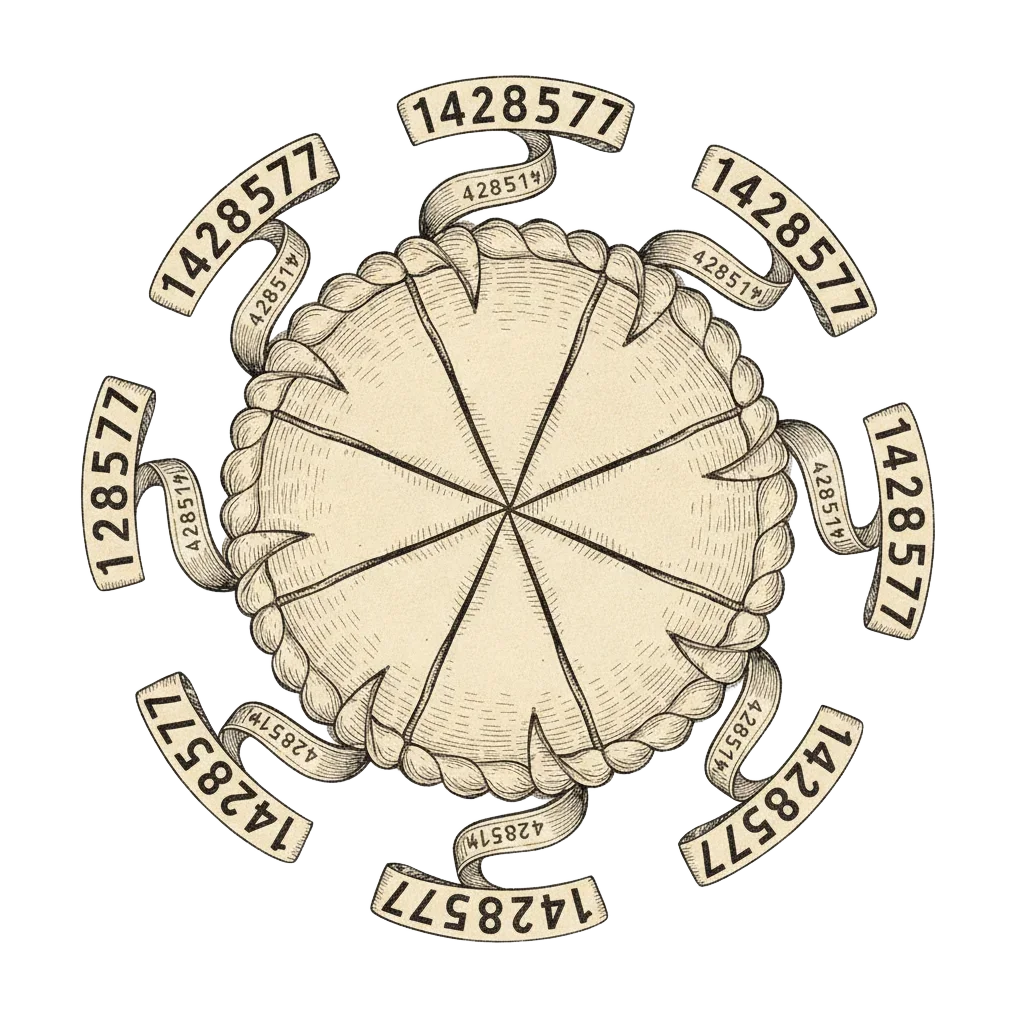
Look closely. Every answer uses exactly the same six digits. And not in a random jumble. They always appear in the same circular order - 1, 4, 2, 8, 5, 7 - just starting from a different place on the circle.
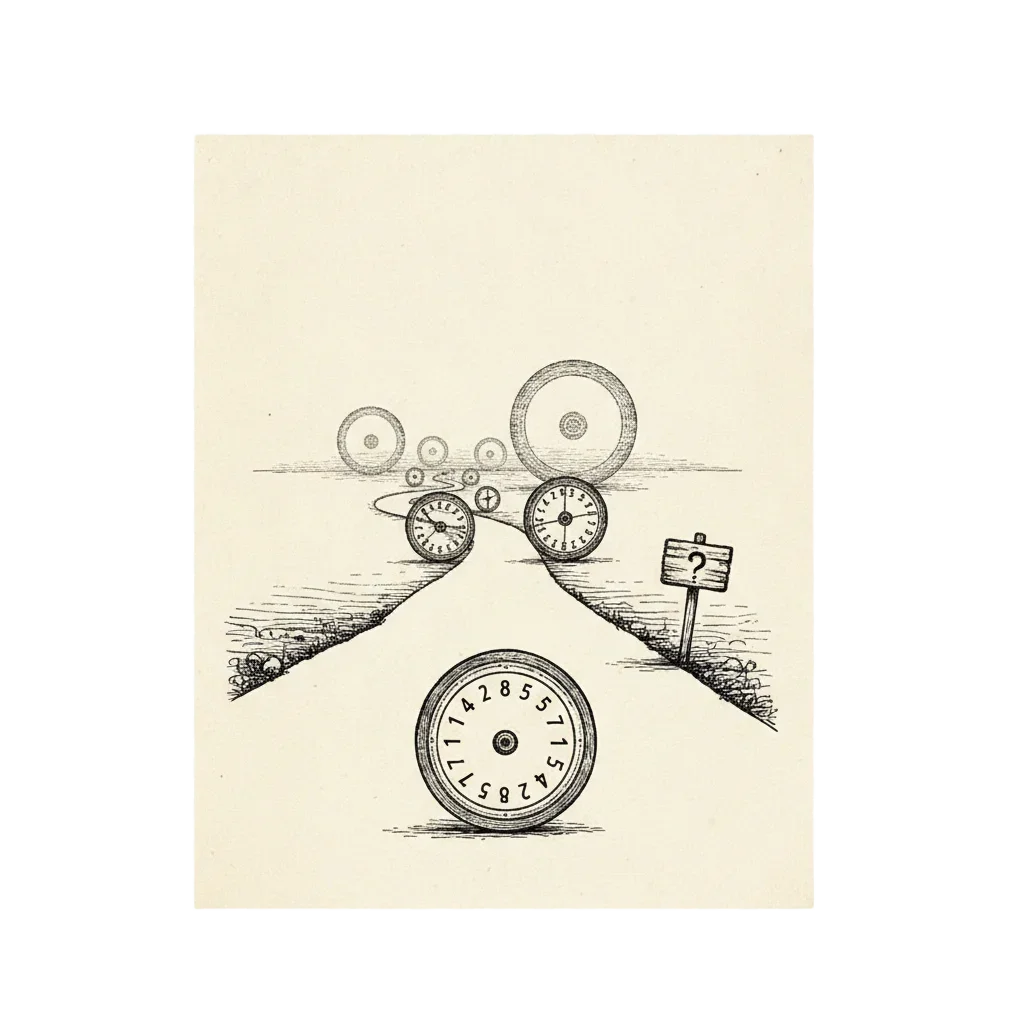
It is as if the number were written around the rim of a wheel, and each multiplication simply turns the wheel a little.
Section two
So far, 142857 has behaved like a perfectly obedient wheel. Now multiply it by 7:
142857 × 7 =
No rotation. No 1, 4, 2, 8, 5 or 7. Just six nines, standing in a row.
It feels like the end of a magic trick - the moment the magician opens the box, and it is empty. Why seven? Why nines? To answer that, we need to go back to one of the first fractions anyone ever learns.
Section three
Take a calculator and divide 1 by 7. You get:
1 ÷ 7 = 0.142857142857142857…
There it is. Our number, repeating forever. Now try 2 ÷ 7:
0.285714285714…
The same six digits again - the same circle - just starting from a different place. In fact, every fraction with 7 on the bottom does this:
So the wheel was never really about multiplication. It is the fingerprint of the number 7, left behind every time you divide by it.
And the row of nines? That is the fraction finishing its sentence. Seven sevenths make one whole - and 0.999999… going on forever is just another way of writing 1.
A secret handshake
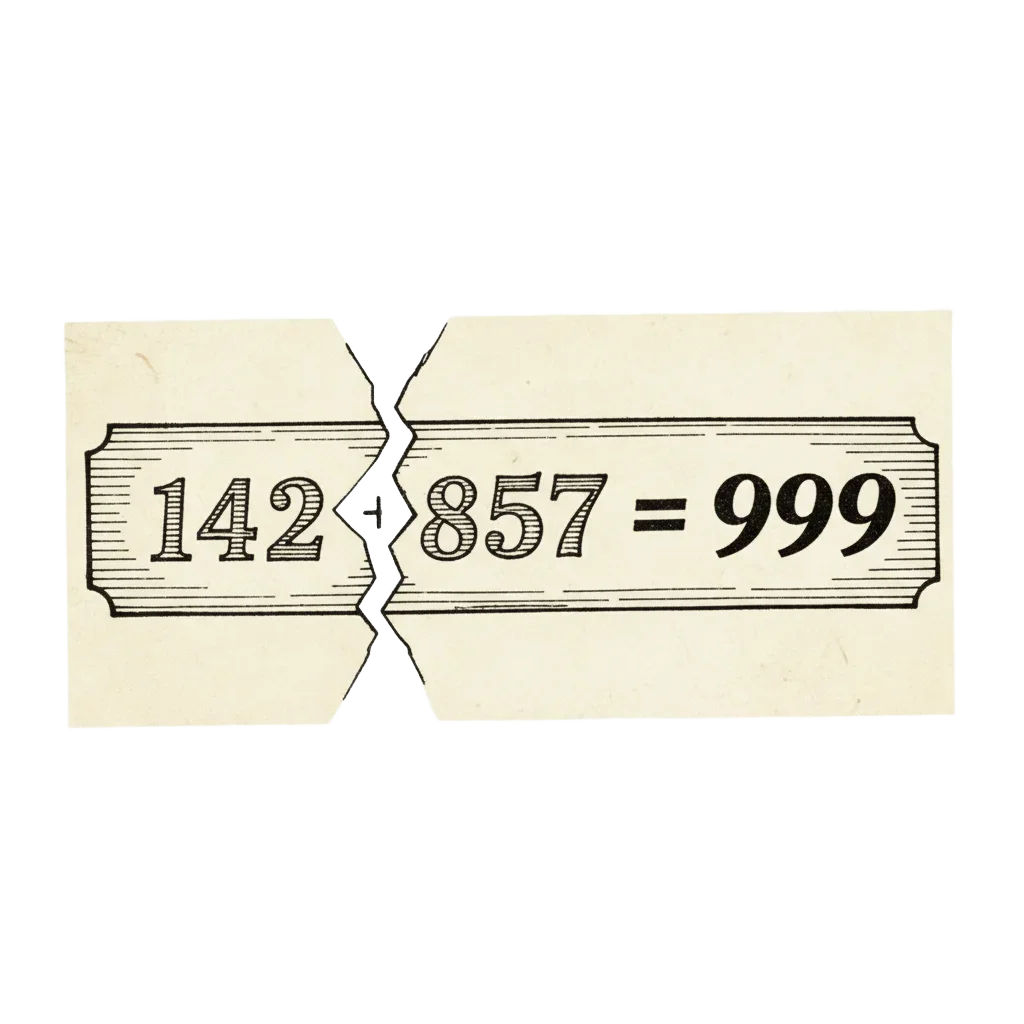
Split 142857 down the middle and add the two halves:
142 + 857 = 999
Split it into three pairs and add them:
14 + 28 + 57 = 99
A French mathematician named E. Midy wrote about this kind of pattern in a pamphlet published in 1836, and it is now known as Midy's theorem.
Section four
Here is the secret, told gently.
When you divide 1 by 7 using long division, you keep getting remainders. And a remainder when dividing by 7 can only ever be 1, 2, 3, 4, 5 or 6 - just six possibilities.
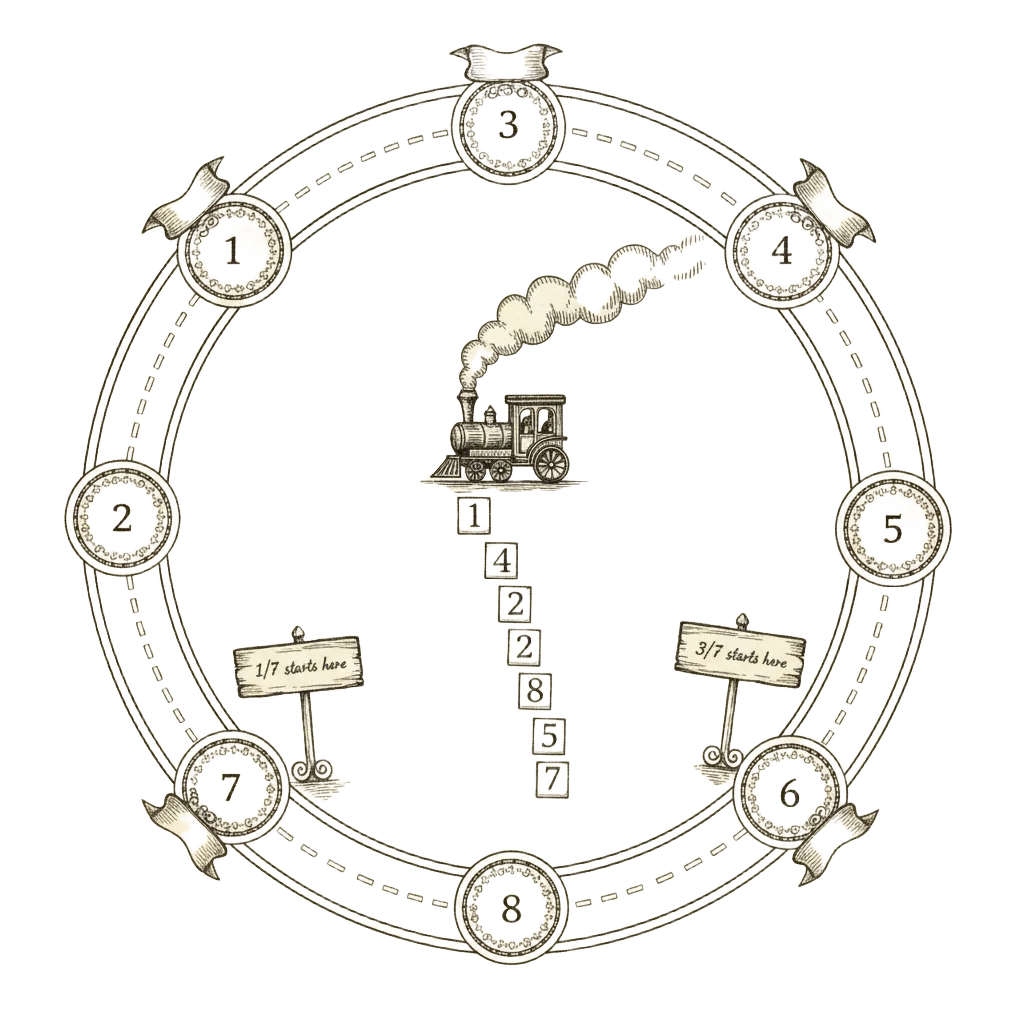
With 7, something lucky happens: the long division visits every single one of those six remainders before it repeats. It walks all the way round a circle of six stops.
Each stop on that circle is also the starting point of another fraction - 3/7 begins at one stop, 5/7 at another, and so on. So all six fractions share one circular road of digits. They just join it at different places.
That is why multiplying 142857 by 2, 3, 4, 5 or 6 only turns the wheel: you are really just switching from one-seventh to two-sevenths, three-sevenths, and so on.
And multiplying by 7 takes you to seven-sevenths - the whole thing - which is why the wheel dissolves into nines.
Section five
You might think every fraction would make a wheel like this. Most do not.
Try 1 ÷ 3 = 0.333… - just one digit, over and over. Try 1 ÷ 11 = 0.090909… - only two digits.
For a fraction to make a full wheel, its long division has to visit every possible remainder before repeating. Only certain prime numbers manage it.
The next one after 7 is 17. Divide 1 by 17 and you get a 16-digit wheel:
0588235294117647
Multiply that by any number from 1 to 16, and the same 16 digits come back, rotated - and multiply it by 17, and you get sixteen nines. But notice the awkward 0 at the front. Written as an ordinary number, without that leading zero, the trick breaks.
The same thing happens with every larger wheel.
Which makes 142857 very special indeed: it is the only number in our everyday decimal system that does this trick perfectly without needing a leading zero.
Section six
There is one more trick in 142857's pocket - and it links to another face in this museum.
Square it:
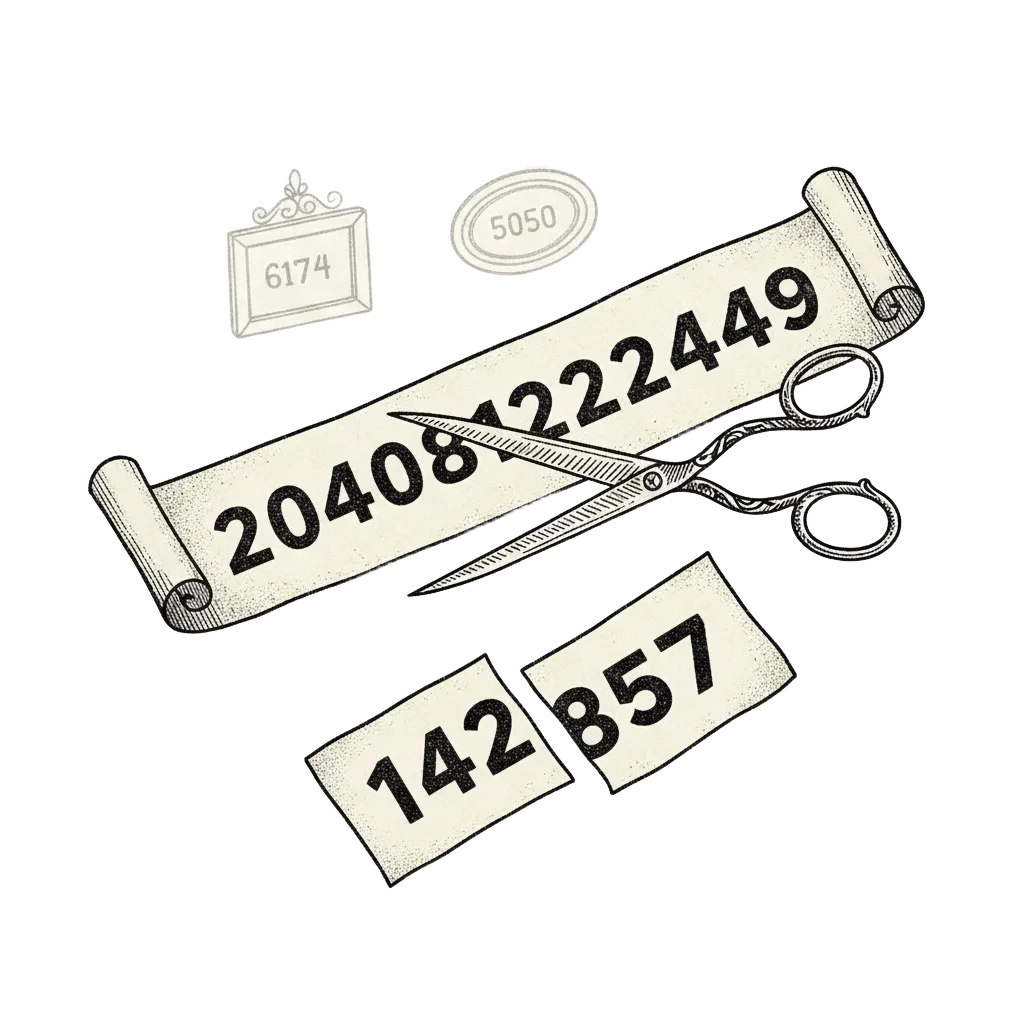
142857 × 142857 =
20408122449
Now cut that answer into two pieces and add them:
20408 + 122449 = 142857
The number comes straight back.
Numbers that do this are called Kaprekar numbers, after D. R. Kaprekar - the schoolteacher from Devlali in India who also discovered 6174.
And here is a small surprise: 5050 is one too. 5050 × 5050 = 25502500, and 2550 + 2500 = 5050.
Section seven
The circle 1–4–2–8–5–7 has even escaped mathematics.
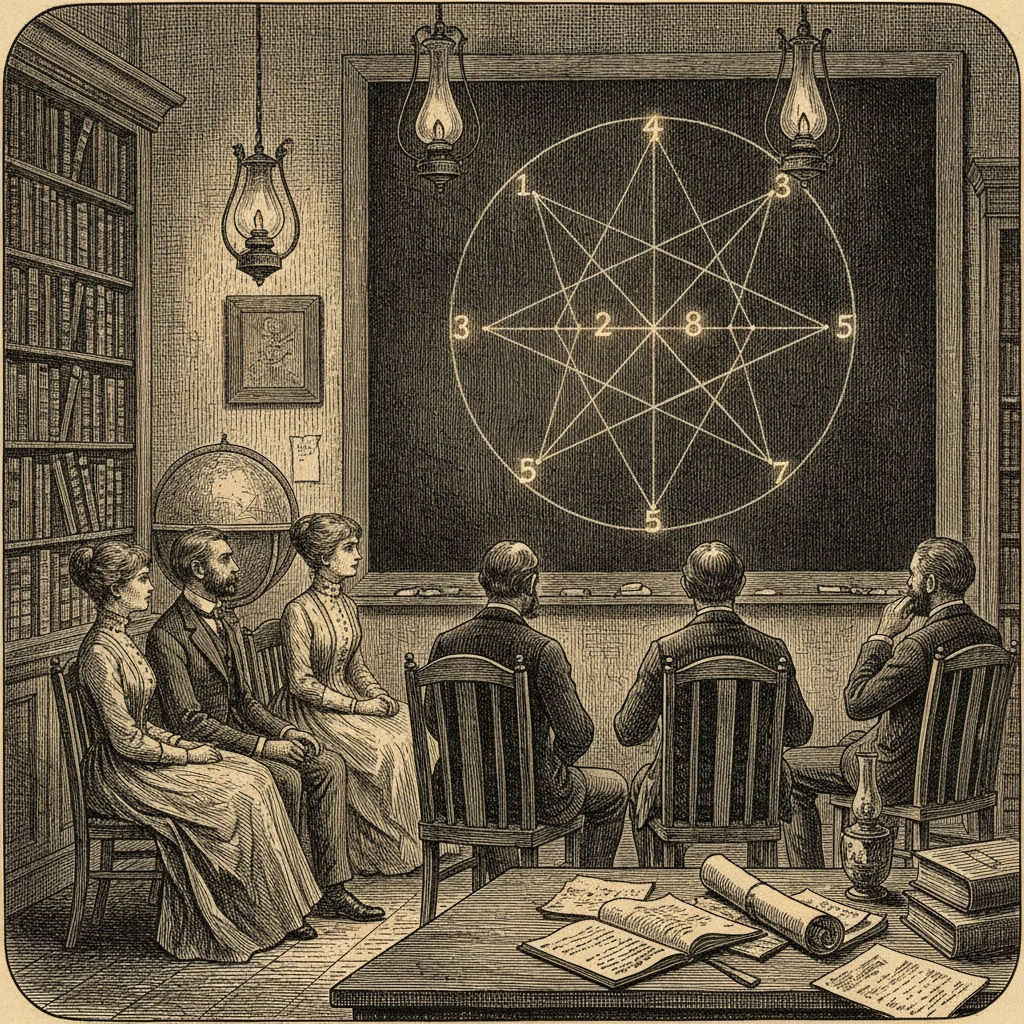
In 1916, in St Petersburg and Moscow, the mystic and teacher G. I. Gurdjieff showed his study groups a symbol called the enneagram: a circle with nine points around its edge.
Inside it, one set of lines joins the points in a very particular order: 1, 4, 2, 8, 5, 7 - and back to 1. It is the decimal of one seventh, drawn as a star.
Gurdjieff's pupil P. D. Ouspensky described the symbol in his book In Search of the Miraculous, published in 1949. Today, versions of the enneagram are drawn in all sorts of places, far from any maths lesson - and inside many of them, 142857 is still quietly going round.
Section eight
Here is something remarkable: mathematicians still do not fully understand these wheels.
Remember, only certain primes - 7, 17, 19, 23 and others - make a full wheel when you divide by them. Are there infinitely many of them? Almost certainly.
In 1927, the mathematician Emil Artin made a famous guess that tells us how often they should appear. Nearly a century later, it has still not been proved.
So the humble fraction 1/7 - something children meet in primary school - sits at the edge of a question that the best mathematicians in the world have not yet answered.
Section nine
Here is why 142857 matters:
Multiply it by 1, 2, 3, 4, 5 or 6, and you get the same six digits in the same circular order.
Multiply it by 7, and you get 999999.
It is the repeating part of 1 ÷ 7 = 0.142857142857…
Every fraction with 7 on the bottom uses the same six-digit circle.
142 + 857 = 999, a pattern known as Midy's theorem.
It is the only number in our decimal system that does this trick without a leading zero.
It is also a Kaprekar number, like 5050: 20408 + 122449 = 142857.
Its circle 1–4–2–8–5–7 is traced inside Gurdjieff's enneagram.
Turn it, and it comes back. Multiply it by seven, and it disappears.
142857 is one seventh, going round and round forever.
Powered by DollarPageClub