Museum Exhibit
For seventeen years, they wait in the dark.
No light. No sound. Just a slow sip of sap from the roots of a tree.
Then, one warm spring evening, the ground opens - and millions of insects climb out at once, as if someone had rung a bell only they could hear.
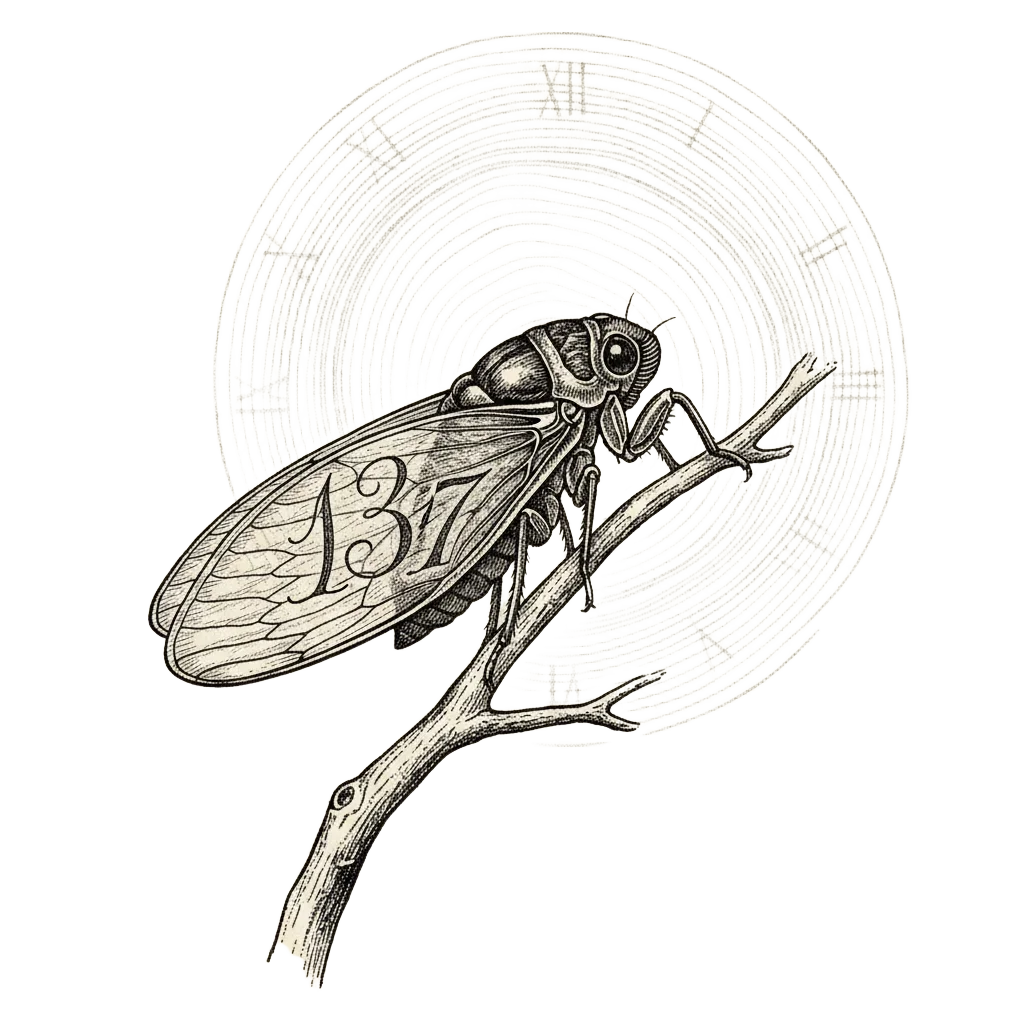
They come every 13 or every 17 years. Never 12. Never 15. Never 16.
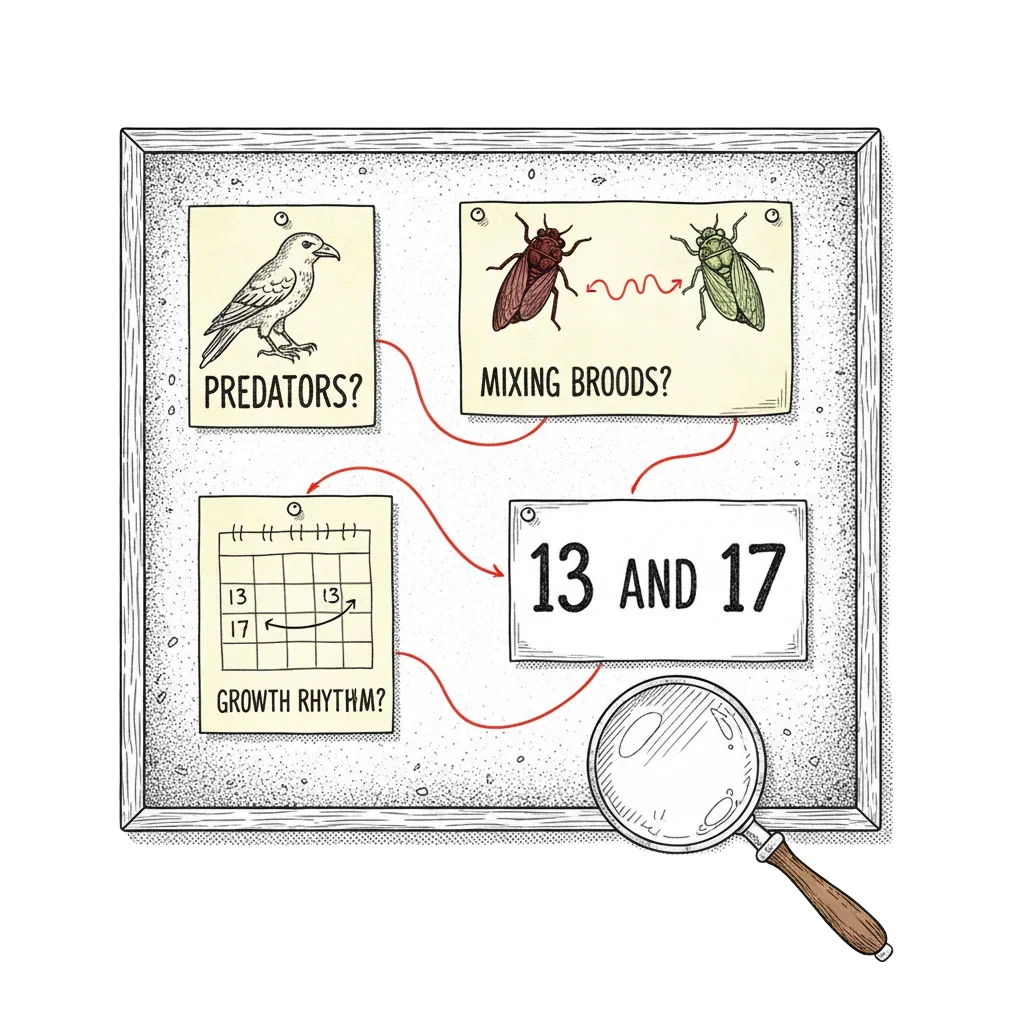
Both numbers are prime. Scientists have spent decades asking whether that is a coincidence.
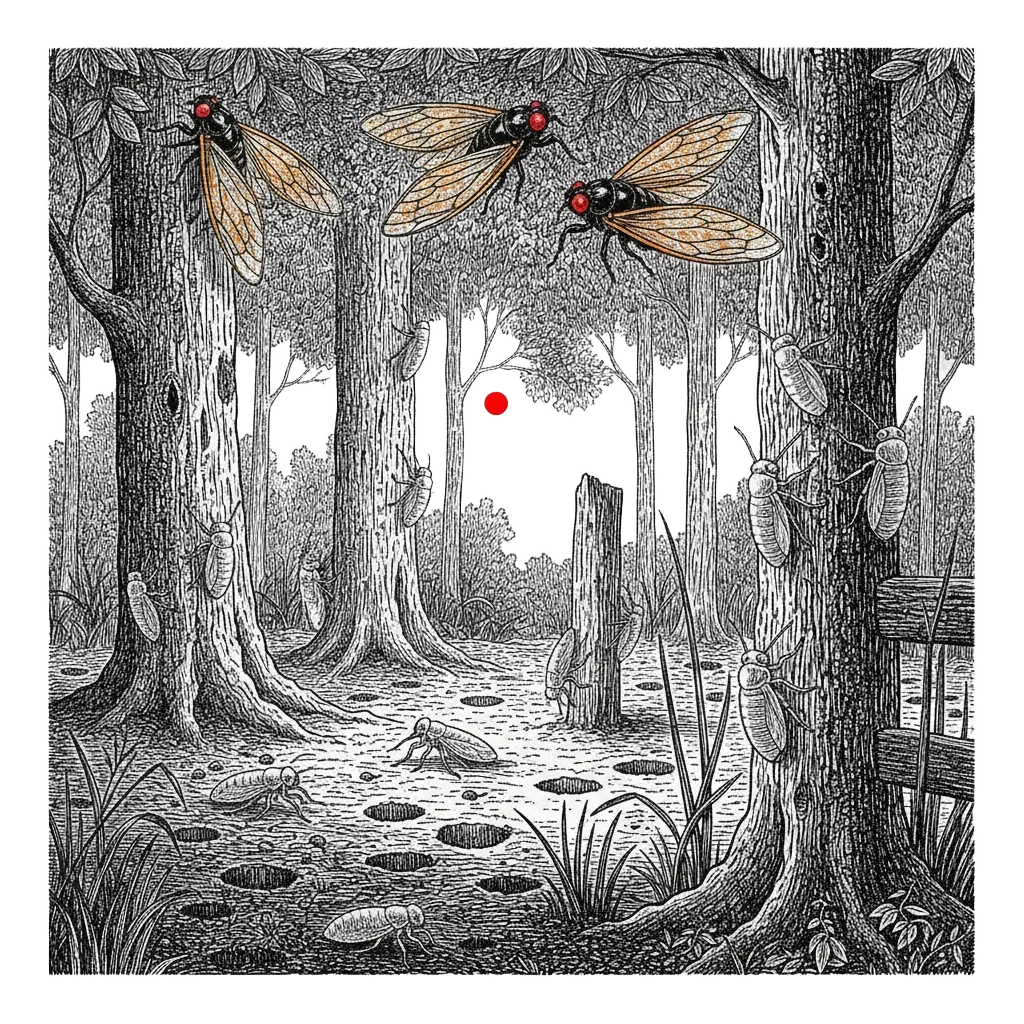
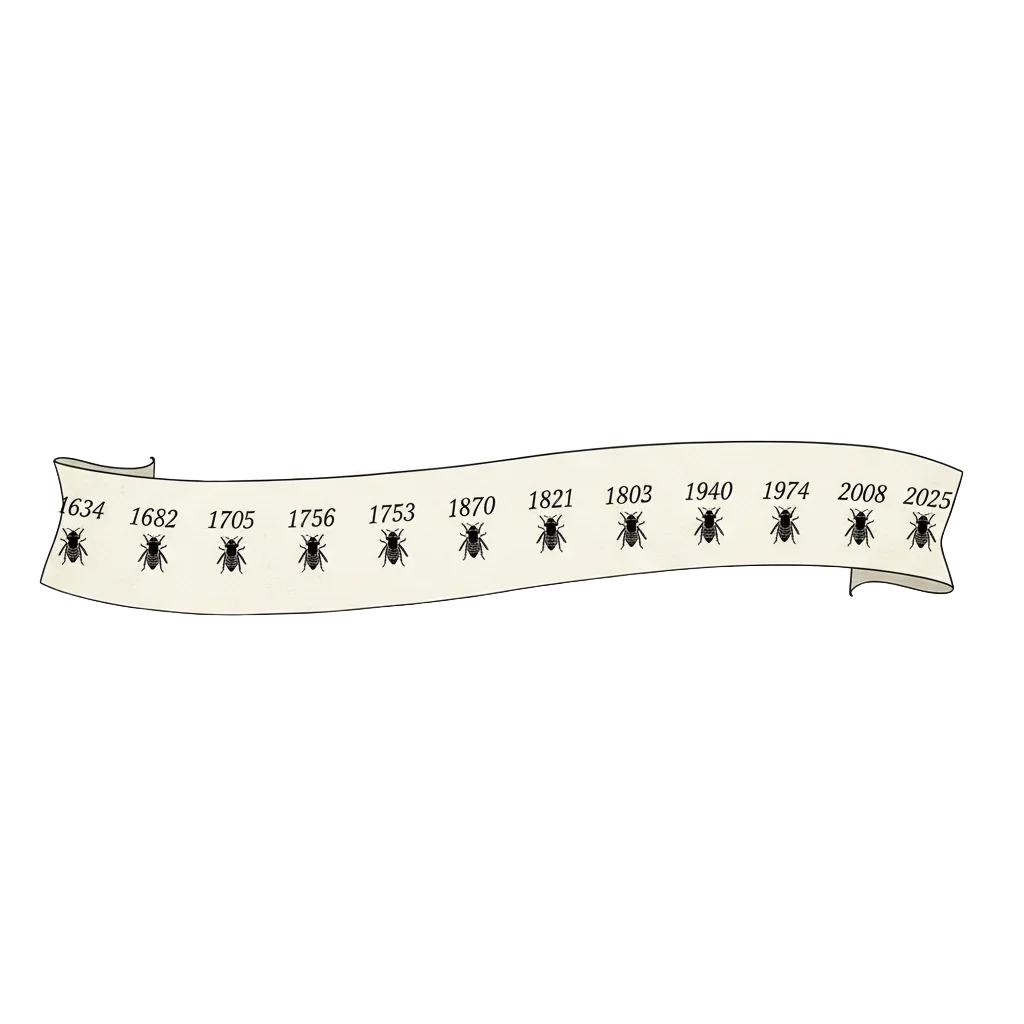
In the spring of 1634, the English settlers of Plymouth Colony in New England saw something no one had warned them about.
Their governor, William Bradford, wrote it down in his chronicle, Of Plymouth Plantation.
All through the month of May, he recorded, there came "such a quantity, of a great sort of flies, like (for bigness) to wasps, or bumblebees, which came out of holes in the ground."
They filled the woods. They crawled over every green thing.
And they made, in Bradford's words, "such a constant yelling noise, as made all the woods ring of them, and ready to deaf the hearers."
Then, just as suddenly, they were gone.
The settlers had never seen such creatures "before or since", Bradford wrote.
Of course they hadn't. The insects would not be back for another seventeen years.
The same family came back - right on time.
Scientists believe the swarm Bradford saw belonged to the group now called Brood XIV. Seventeen years later, it came back. And again, and again. Its descendants emerged most recently in 2025 - exactly 23 cycles of 17 years after Bradford picked up his pen (1634 + 23 × 17 = 2025).
The creatures Bradford met were periodical cicadas - insects found in the eastern United States and nowhere else on Earth.
They are not locusts, whatever the colonists called them. They do not strip fields bare. They are gentle, clumsy, and completely harmless to people.
But their lives are astonishing.
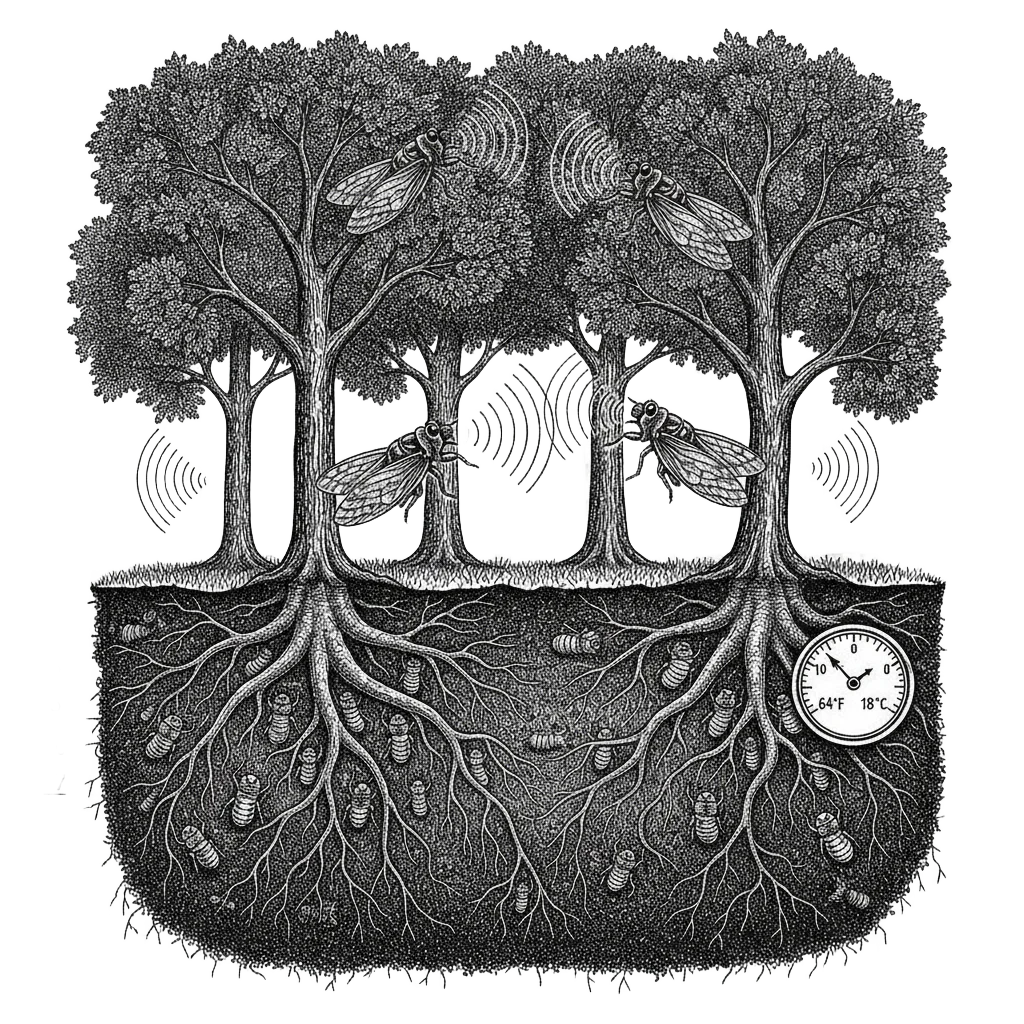
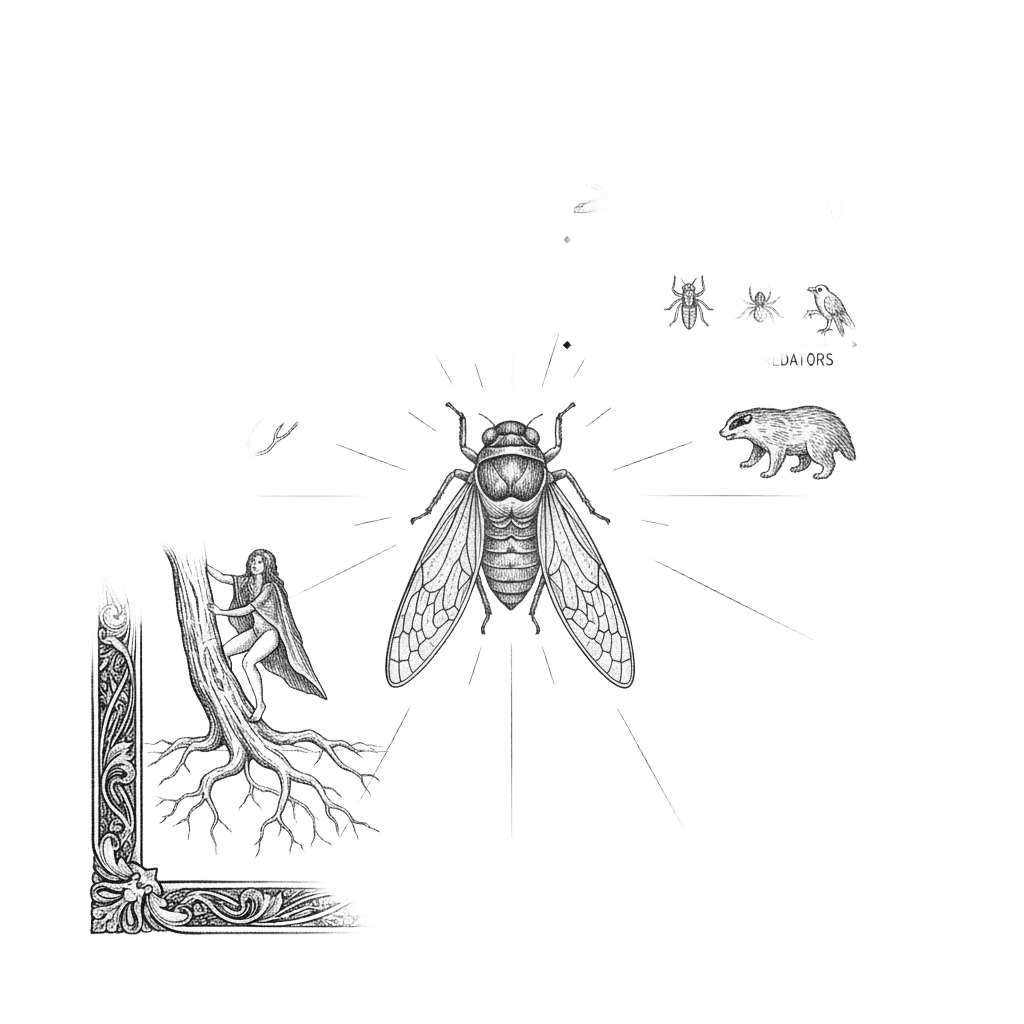
A periodical cicada spends about 99.5% of its life underground, as a young nymph clinging to a tree root and drinking its watery sap. It grows slowly, in the dark, for 13 or 17 years depending on its kind.
Then, when the soil about 20 centimetres down warms to around 18 °C (64 °F), the whole population climbs out within a few nights of one another. They shed their skins, harden, and fly up into the trees. For a few short weeks, the males sing to attract mates. Females lay their eggs in twigs. Then the adults die - and the tiny new nymphs drop to the ground, burrow down, and start the long wait again.
The numbers are staggering: in some places, more than 1.5 million cicadas per acre. The chorus of males can reach around 100 decibels close by - as loud as a motorbike or a power tool.
How does a cicada count to seventeen?
It seems to count the seasons of its tree. In one experiment, published in 2000, scientist Richard Karban and colleagues moved 15-year-old cicada nymphs onto peach trees that were tricked into going through two growing seasons in a single year. The cicadas came out a year early - as if they had counted the extra season as an extra year.
Here is the puzzle that has fascinated scientists for more than half a century.
There are seven species of periodical cicada. Some run on a 17-year cycle. Others run on a 13-year cycle. None of them uses 12, 14, 15, 16, or 18.
13 and 17 have something in common: they are prime numbers. A prime number can only be divided evenly by 1 and by itself. You cannot split 13 years into equal smaller chunks. You cannot split 17 years either.
Could the cicadas' long, strange cycles have something to do with that?
In 1966, the biologists Monte Lloyd and Henry Dybas published a famous study of the "periodical cicada problem", and suggested that long, prime-numbered cycles might help cicadas stay out of step with their enemies. Eleven years later, the writer and biologist Stephen Jay Gould helped make the idea famous in an essay for a general audience.
The idea is simple - and rather beautiful.
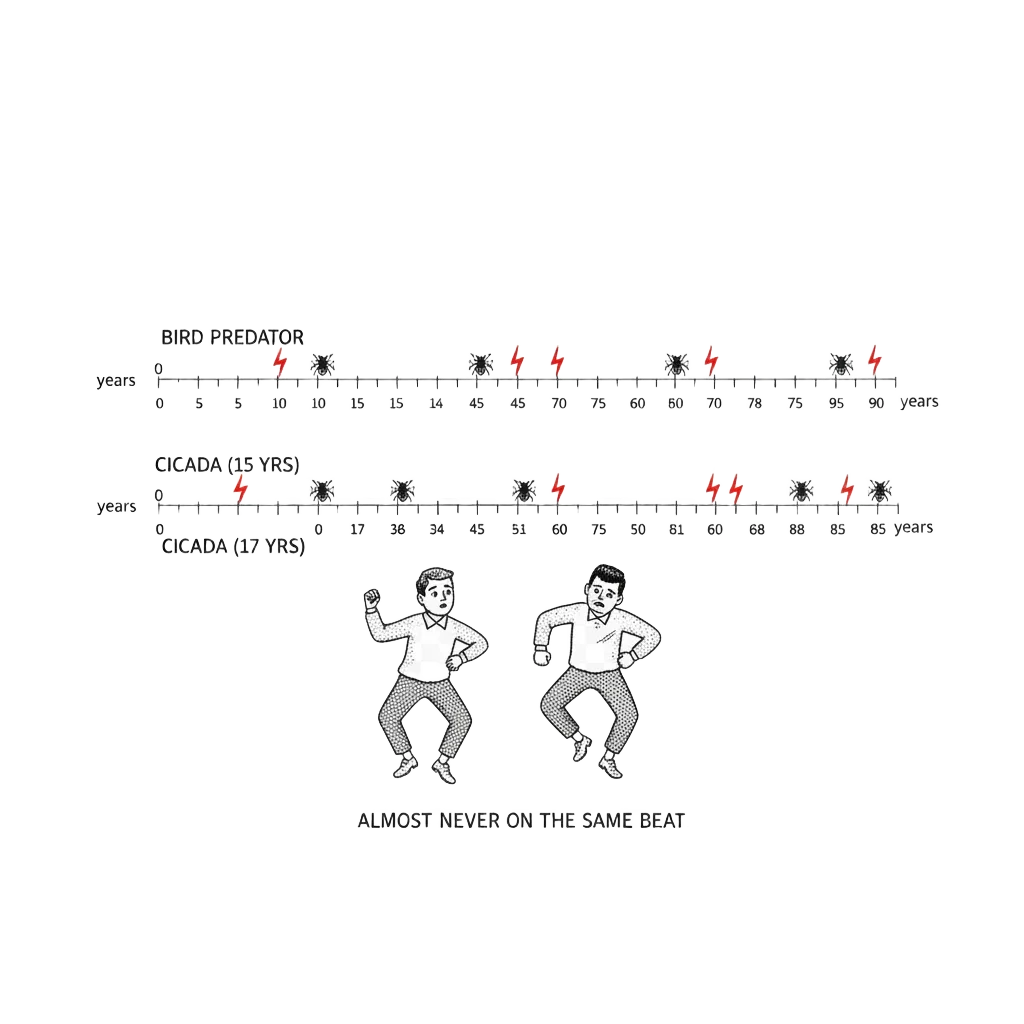
Imagine a predator - a bird, a wasp, a parasite - whose population booms every 3 years.
Now imagine a cicada that comes out every 12 years. Because 12 is 3 × 4, every single cicada emergence lands in a boom year for the predator: at 12 years, 24 years, 36 years. The cicadas walk straight into a feast every time.
Now make the cicada wait 13 years instead. The two cycles only line up when both clocks agree - and for 3 and 13, that happens only every 39 years. Two out of every three cicada emergences now miss the predator's good years completely.
Try a predator on a 5-year cycle:
Prime-numbered cycles are hard to fall into step with. Only a predator that itself ran on a 13- or 17-year cycle could meet them every time - and no such predator is known.
In short: if you are an insect trying not to be anyone's regular dinner, a big prime number is an excellent hiding place.
Timing is only half the trick. The other half is sheer numbers.
When a brood emerges, birds, squirrels, raccoons, fish, snakes, and even pet dogs gorge themselves on cicadas. It makes no difference. There are simply far more cicadas than all the predators together can possibly eat. Biologists call this predator satiation: flood the world with food, and the hungry get full long before you run out.
That only works if everyone comes out together. A cicada that emerges a year early, alone, gets eaten. A cicada that emerges with millions of its neighbours has a good chance of surviving.
So the cicadas have two defences working at once: come out all at once, and come out when no one is expecting you.
Here is the honest part.
The prime-number explanation is a leading hypothesis, not a proven fact. No one has found the short-cycled predator that the story needs. Some scientists think the predators the cicadas once dodged may have vanished long ago - or never quite existed in the neat form the maths imagines.
Other researchers have offered different reasons why primes might win. The Japanese mathematical biologist Jin Yoshimura and colleagues suggested that the real danger was not predators but other cicadas. If broods with different cycles kept emerging together and interbreeding, their children's timing could be scrambled. Prime-numbered broods rarely meet each other - so they stay pure and stay on schedule.
And some biologists wonder whether the long cycles came first - perhaps as a way to survive the cold, short summers of the Ice Ages - and their being prime is only part of the story.
Nobody has settled it yet. That is part of the fun.
Because 13 and 17 are both prime, a 13-year brood and a 17-year brood almost never come out in the same year. For one particular pair of neighbours, it happens only once every 13 × 17 = 221 years.
In spring 2024, it happened.
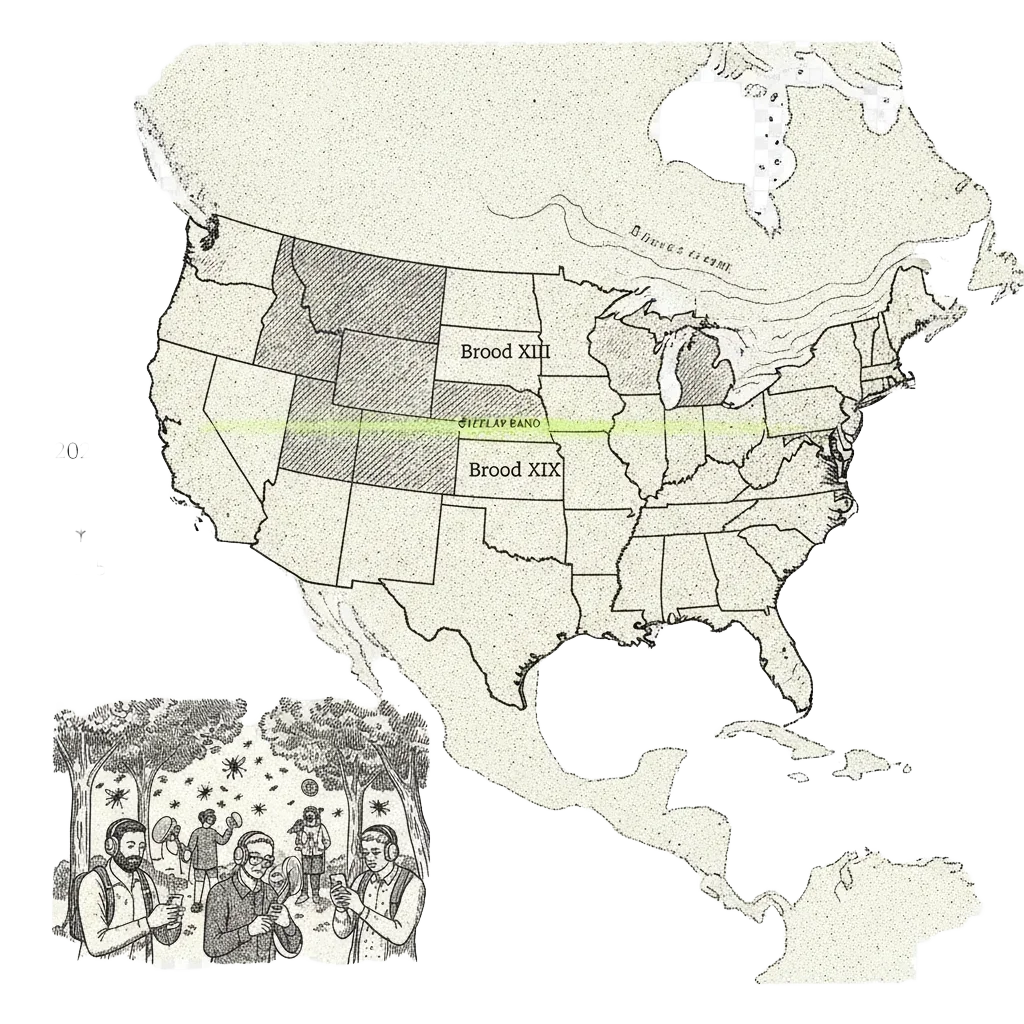
Brood XIII, a 17-year brood centred on northern Illinois, and Brood XIX, a huge 13-year brood spread across the south and Midwest, emerged in the same season - for the first time since 1803, when Thomas Jefferson was president.
Across parts of more than a dozen states, the trees roared. Some estimates put the total at a trillion insects or more.
The two broods mostly stayed apart; they only touched in a narrow band of central Illinois. But for a few weeks, the calendar of two prime numbers lined up - and people came from all over to listen.
If you missed it, the next chance for this pair is 2245.
Why 221?
Two clocks, one ticking every 13 years and one every 17, only strike together when a year is divisible by both. Because 13 and 17 share no common factors, the first time that happens is 13 × 17 = 221 years. 1803 + 221 = 2024. 2024 + 221 = 2245.
Prime numbers usually live in maths textbooks, cryptography, and puzzles.
It is startling to think they might also be written into the life of an insect - a small, clumsy creature that has never counted anything in its life except the seasons of a tree.
Whether the prime-number story turns out to be the whole answer, part of the answer, or a lovely coincidence, periodical cicadas remain one of the strangest timekeepers on Earth.
Every time a brood emerges, newspapers print the same question: why 13? why 17?
And every time, a new generation of people meets the idea that numbers are not only something we invent. Sometimes, they are something the living world stumbles into - and keeps.
The cicada has never learned arithmetic.
But for seventeen years at a time, it may be hiding inside it.
Powered by DollarPageClub