

Museum of Numbers
Our Exhibits · Mathematical Curiosities

27

The small number that climbs a mountain

Hailstone numbers · Collatz conjecture · 111 steps

Pick a number. Follow two tiny rules. Most numbers tumble down to 1 in a handful of steps.

26 takes 10 steps. 28 takes 18.

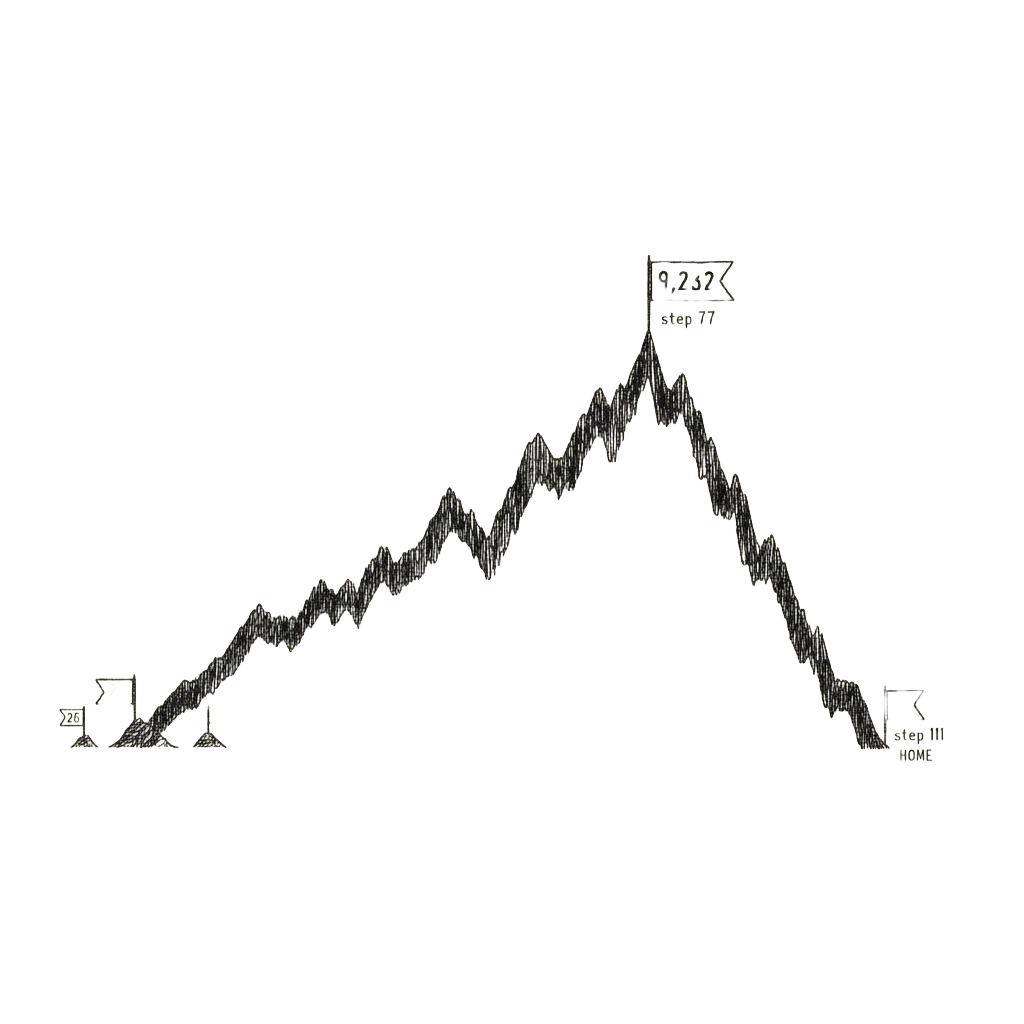
But 27, sitting quietly between them, sets off on a journey of 111 steps, climbs as high as 9,232, and only then comes home.

Nobody on Earth can prove that every number comes home at all.
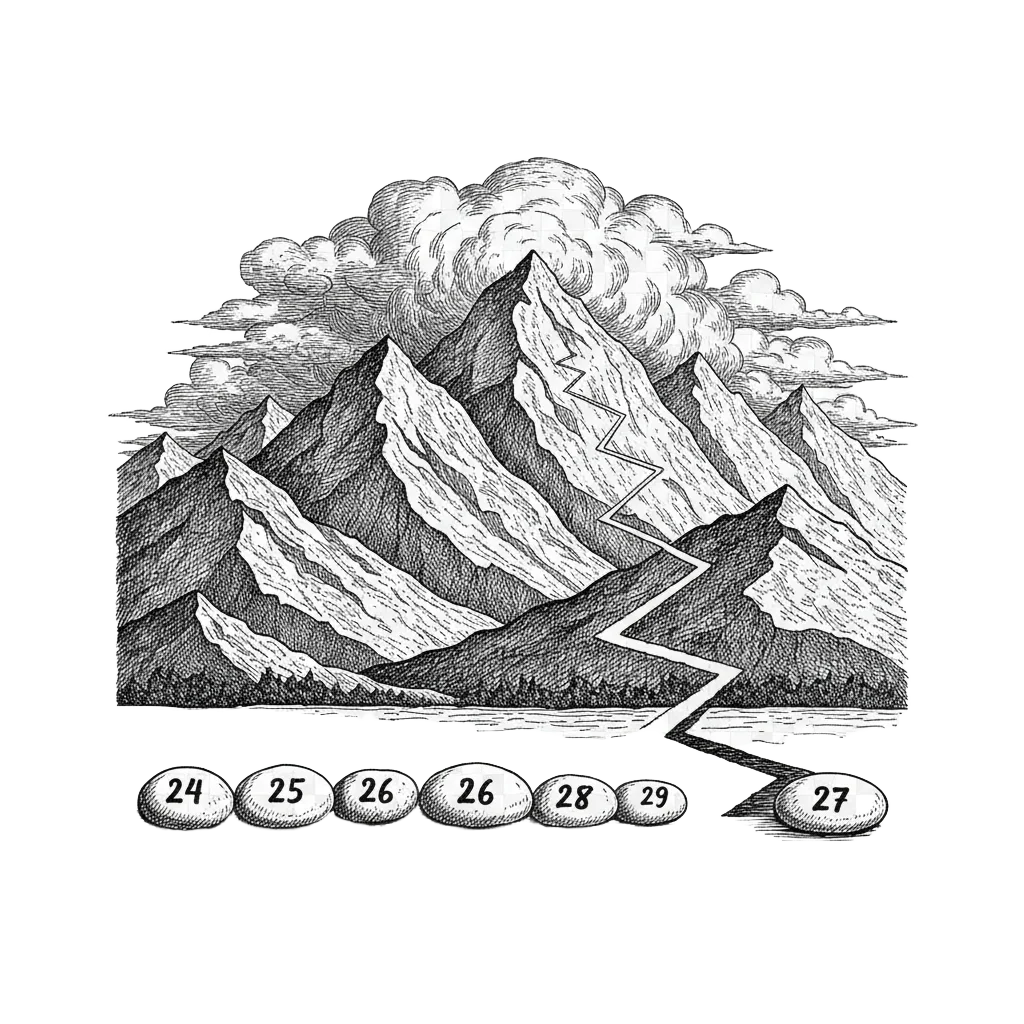
Ink etching of a vast mountain range at dusk. Small numbered pebbles 24 through 29 rest at the foot except for pebble 27 which has set off alone up a winding trail disappearing into the clouds

Two rules, one game

Here is the whole game:

1

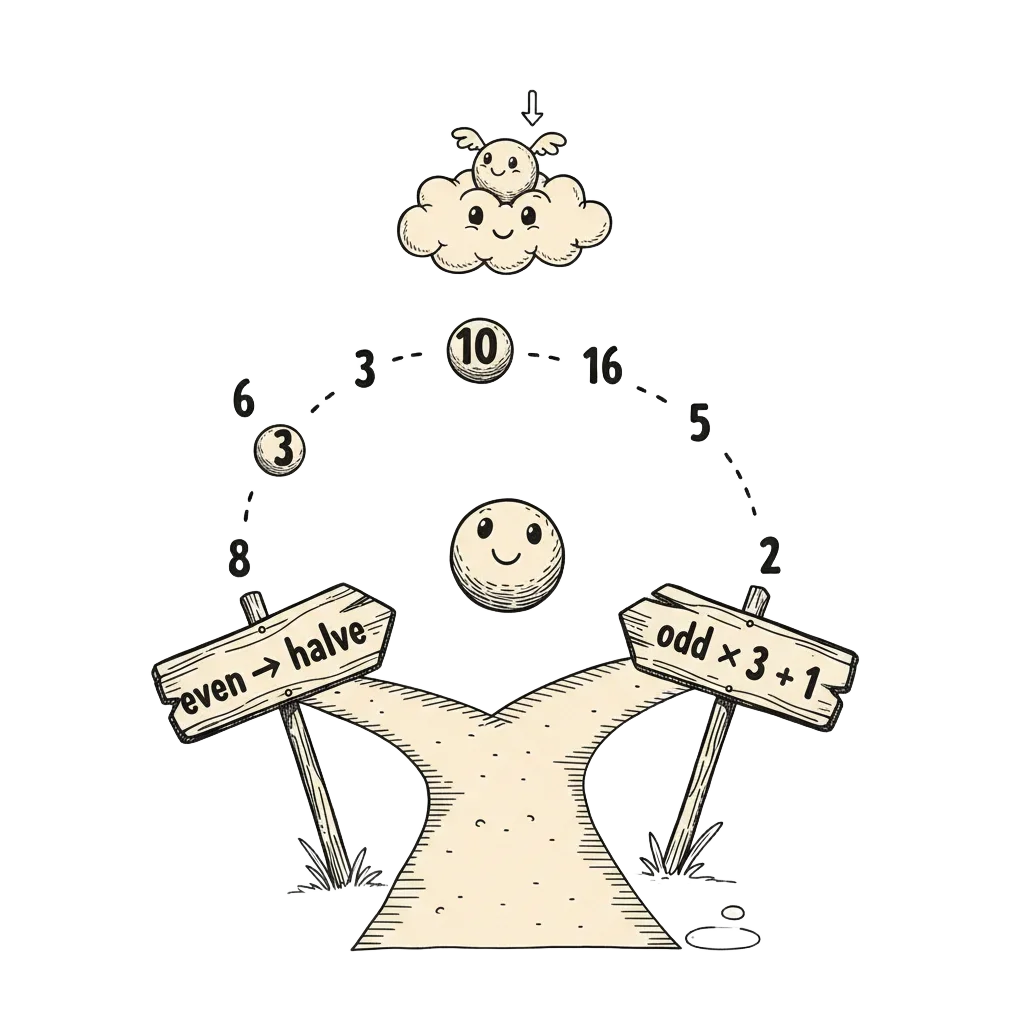
If your number is even, cut it in half.

2

If your number is odd, multiply it by 3 and add 1.

Then do the same thing to the answer. And again. Stop when you reach 1.

Let's try it with 6:

6 → 3 → 10 → 5 → 16 → 8 → 4 → 2 → 1

Eight steps, and home.

Try your age, your house number, the day of the month you were born. Each one will bounce up and down for a while, like a hailstone tossed around inside a storm cloud, and then fall to 1.

That is why these journeys are often called hailstone numbers.

Playful ink illustration of a forked road with two signposts labelled even halve and odd times three plus one, a bouncing ball tracing the journey of 6, and a hailstone in a cloud

A small aside

Why stop at 1?

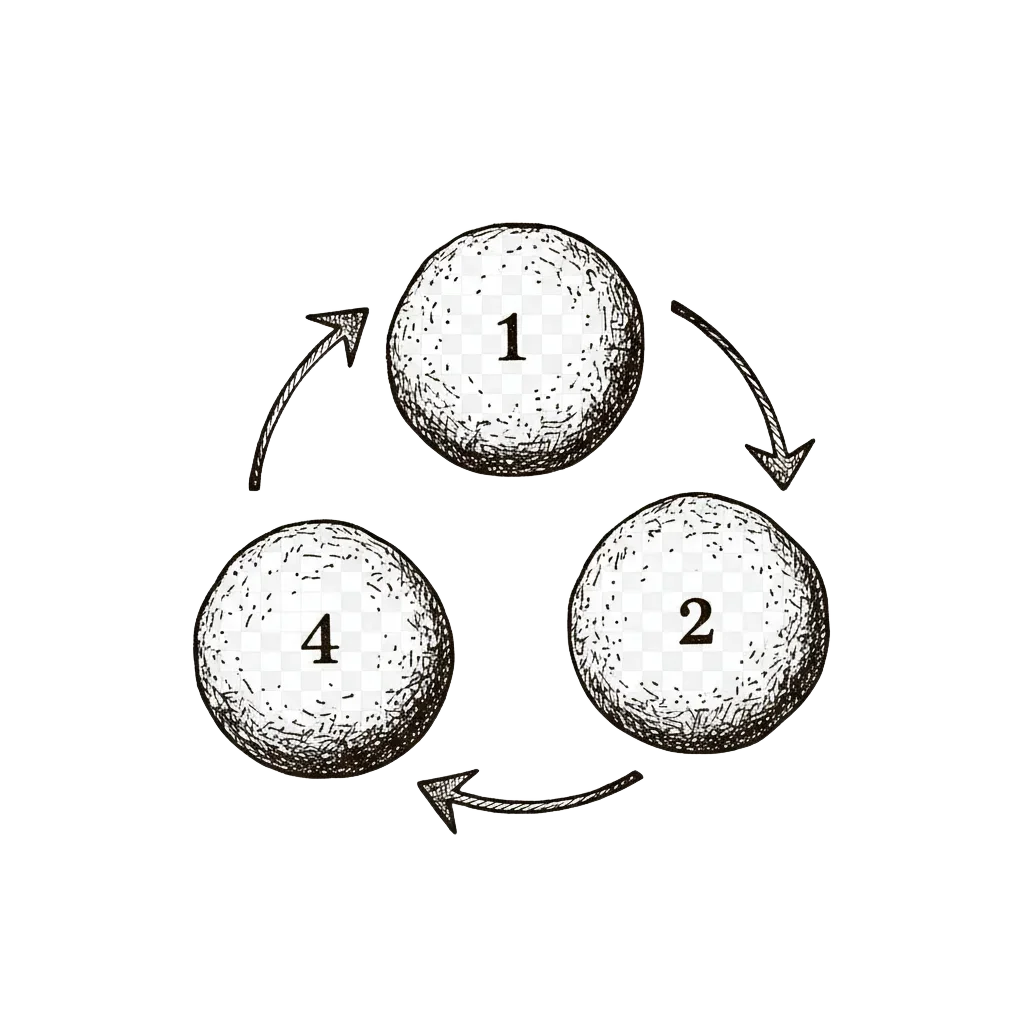
Because if you keep going, 1 becomes 4, then 2, then 1 again - a tiny loop, forever: 1 → 4 → 2 → 1. Reaching 1 means you have fallen into that loop and the journey is over.

Three stepping stones labelled 1, 4 and 2 in a circular loop with arrows

A puzzle in a young man's notebook

In 1937, a young German mathematician named Lothar Collatz - just two years after finishing his doctorate - started wondering about rules like this one.

He suspected something simple: whatever number you start with, you always end up at 1.

It is the kind of guess you could explain to a child. Collatz did not publish it as a grand discovery. Instead, the puzzle spread the way a good riddle does - by word of mouth, from one mathematician to the next, across universities and continents.

As it travelled, it picked up names: the 3n + 1 problem, the Syracuse problem, Kakutani's problem, Ulam's problem. Mathematicians started calling it the Collatz conjecture - a conjecture being a guess that everyone believes, but nobody has yet proved.

- A puzzle travels by word of mouth

Ink etching of a young Lothar Collatz at a wooden desk in 1930s Germany, notebook open with chains of numbers, chalkboards and notes in the background
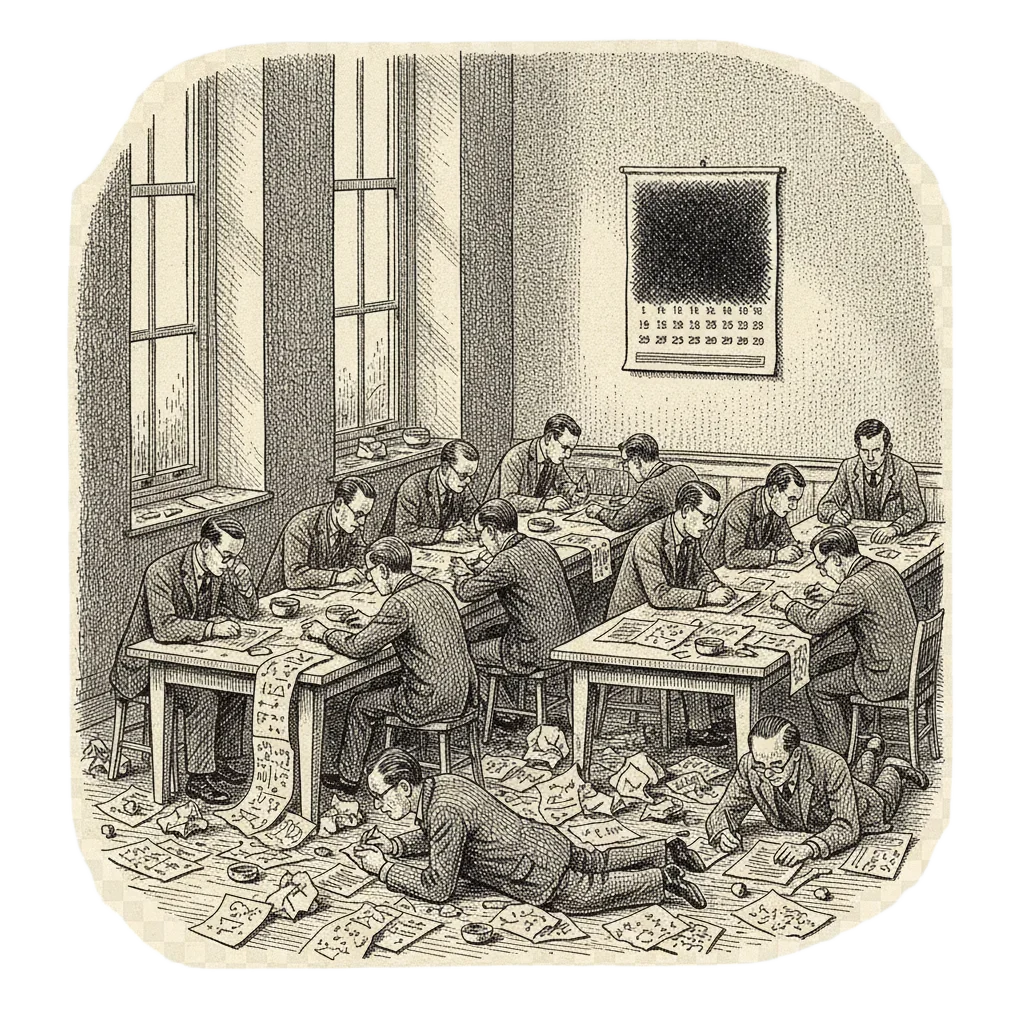
Humorous ink illustration of 1960s mathematicians hunched over number chains in a common room, coffee going cold, a calendar with a whole month crossed off

A famous distraction

The month Yale stopped working.

Around 1960, the mathematician Shizuo Kakutani passed the puzzle around. He later recalled: "For about a month everybody at Yale worked on it, with no result. A similar phenomenon happened when I mentioned it at the University of Chicago. A joke was made that this problem was part of a conspiracy to slow down mathematical research in the U.S."

The long way home

Now try the game with 27.

It starts innocently enough: 27 is odd, so it becomes 82. Then 41. Then 124, 62, 31, 94, 47, 142, 71, 214, 107…

And it keeps going. Up and down, but mostly up.

Numbers smaller than 27 never climb higher than 160. But 27 soars past 1,000, then past 5,000, and after 77 steps it reaches its summit: 9,232 - more than 340 times its starting size.

Then, at last, the fall begins. From the peak it takes another 34 steps to tumble back down, passing through 23, 70, 35, 106, 53, 160, 80, 40, 20, 10, 5, 16, 8, 4, 2 - and finally 1.

In total: 111 steps. 41 of them are "times three plus one", and 70 are halvings.

Its neighbours make it look even stranger. 25 gets home in 23 steps. 26 in just 10. 28 in 18. 27 is the first number that needs more than a hundred.

111

Total steps

9,232

Summit at step 77

340×

Starting size

Dramatic ink mountain chart of the journey of 27: a low start at 27, a long jagged climb to a summit labelled 9232 at step 77, then a steep descent to 1 at step 111. The journeys of 26 and 28 appear as tiny bumps at the base.

A small surprise

Familiar faces on the mountain.

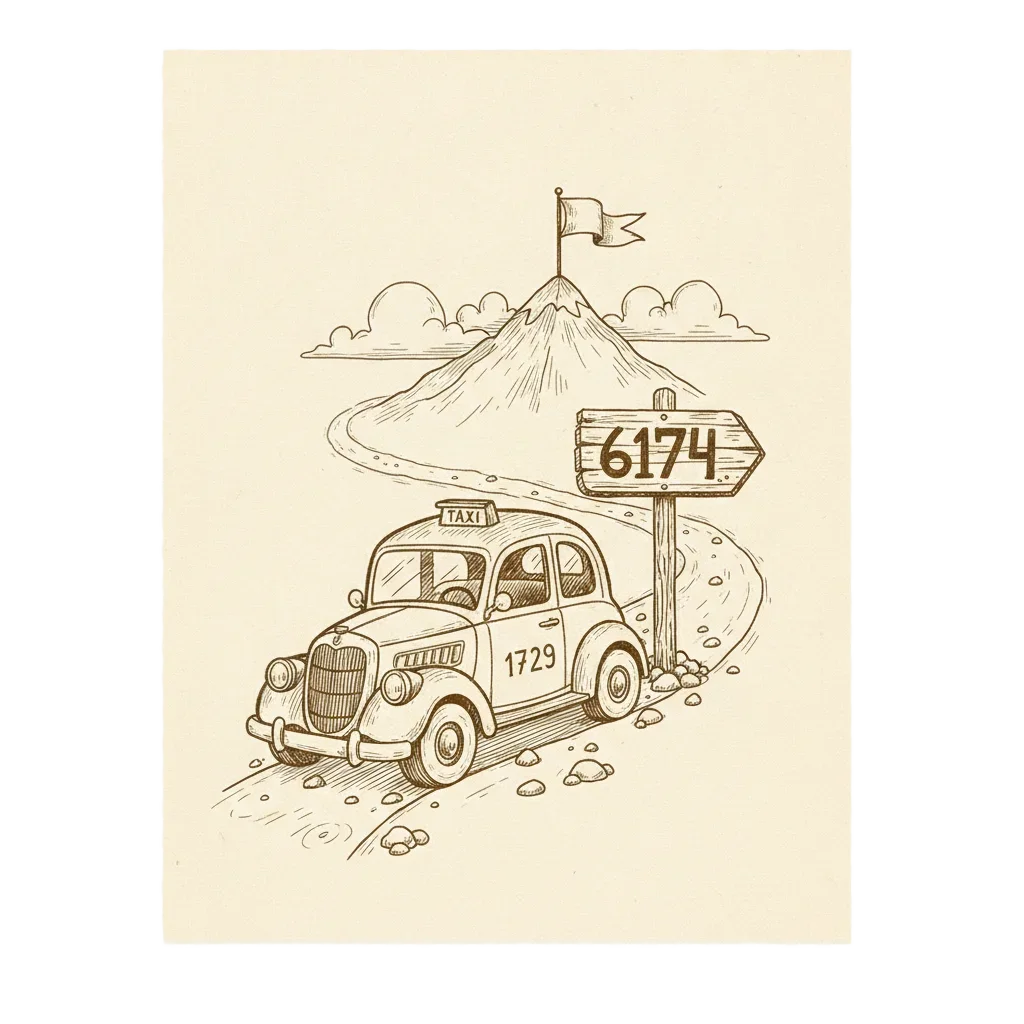
The museum's other numbers get caught up in this too. 6174 takes exactly 111 steps, the same as 27. That's no fluke: after 25 steps each, both numbers land on 310, and from there they share the same path all the way home. And 1729, Ramanujan's taxi number, joins 27's trail too. It climbs to the very same summit, 9,232, and gets home in 104 steps.

Ink illustration of a vintage taxi labelled 1729 and a signpost marked 6174 both merging onto 27s mountain trail heading for the same summit flag

Enjoying this story?

Enjoying this story?

NumberMuseum tells the stories behind remarkable numbers - the people, the accidents, and the surprises hiding inside them. Get the next one delivered to your inbox.

One new story a week, at most.

At most one email a week.

Why is it so hard?

The rule could hardly be simpler. So why can't anyone prove that every number reaches 1?

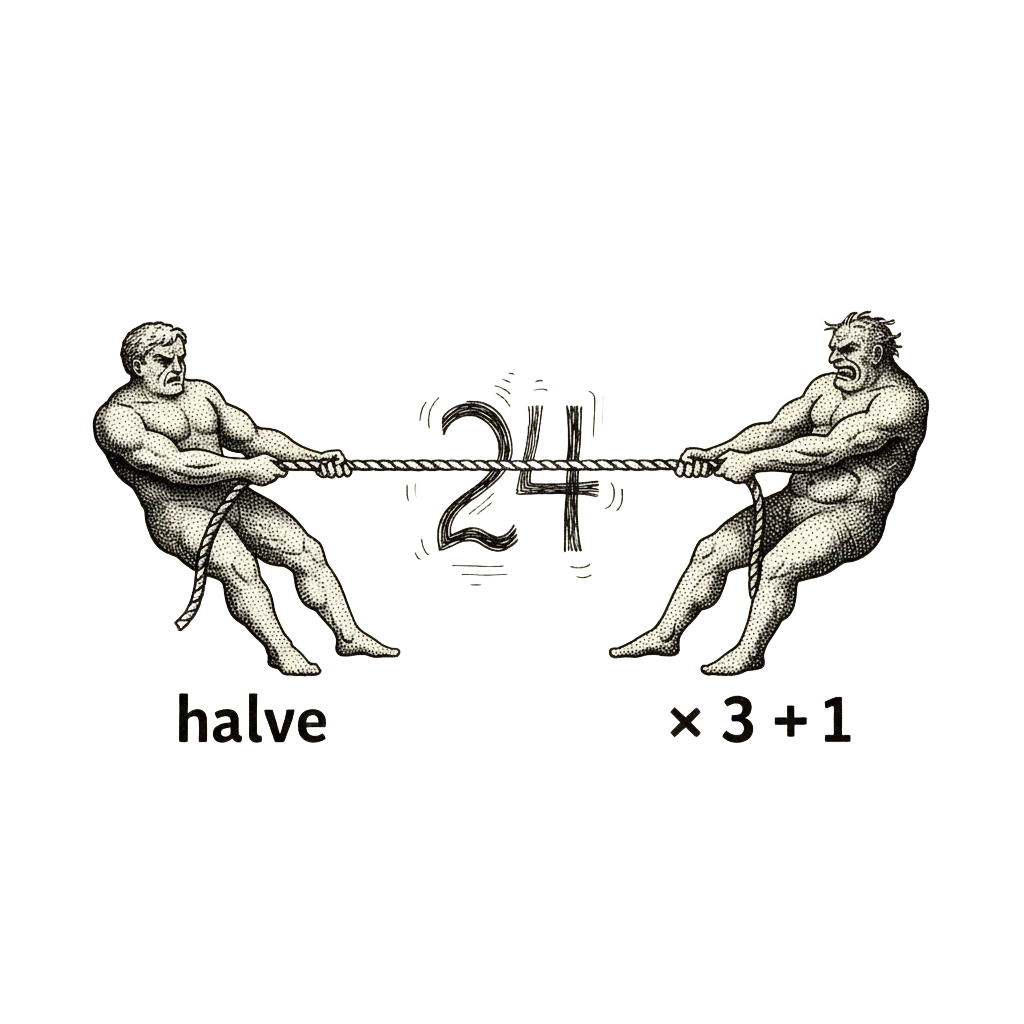
Because the two rules pull in opposite directions.

Halving shrinks a number. Tripling makes it bigger. And you never know in advance which rule is coming next - that depends on whether each new number happens to be odd or even, which looks almost random.

On average, the halvings win. Every "times three plus one" produces an even number, so it is always followed by at least one halving, and very often more. Over a long journey the number tends to drift downward, the way a ball rolling down a bumpy hill eventually reaches the bottom.

But "tends to" is not "always". To prove the conjecture, you would have to rule out two possibilities for every number there is:

  • A number whose journey climbs forever and never comes down.

  • A secret loop somewhere out among the giant numbers, which traps a journey and never lets it reach 1.

Nobody has ever found either one. Nobody has ever proved they don't exist.

Ink tug of war illustration: a figure labelled halve pulling down and a figure labelled times 3 plus 1 pulling up, a number wobbling in the middle, faint dotted paths suggest an endless climb and a looping trap in the background
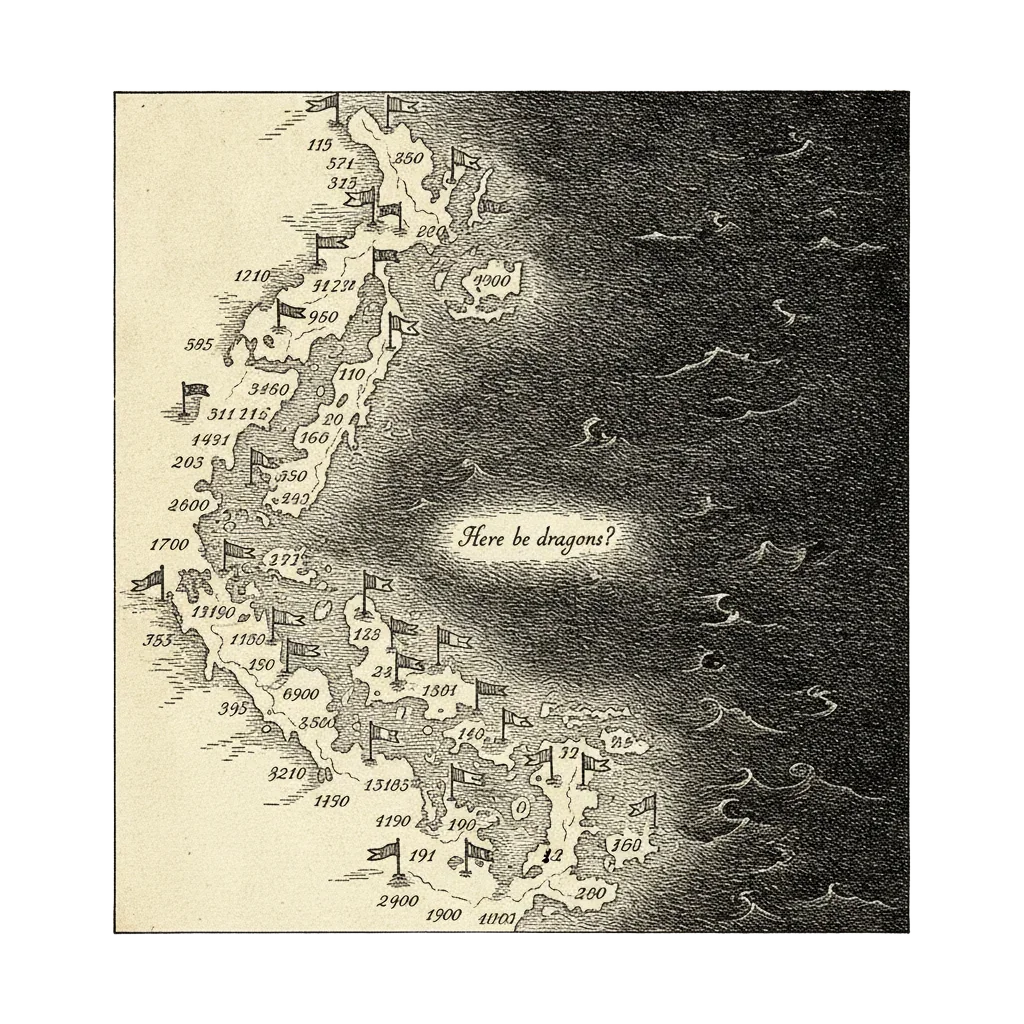
Ink old nautical chart with a brightly lit coastline of checked numbers all ending in flags at 1, and beyond it a vast dark ocean labelled Here be dragons

Checked to the edge of the known world

Computers have tested the rule on an unimaginable number of starting points - every number up to about 2.36 × 10²¹, which is more than two thousand billion billion.

Every single one comes home to 1.

And yet, in mathematics, that is not a proof. There are infinitely many numbers, and the first one that breaks the rule could be hiding just beyond the last one anyone checked.

The problem has become famous for this mix of simplicity and stubbornness. The great Hungarian mathematician Paul Erdős - who loved hard problems and offered cash prizes for them - is quoted as saying:

"Mathematics may not be ready for such problems."

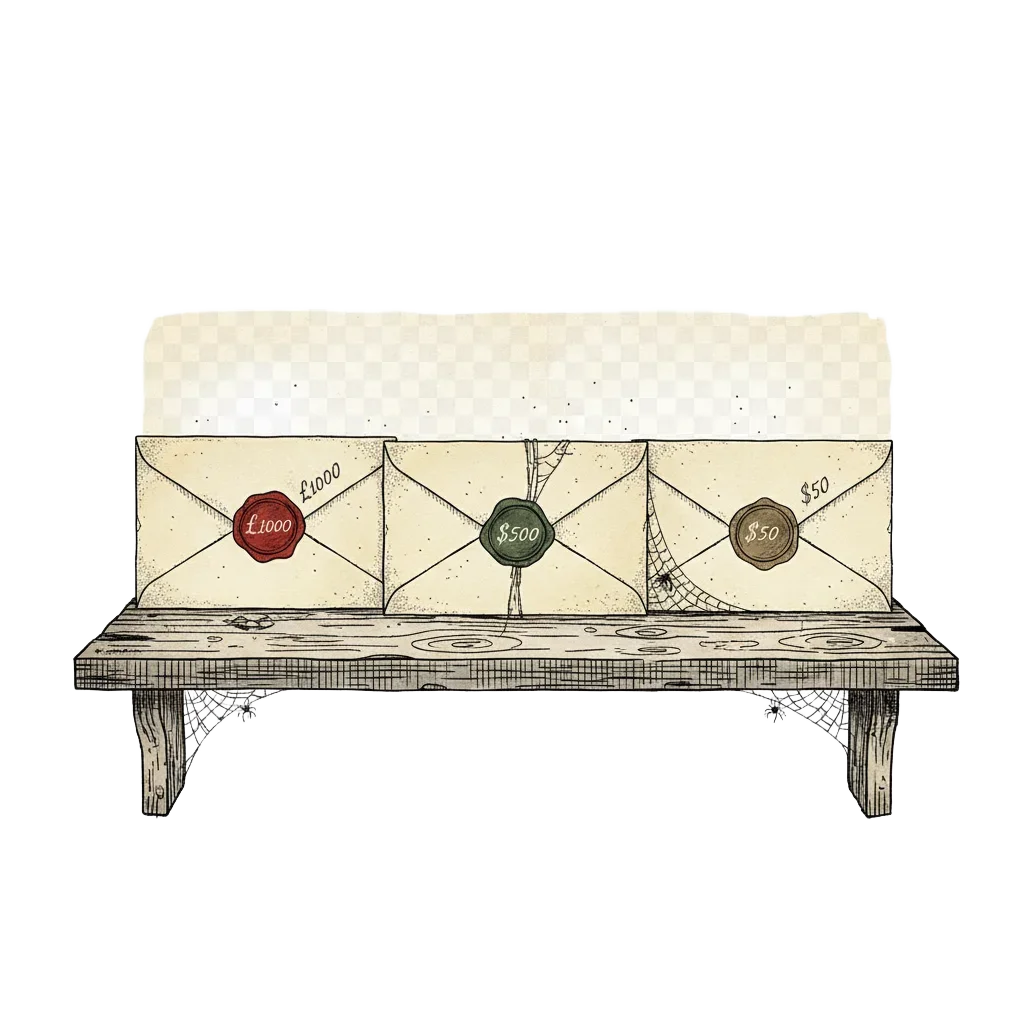
Three old envelopes labelled with prize amounts gathering dust on a shelf

Unclaimed

Prizes nobody has collected.

Over the years, rewards have been offered for solving it - including $50 from the geometer H. S. M. Coxeter in 1970, $500 from Paul Erdős, and £1,000 from the British educator Bryan Thwaites. They remain unclaimed.

Almost, for almost all

In September 2019, the mathematician Terence Tao posted a paper that made headlines.

He did not solve the problem. But he proved something remarkable about it: for almost all starting numbers, the journey eventually falls to a value that is very small compared with where it started.

Put simply: nearly every number, if you follow it long enough, gets very close to home. For example, of the numbers bigger than a quadrillion, at least 99% eventually drop below 200.

It was the biggest step forward in decades - and still not the whole answer.

As Tao put it:

"You can get as close as you want to the Collatz conjecture, but it's still out of reach."

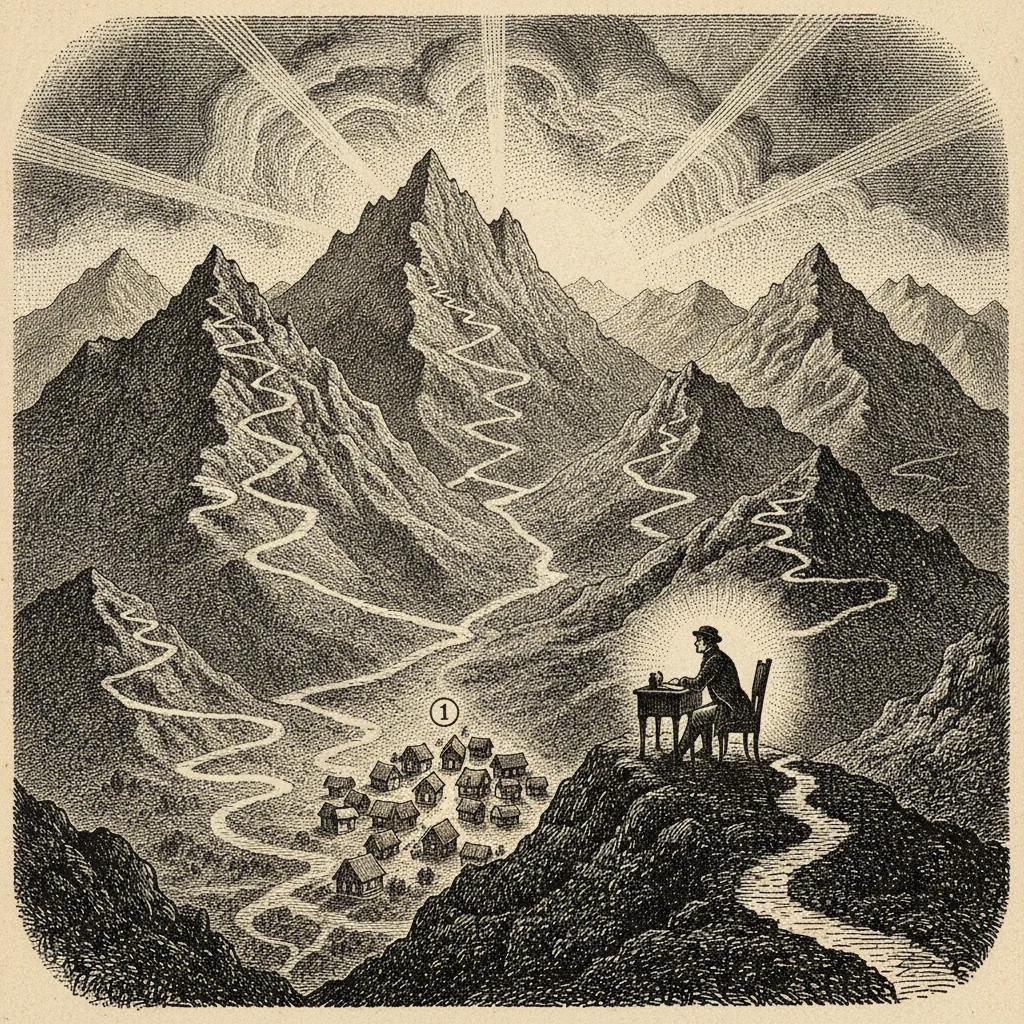
Luminous ink mountain landscape at dawn, almost every trail lit and running down to a village marked 1, a few trails still in shadow, a lone figure at a desk on a ridge looking down
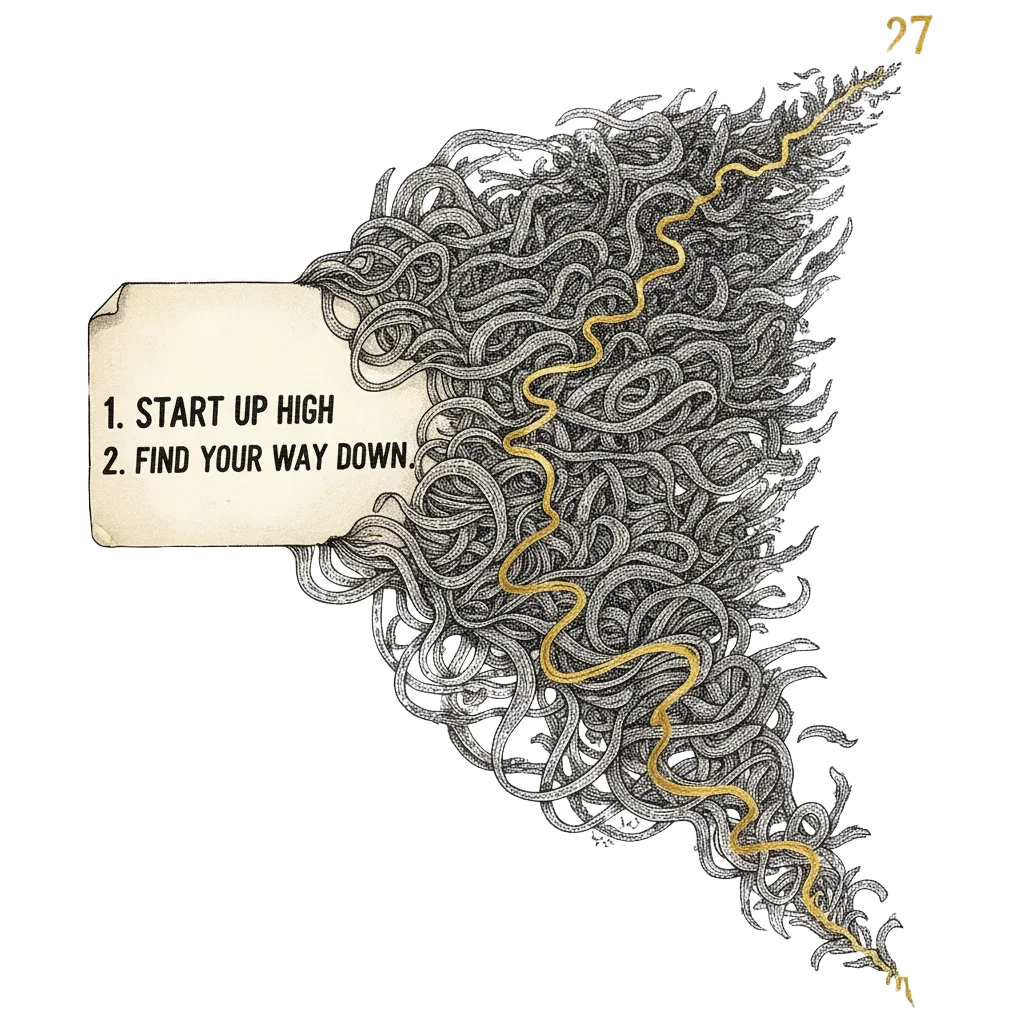
Ink illustration of a small card with two rules, from which flows a vast organic tangle of rising and falling hailstone paths like a murmuration of birds, the path of 27 highlighted in gold

Simple rules, wild journeys

The Collatz conjecture teaches one of the strangest lessons in mathematics: a simple rule does not mean a simple outcome.

Two instructions that a child can follow produce journeys so unpredictable that some of the best minds in the world cannot tame them.

Scientists see the same thing everywhere. Simple rules for how birds follow their neighbours create swirling flocks. Simple rules for weather create storms nobody can forecast weeks ahead.

27 is the clearest little window onto that idea. It is small enough to follow with a pencil on a long train journey - and unruly enough to remind us how much we still don't know.

Ink illustration of a person surrounded by towering stacks of paper with number chains, a phone on the desk not ringing

A warning, in comic form.

The web comic xkcd summed up the puzzle's pull: "The Collatz Conjecture states that if you pick a number, and if it's even divide it by two and if it's odd multiply it by three and add one, and you repeat this procedure long enough, eventually your friends will stop calling to see if you want to hang out."

27 in a nutshell

Here is why 27 matters:

01

The game: if a number is even, halve it; if it is odd, multiply by 3 and add 1. Repeat.

02

Lothar Collatz guessed in 1937 that every starting number eventually reaches 1.

03

27 takes 111 steps to get there, climbing to a peak of 9,232 at step 77.

04

Its neighbours 26 and 28 need only 10 and 18 steps.

05

Computers have checked every number up to about 2.36 × 10²¹. All reach 1.

06

In 2019, Terence Tao proved that almost all numbers get close to home - but the full conjecture is still unsolved.

"

Mathematics may not be ready for such problems.

Paul Erdős, is quoted as saying

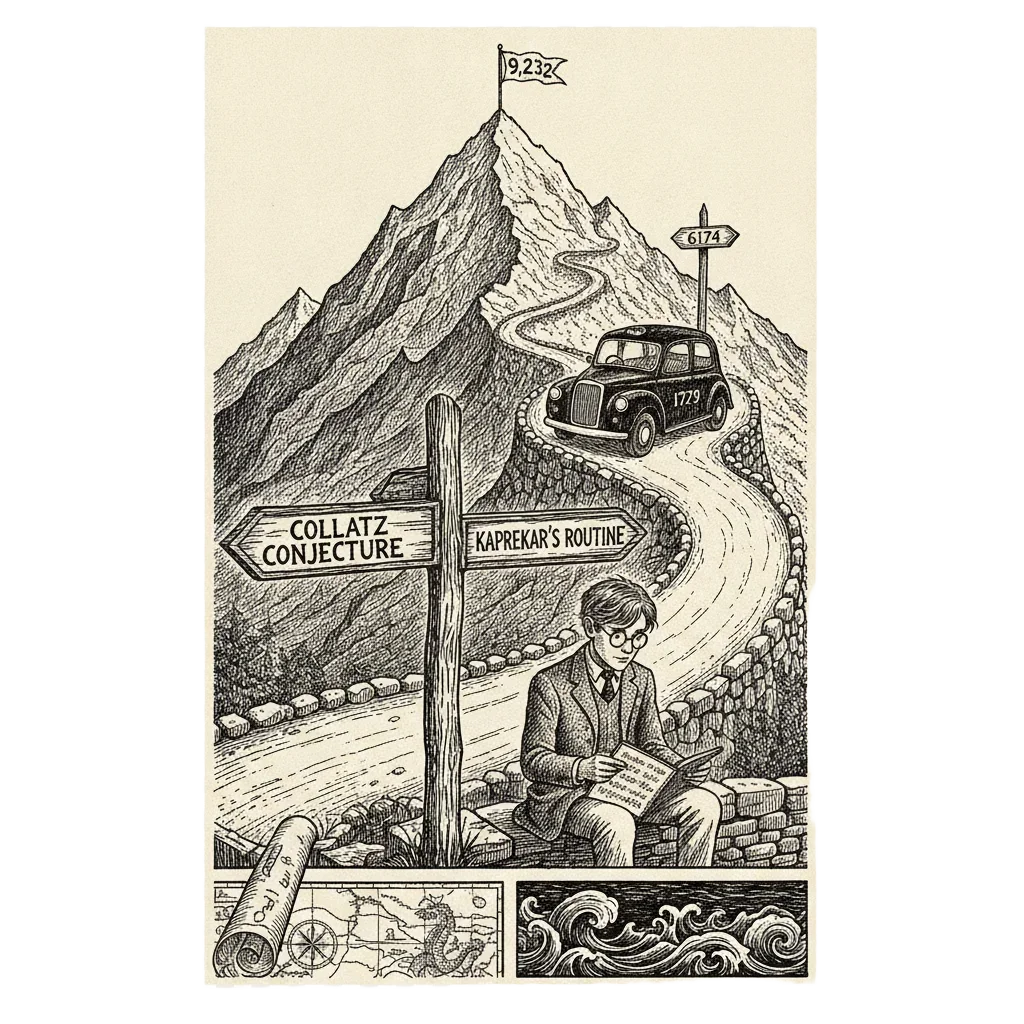
Final recap ink illustration combining the two-rule signpost, young Collatz with his notebook, the mountain journey of 27 with its 9232 summit, the 1729 taxi and 6174 signpost on the trail, and an old map with a dark ocean of unchecked numbers

Two rules a child can follow. A question no one can answer.

27 is the proof that a short journey can take the long way home.

Inspired by

Mathematics Science History Engineering Culture Cartography Computing Probability

Powered by DollarPageClub