Mathematical Curiosities
1729
The smallest number expressible as the sum of two cubes in two different ways. Hardy and Ramanujan were both in the room.
ReadComputing Limits · Exhibit No. 3
The number where computers run out of room
In December 2014, a pop song did something no hacker had managed. It made the most famous video site in the world admit it had a problem with counting. The song was "Gangnam Style." The number it was racing towards was 2,147,483,647. It is one of the most important limits in modern computing - and it has quietly broken games, airline schedules and even aeroplanes.
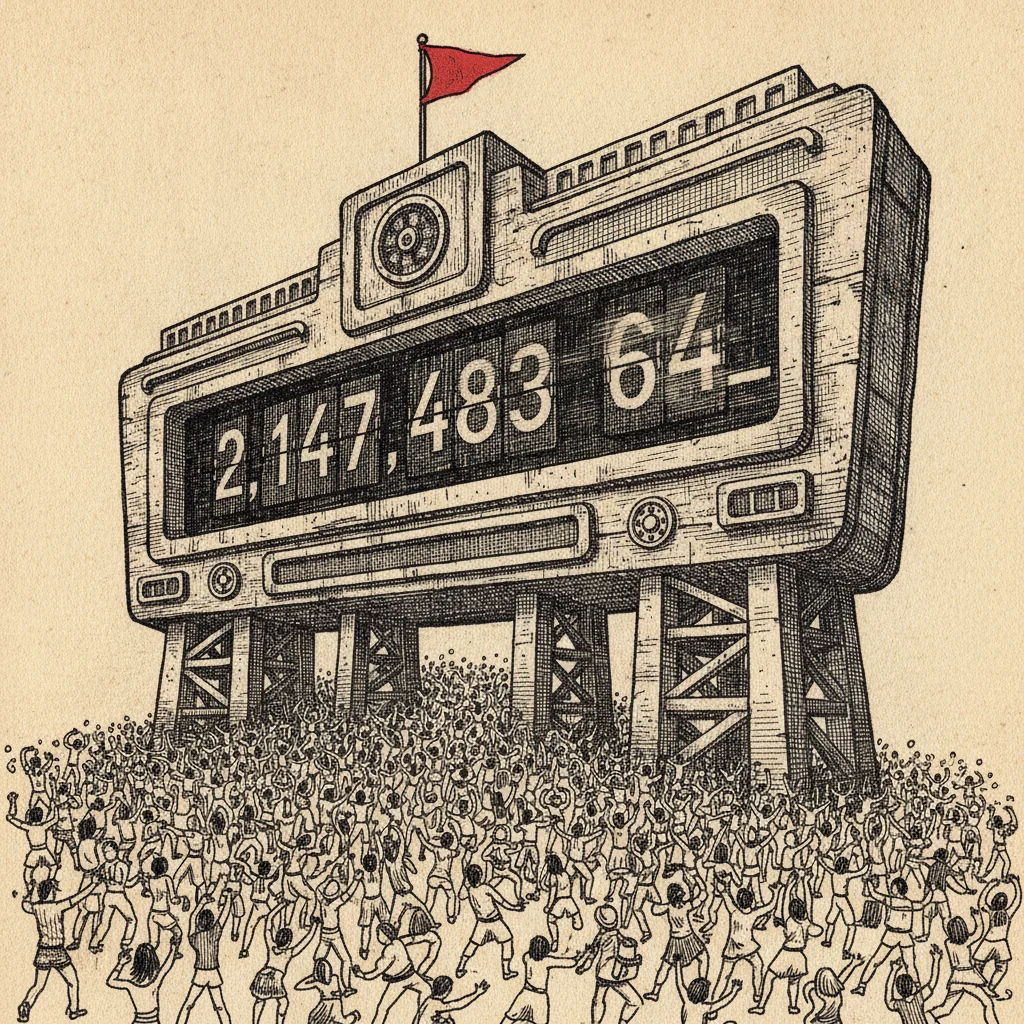
↳ a party approaching a cliff edge
PSY's "Gangnam Style" appeared on YouTube in July 2012. By December that year, it had become the first video ever to pass one billion views. It kept going.
By early December 2014, it was heading towards 2,147,483,647 views - the largest number YouTube's original view counter had been built to hold.
YouTube responded with a wink. In a post on Google+, it wrote:
"We never thought a video would be watched in numbers greater than a 32-bit integer (=2,147,483,647 views), but that was before we met PSY."
It announced that the counter had been upgraded to a far bigger one - and hovering over the view count made the digits spin wildly. In truth, YouTube's engineers had quietly made the upgrade months earlier. The "emergency" was an Easter egg.
But the limit was real. And a lot of other software has not been so lucky.

Long before computers, this number already had a claim to fame.
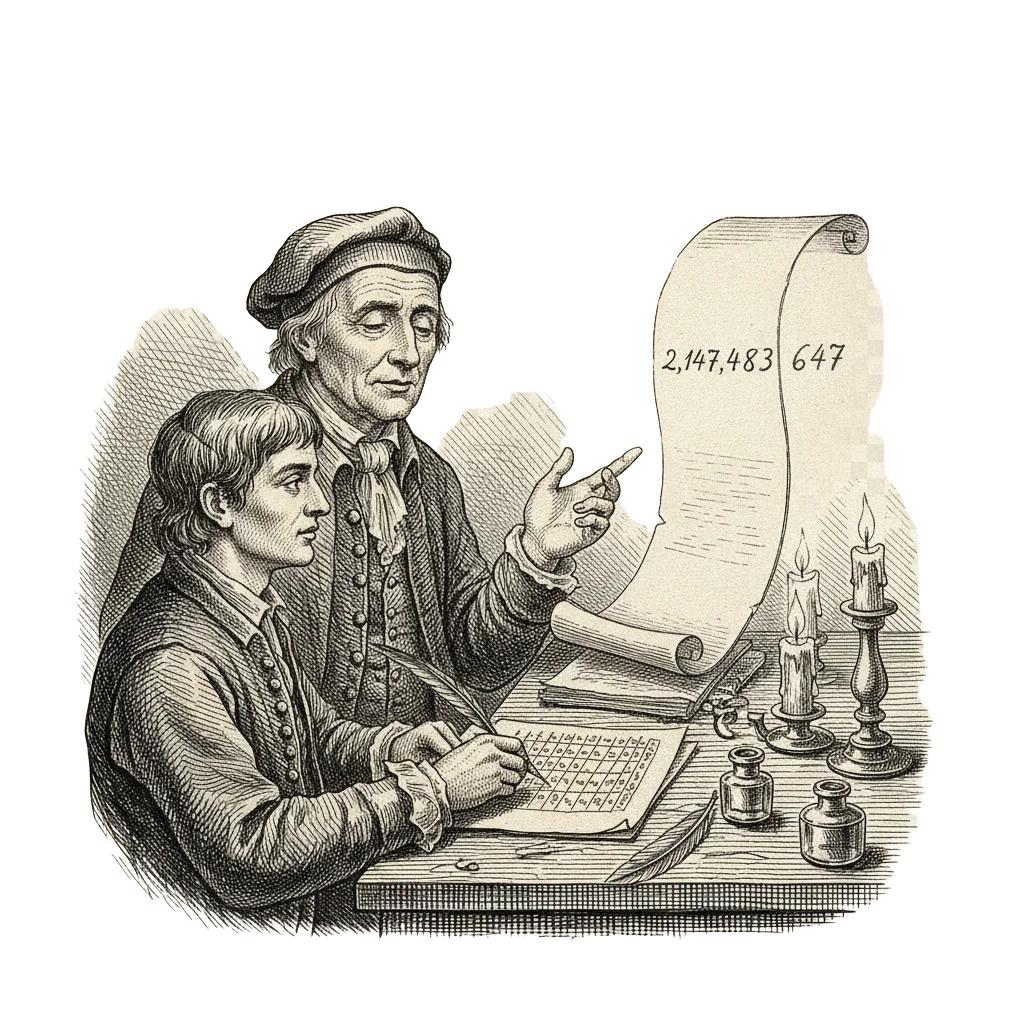
In 1772, the great Swiss mathematician Leonhard Euler set out to check whether 2,147,483,647 was a prime - a number that cannot be divided evenly by anything except 1 and itself.
Euler was, by then, almost completely blind.
Checking by brute force would have meant trying thousands upon thousands of possible divisors. But Euler used clever reasoning to show that only a few hundred special candidates could possibly divide it. He checked them - and none did.
2,147,483,647 was prime.
He reported it in a letter to a member of the famous Bernoulli family of mathematicians. For nearly a century afterwards, it was the largest prime number anyone knew.
A number made of doubling
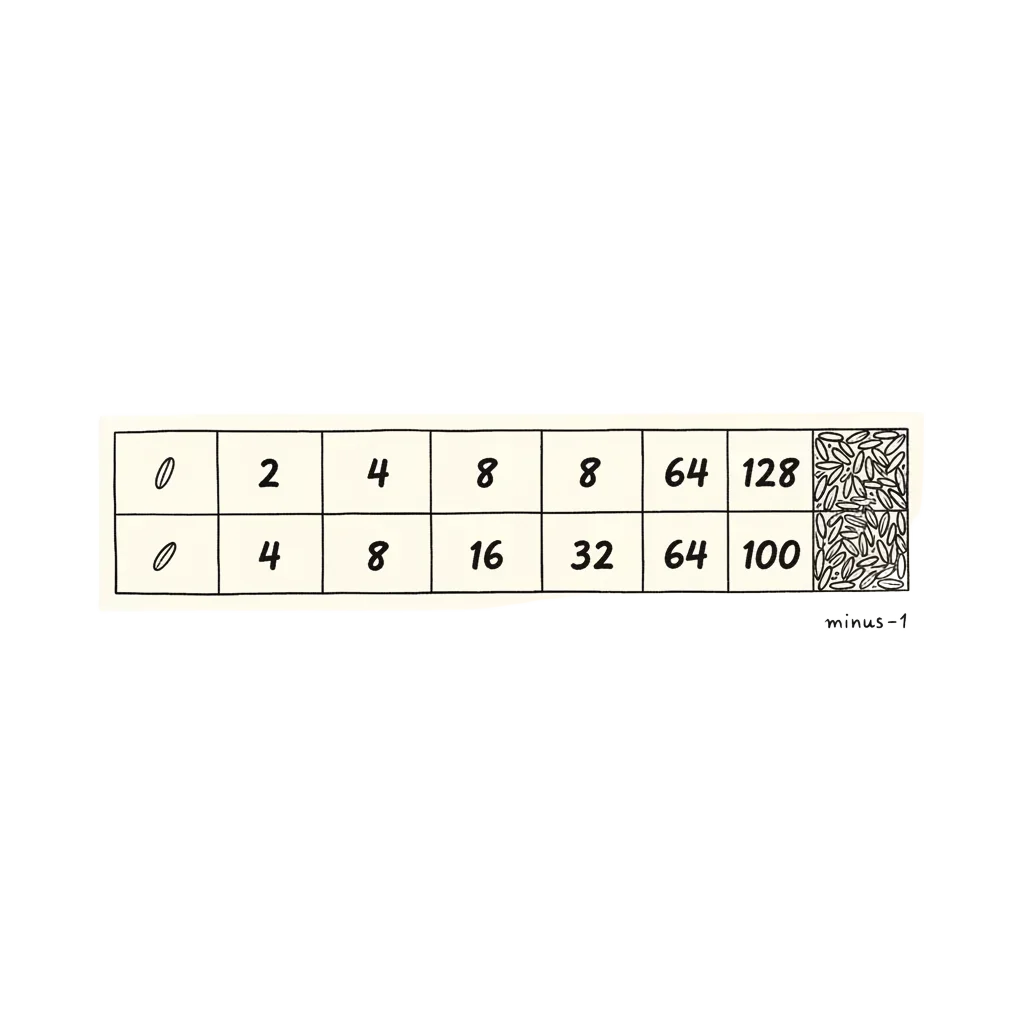
2,147,483,647 is what you get when you double 1 thirty-one times and subtract 1:
2³¹ − 1
Numbers of this shape are called Mersenne numbers, after the 17th-century French monk Marin Mersenne. The largest prime known today is one of them too.
So why did this 18th-century prime end up inside YouTube's counter? Because computers count differently from us.
We count with ten digits, 0 to 9. Computers count with just two: 0 and 1 - tiny switches that are either off or on. This is called binary.
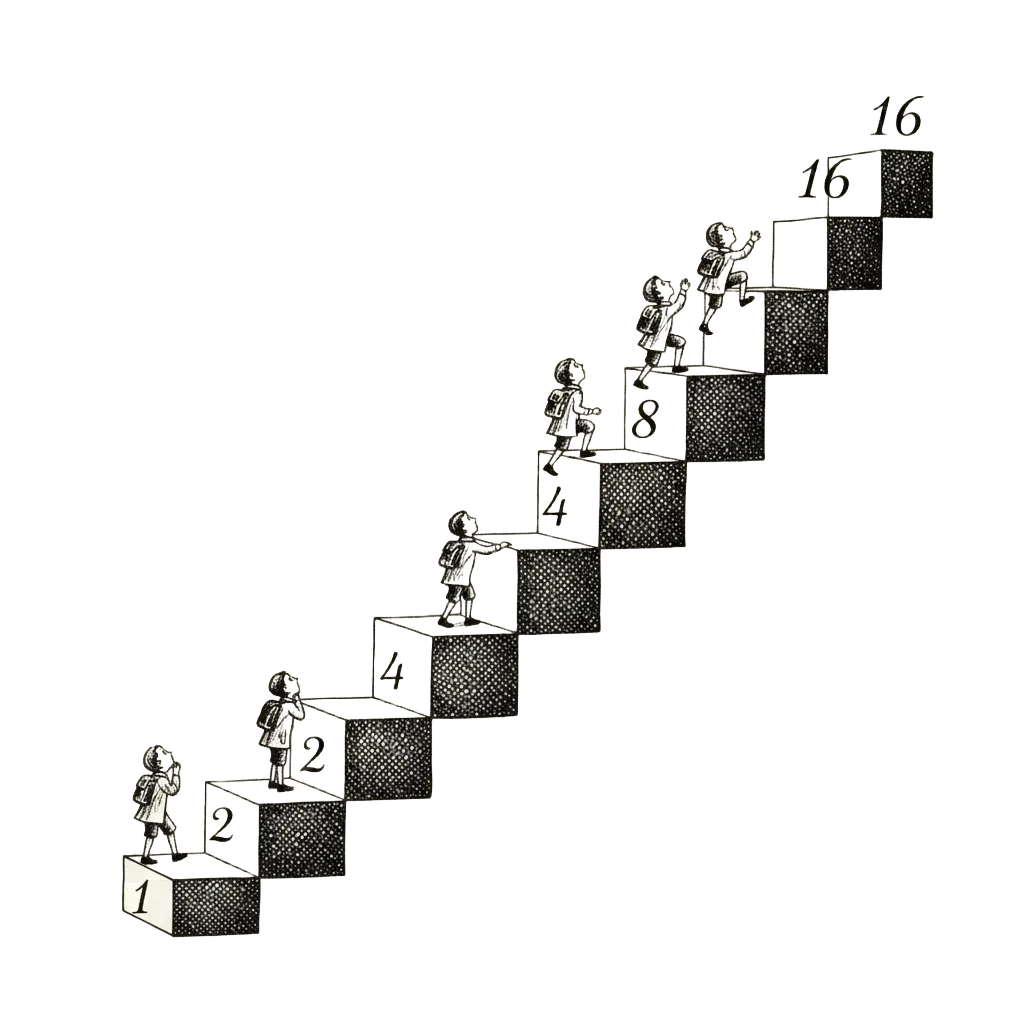
In binary, each extra place is worth double the one before: 1, 2, 4, 8, 16, 32…
Many computers store an ordinary whole number in a box of 32 of these switches. One switch is used to say whether the number is positive or negative. That leaves 31 for the number itself.
Turn all 31 switches on, and you get the biggest number the box can hold:
1111111111111111111111111111111
which, added up, is 1 + 2 + 4 + 8 + … + 1,073,741,824 = 2,147,483,647.
That is 2³¹ − 1 - Euler's prime, hiding inside almost every computer on Earth.
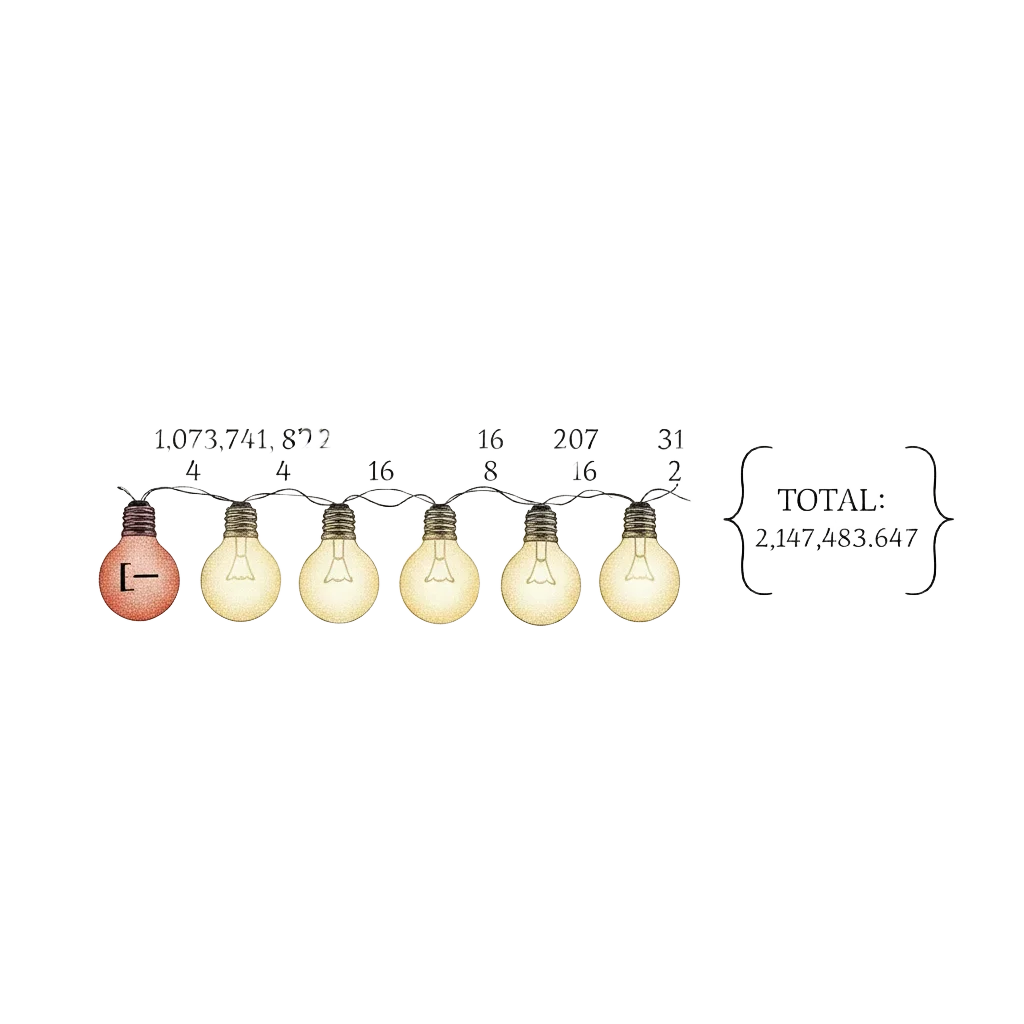
↳ 32 switches - one for the sign, 31 for the number
A sum hiding in plain sight
Just like 5,050 is secretly 1 + 2 + 3 + … + 100, 2,147,483,647 is secretly 1 + 2 + 4 + 8 + … all the way up to 1,073,741,824 - thirty-one doublings added together.
Think of the mileage counter in an old car - the odometer.
If it has six digits, the highest it can show is 999,999. Drive one more mile, and every wheel rolls over at once. It does not say 1,000,000. It says 000,000. As far as the car knows, it is brand new.
Computers do the same thing, with a twist.
Add 1 to 2,147,483,647, and all the switches roll over - including the one that means "plus or minus." The number does not become 2,147,483,648.
It becomes −2,147,483,648.
The biggest positive number, plus one, turns into the biggest negative number. Programmers call this overflow.
Imagine a bank balance, a game score, or a timer suddenly jumping from over two billion to minus two billion. That is what overflow can do.
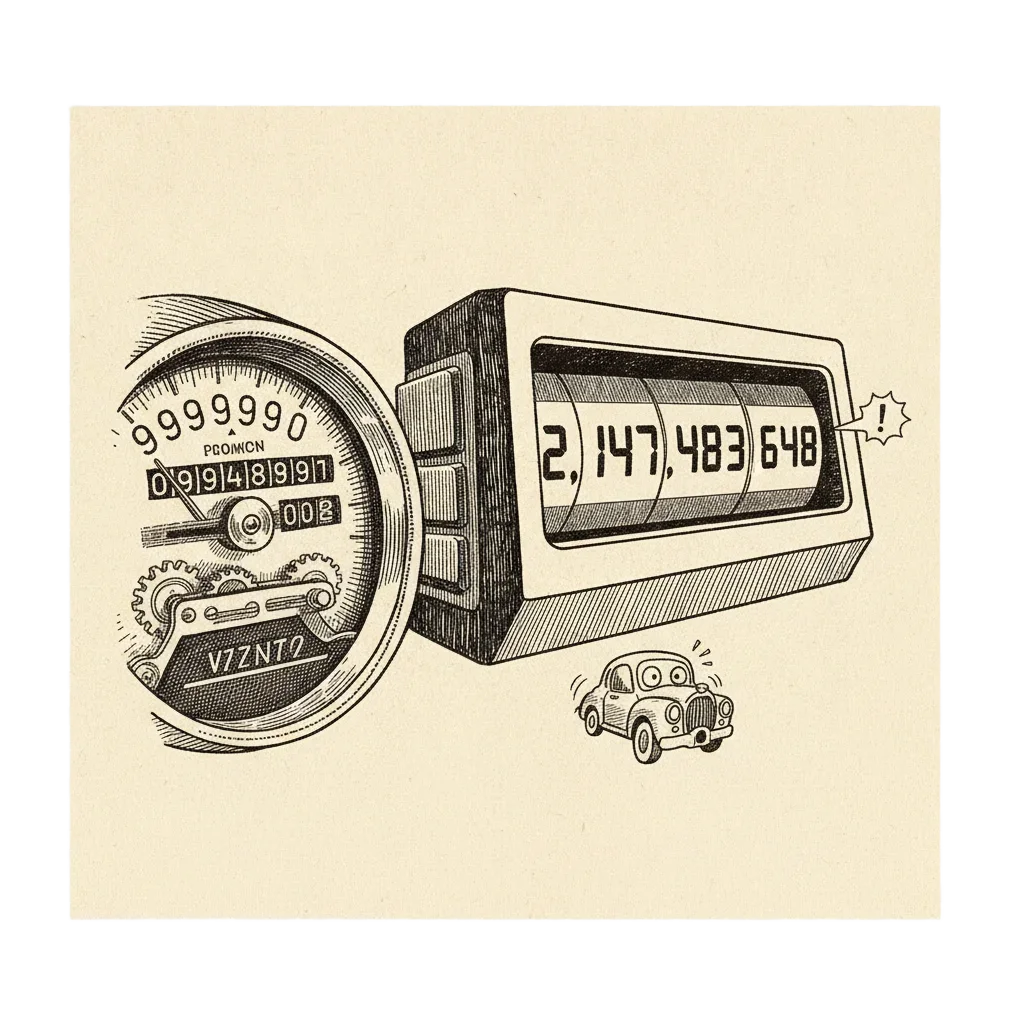
↳ the odometer rolls over - computers do exactly the same
Overflow is not just a theory. Real systems have hit this wall.
An airliner that needed switching off.
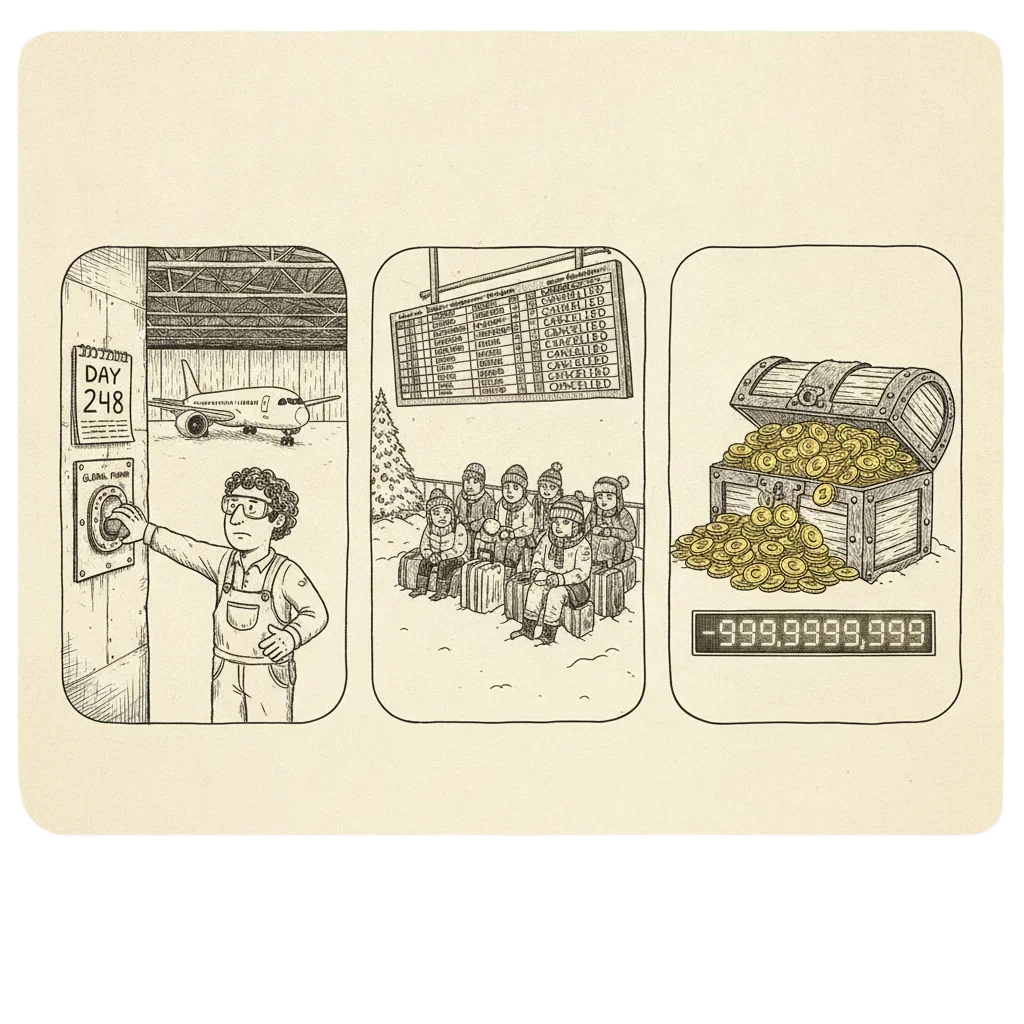
In 2015, US aviation authorities warned that a Boeing 787 left powered on continuously for 248 days could lose all its main electrical power, because a software counter in its generator controls would overflow. Boeing found it in laboratory testing; the fix, until new software arrived, was to switch the planes off and on again regularly. And 248 days is a telling number. A counter that ticks 100 times a second reaches 2,147,483,647 after almost exactly 248.55 days.
An airline at Christmas.
In December 2004, the US regional airline Comair saw its crew-scheduling computer collapse during a winter storm. The system could only record a limited number of schedule changes in a month - reported as 32,768, the limit of a smaller, 16-bit counter. The storm forced so many changes that it hit the limit on Christmas Eve. Around 1,100 flights were cancelled and tens of thousands of passengers were stranded.
Games with a ceiling.
In many video games, 2,147,483,647 is the most gold, coins or points a player can hold. Push past it, and players sometimes see their fortune flip into a giant negative number.
A date to remember: 2038
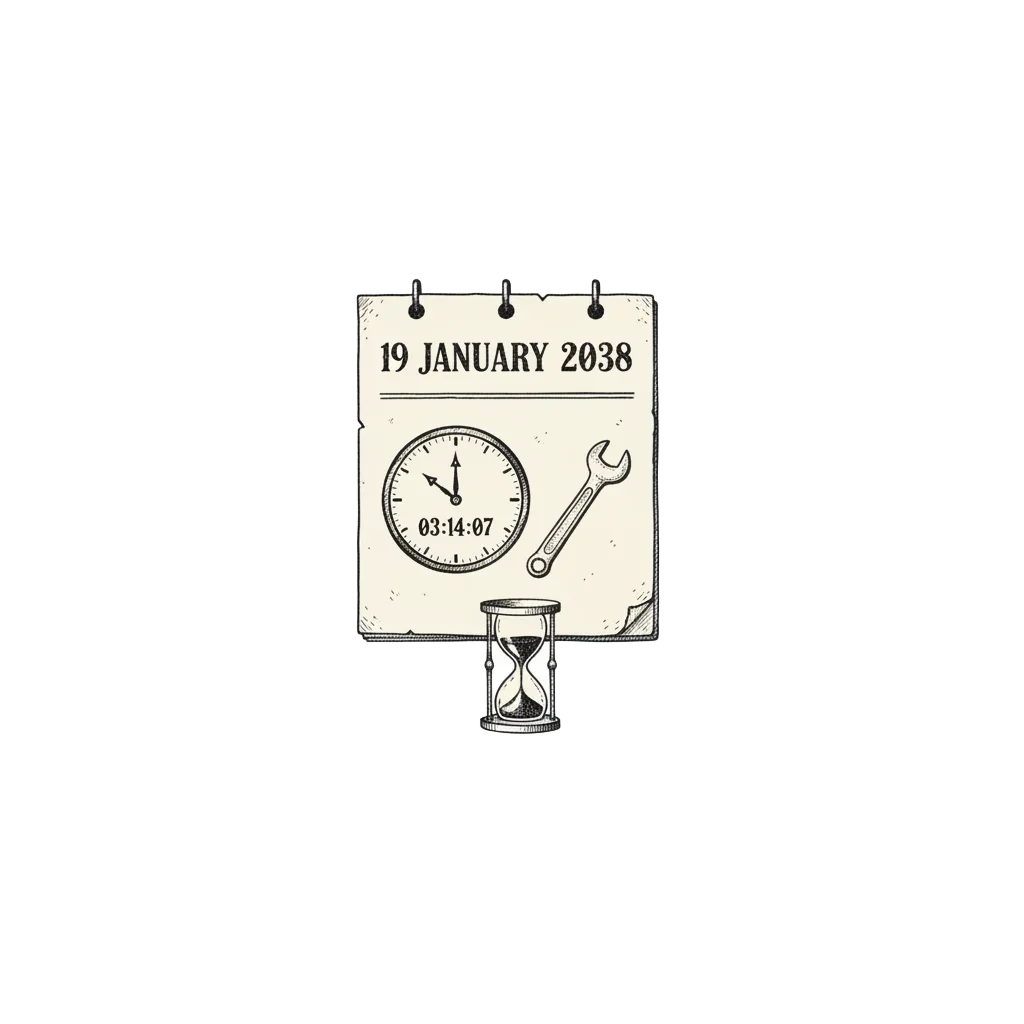
Many computers count time as the number of seconds since the start of 1970. Stored in a 32-bit box, that count reaches 2,147,483,647 at exactly 03:14:07 UTC on 19 January 2038. One second later, old systems that have not been updated could think it is 1901. Engineers have been fixing this - quietly - for years.
Today, most new software does exactly that.
The next common size up is 64 switches instead of 32. Doubling the number of switches does not double the limit - it multiplies it by more than four billion.
The biggest number a 64-bit box can hold is 9,223,372,036,854,775,807 - over nine billion billion.
That is the kind of counter YouTube switched to. At that size, every person on Earth could watch "Gangnam Style" ten times a day, every day, for 300,000 years - about as long as our species has existed - and still not reach the top.
But every box, however big, has a top.
That is the bigger idea behind 2,147,483,647: computers do not really do infinity. Every number inside a machine lives in a box of fixed size, and somebody had to decide how big that box would be.
Most of the time, nobody notices. Until something - a song, a storm, a plane left switched on - counts a little too far.
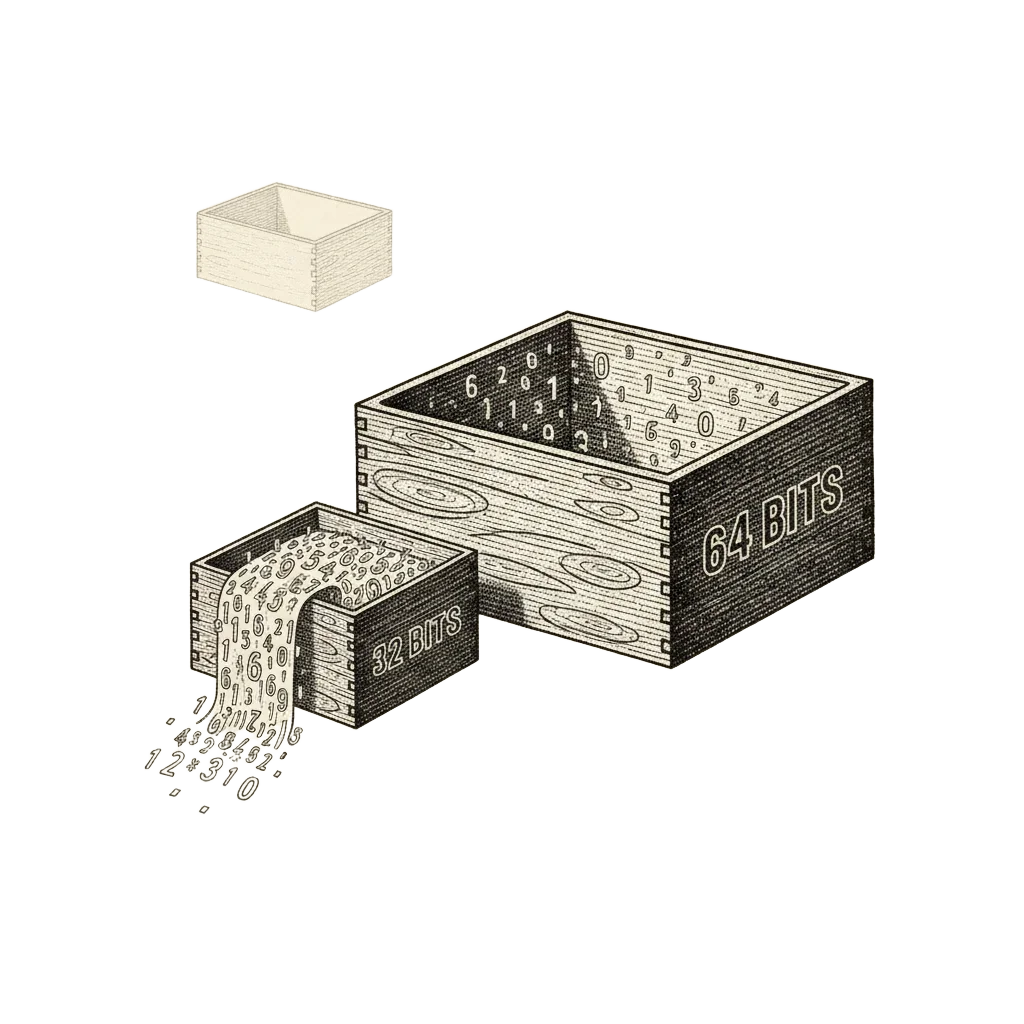
↳ every box, however big, has a top
Programmers recognise 2,147,483,647 at a glance. It turns up in error messages, bug reports and game glitches the world over.
It is remembered because it sits at the crossroads of two very different stories: a blind mathematician in 1772, proving it was prime by pure thought - and the modern world, where it became the invisible ceiling inside billions of machines.
It is a reminder that computers are not magic. They are extremely fast counters, working inside limits that humans chose.
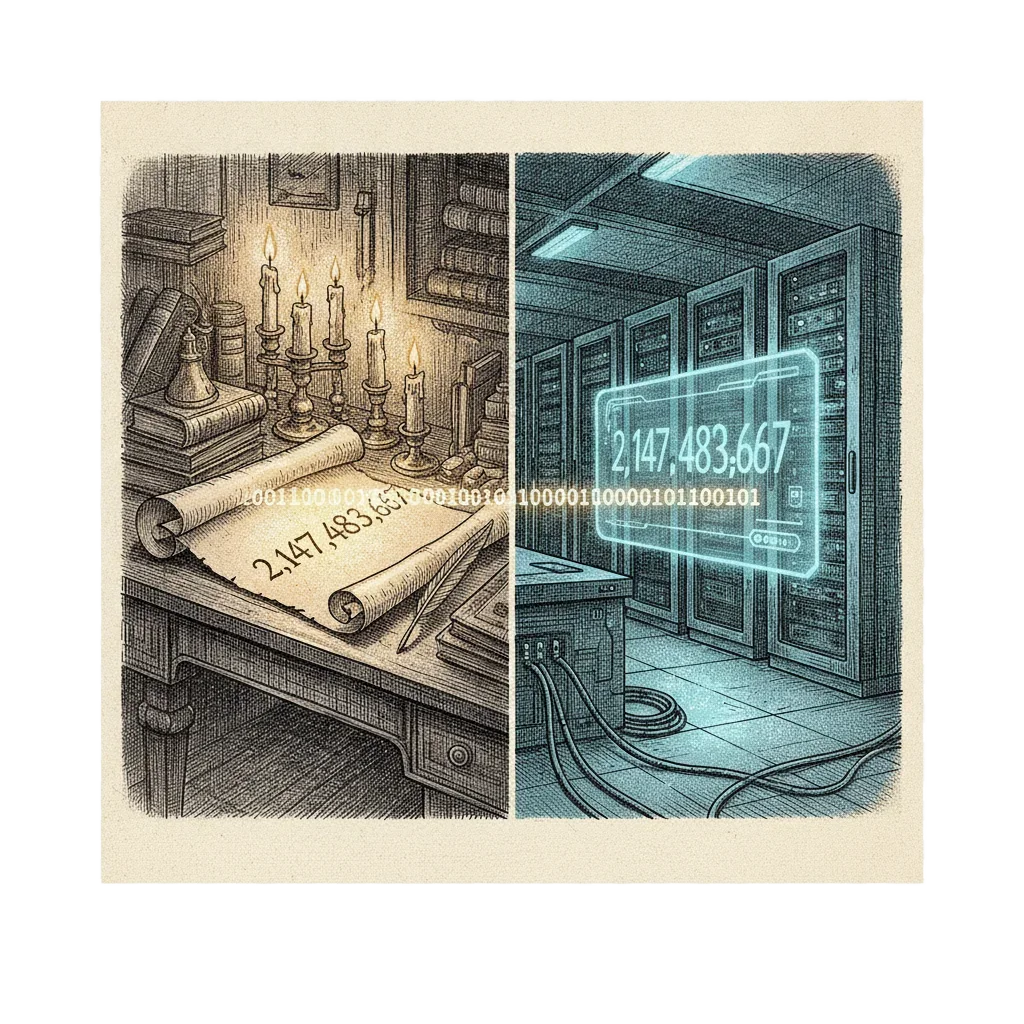
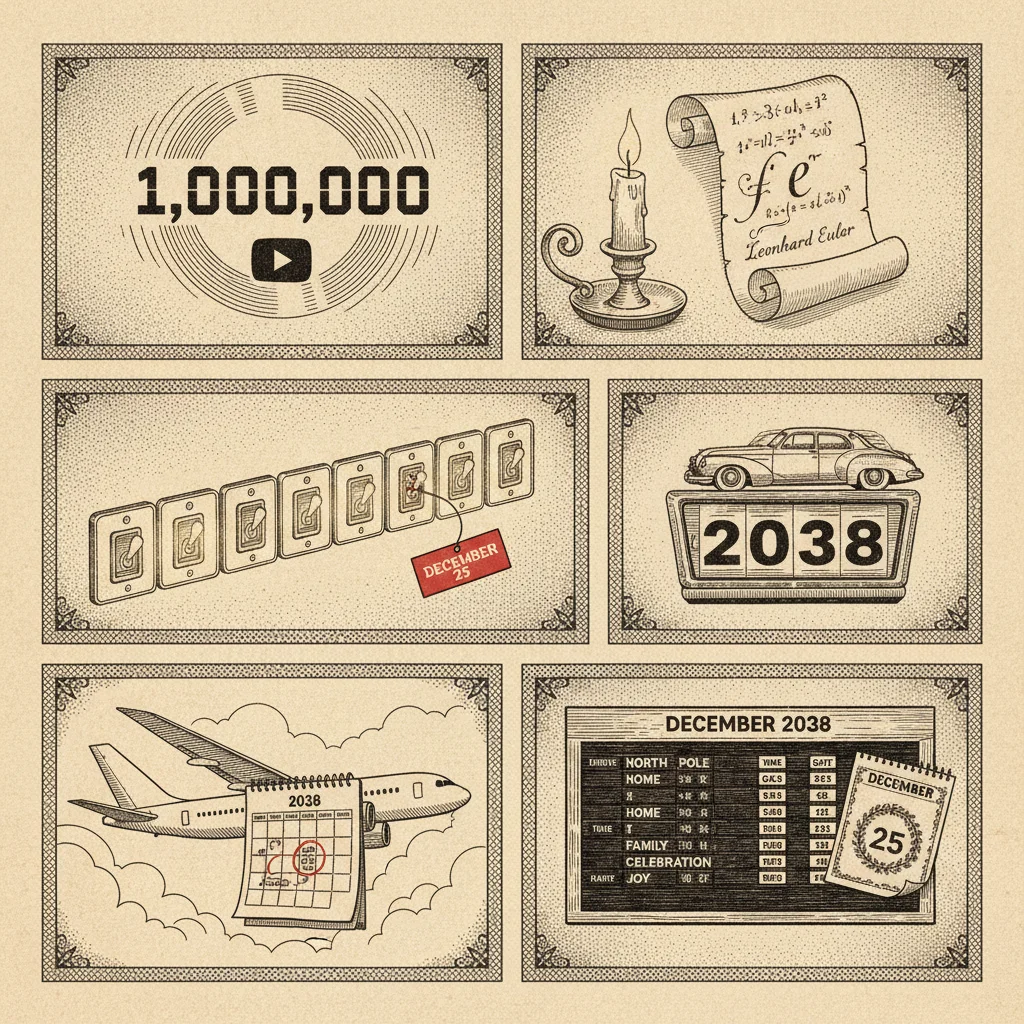
Here is why 2,147,483,647 matters:
It is 2³¹ − 1: the largest number that fits in a standard signed 32-bit computer integer.
Add 1, and it overflows to −2,147,483,648, like an odometer rolling over.
In 1772, a nearly blind Leonhard Euler proved it is prime; it stayed the largest known prime for nearly a century.
In 2014, "Gangnam Style" approached it on YouTube, which joked about upgrading to a 64-bit counter.
A Boeing 787 counter would overflow after 248 days of continuous power.
Many systems that count seconds from 1970 will reach it on 19 January 2038.
Not a crash. Not a hack. Just one more than the box could hold.
Sometimes a computer fails simply because it has run out of numbers.
- The Oddly Specific Numbers Desk
Powered by DollarPageClub