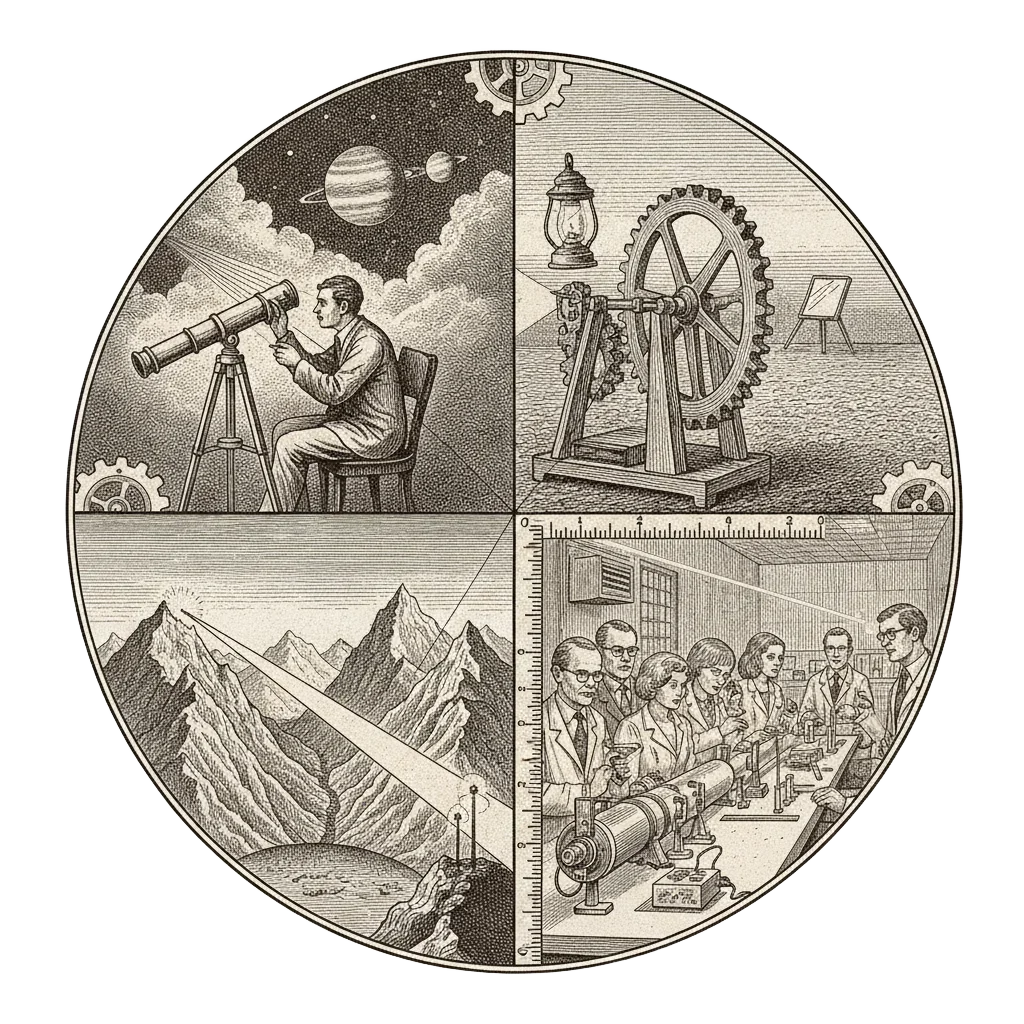
Physics & Constants - Exhibit No. 003
The speed we turned into a ruler
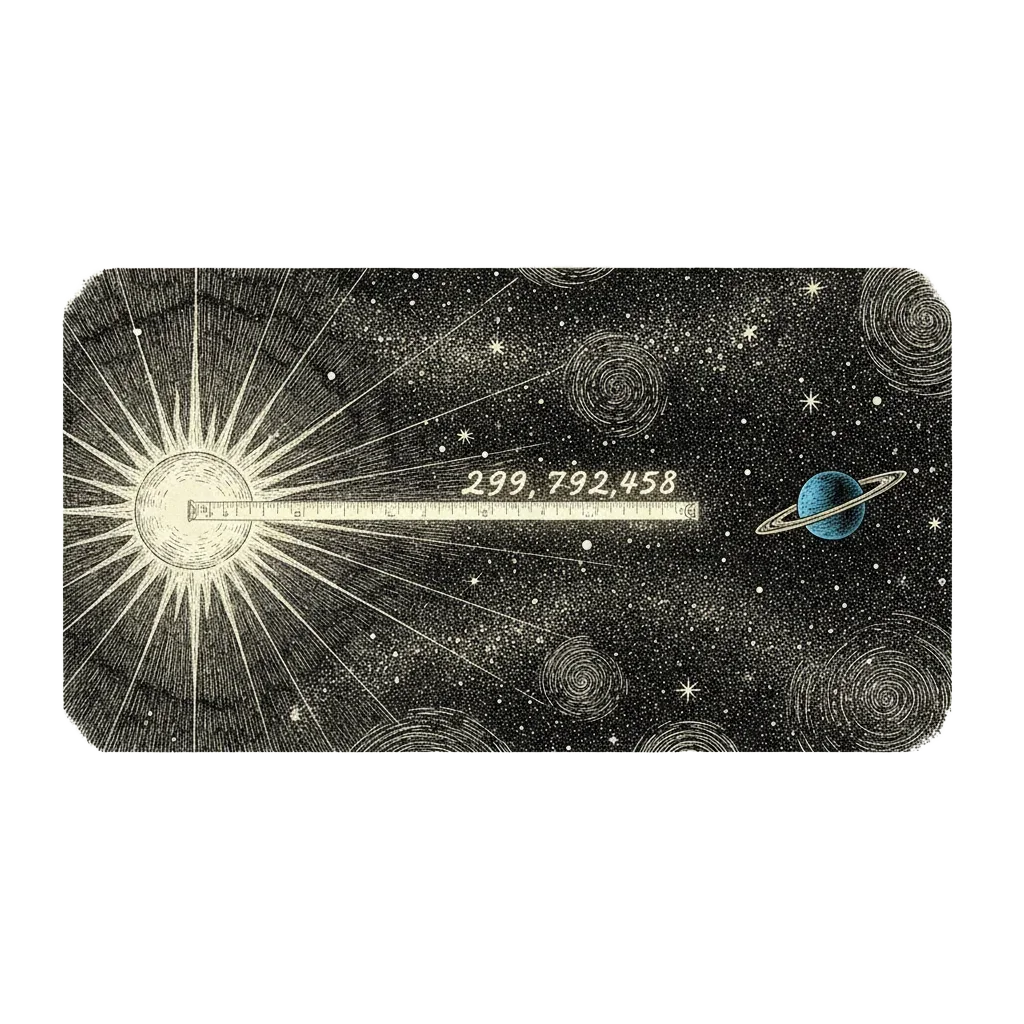
Light travels at 299,792,458 metres per second in a vacuum. Not roughly. Not "about". Exactly.
No experiment will ever change that number - not because we have measured light perfectly, but because in 1983 we decided to measure everything else by it.
This is the story of how the fastest thing in the universe became our ruler.
Chapter 1
For most of history, people assumed light was instant. You open your eyes, and the world is simply there.
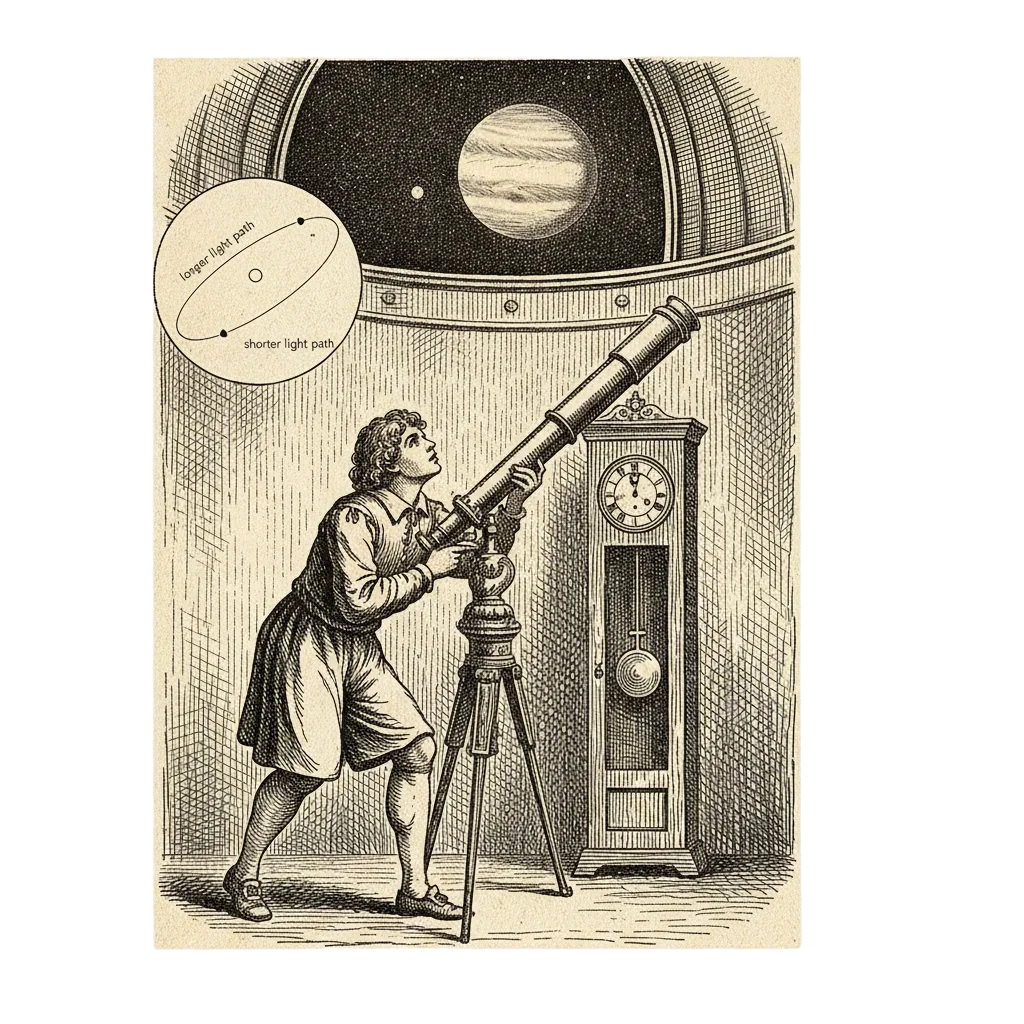
Then, in the 1670s, a young Danish astronomer named Ole Rømer was working at the Paris Observatory, timing the little moon Io as it slipped in and out of Jupiter's shadow.
Io should have disappeared like clockwork. But it didn't.
When Earth was moving away from Jupiter, the eclipses came late. When Earth was moving towards it, they came early.
In 1676, Rømer made a bold prediction: an upcoming eclipse of Io would be about ten minutes late.
His explanation was simple and astonishing. The clock in the sky was fine. It was the light from Jupiter that took time to reach us - and when Earth was farther away, the light had farther to travel.
Light, it turned out, had a speed.
Margin Note
The man who timed light, then lit the streets.
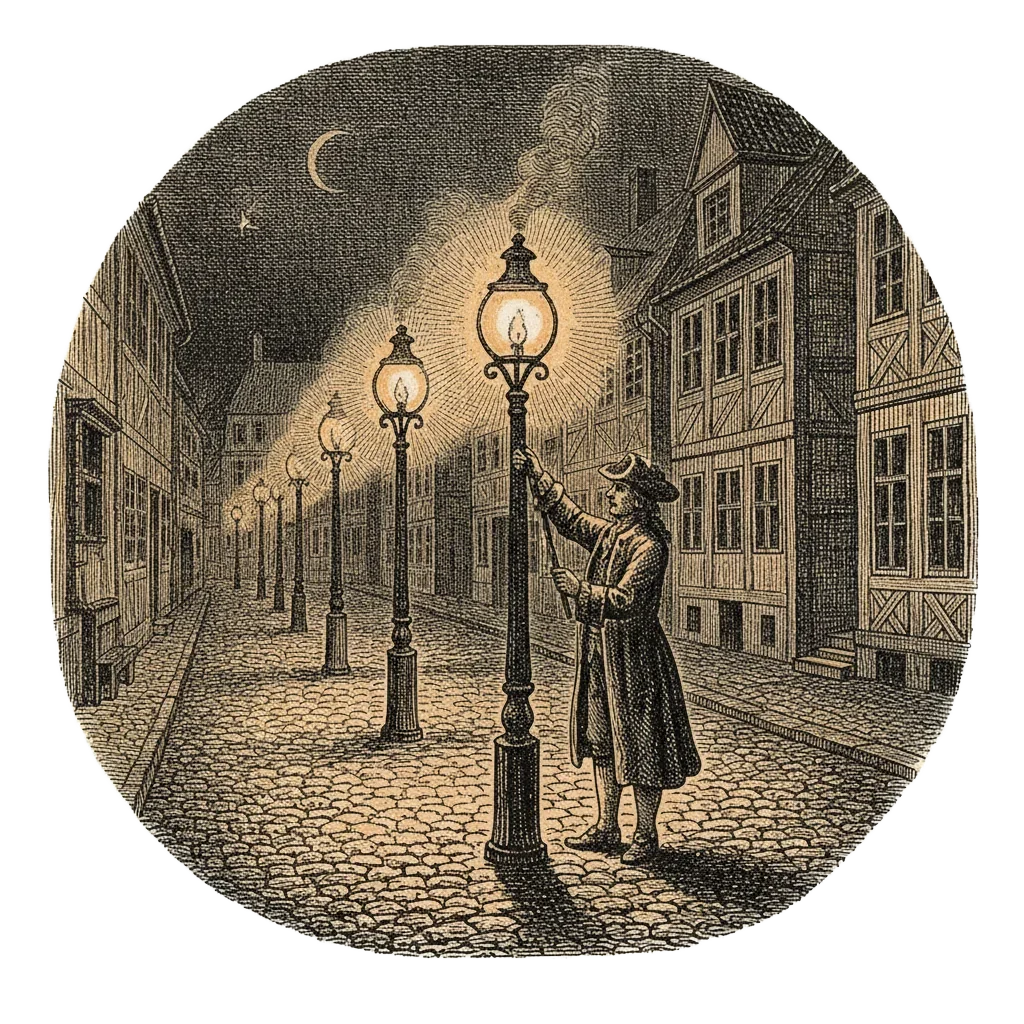
Rømer later went home to Denmark and, in 1705, became chief of police in Copenhagen. He is said to have fired the whole police force, and he brought in the city's first street lights: oil lamps along the streets.
Chapter 2
Knowing light had a speed was one thing. Measuring it on Earth was another.
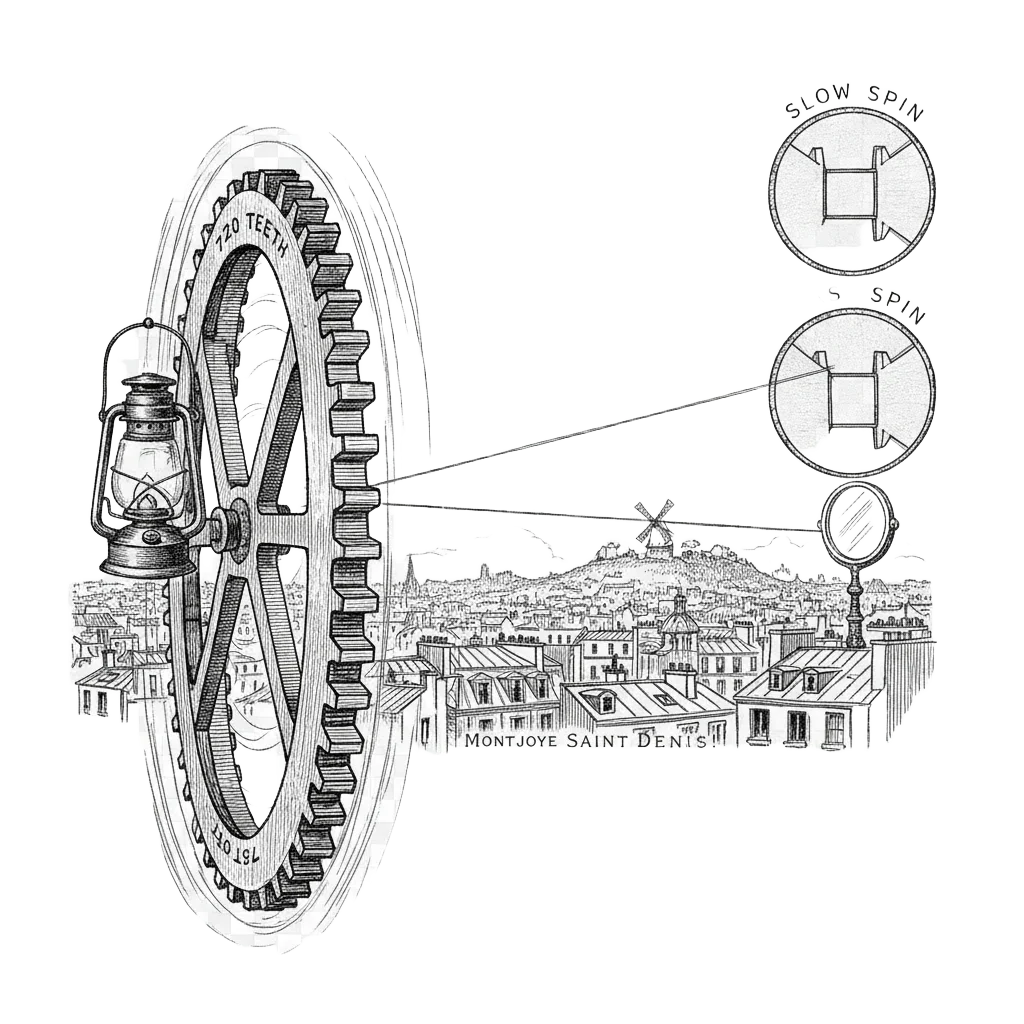
In 1849, the French physicist Hippolyte Fizeau built an ingenious machine in the bell tower of his family's house in Suresnes, just outside Paris.
He shone a beam of light through the gaps of a spinning toothed wheel, with 720 teeth, out to a mirror more than 8 kilometres away on the hill of Montmartre, and back again.
Spin the wheel slowly, and the returning light passes back through the same gap. Spin it just fast enough, and the returning light hits a tooth instead - and vanishes.
From how fast the wheel was spinning when the light disappeared, Fizeau could work out how long the round trip took.
His answer came out at about 313,000 kilometres per second - too high by less than five percent, but an astonishing achievement for a spinning wheel and a mirror on a hill.
A Museum Coincidence
Bradley, starlight, and a familiar number.
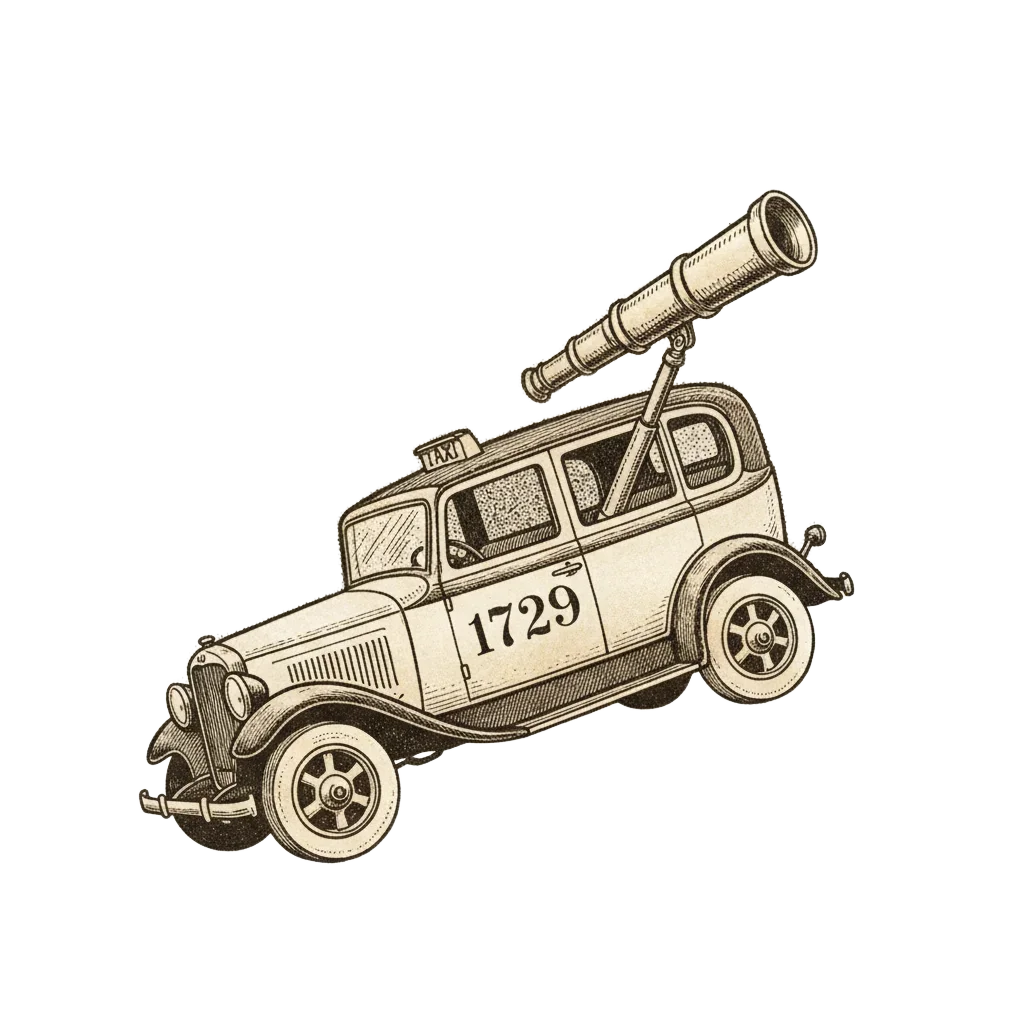
Before anyone measured light on Earth, the English astronomer James Bradley found another way to time it from the sky, by noticing the stars shift slightly as Earth moves along its orbit. He published his result in 1729 - the same number as the museum's famous taxi.
See the 1729 exhibitChapter 3
For the next eighty years, one man became almost obsessed with this number.
Albert Michelson began measuring the speed of light as a young instructor at the US Naval Academy, publishing his first result in 1879. He refined the method again and again for the rest of his life.
In 1907, he became the first American to win a Nobel Prize in the sciences, for his precision optical instruments and the measurements he made with them.
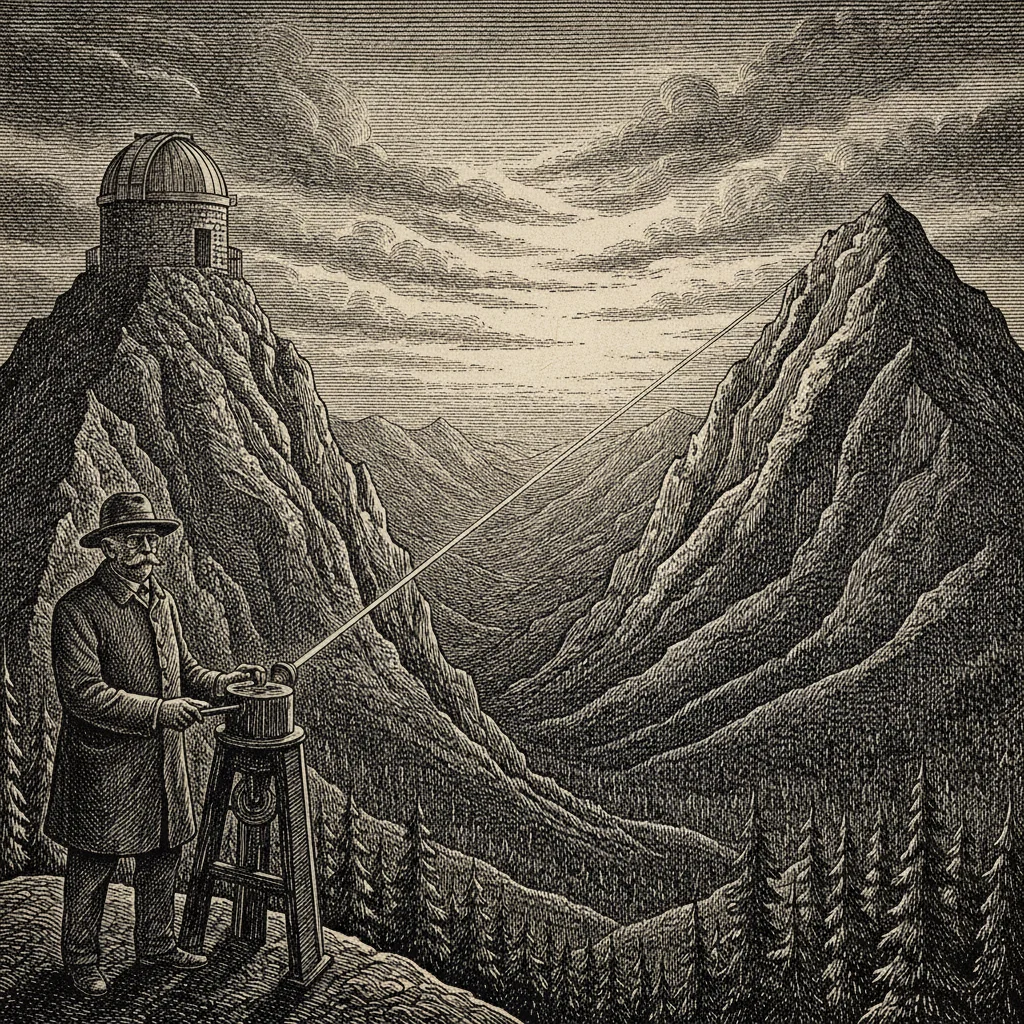
In the 1920s, he fired light between two mountain tops in California - from Mount Wilson to Mount San Antonio, about 35 kilometres away - and measured its speed at 299,796 kilometres per second, give or take 4.
That was less than 4 kilometres per second away from the value we use today.
"A lifetime spent chasing one number, with instruments made by hand, across valleys wide enough to lose a cloud in."
- The Oddly Specific Numbers Desk
Chapter 4
By the 20th century, a strange problem was creeping up on scientists.
The speed of light was being measured in metres per second. But what, exactly, is a metre?
For a long time it was a metal bar kept in a vault near Paris. Later it was defined using the wavelength of light given off by krypton atoms.
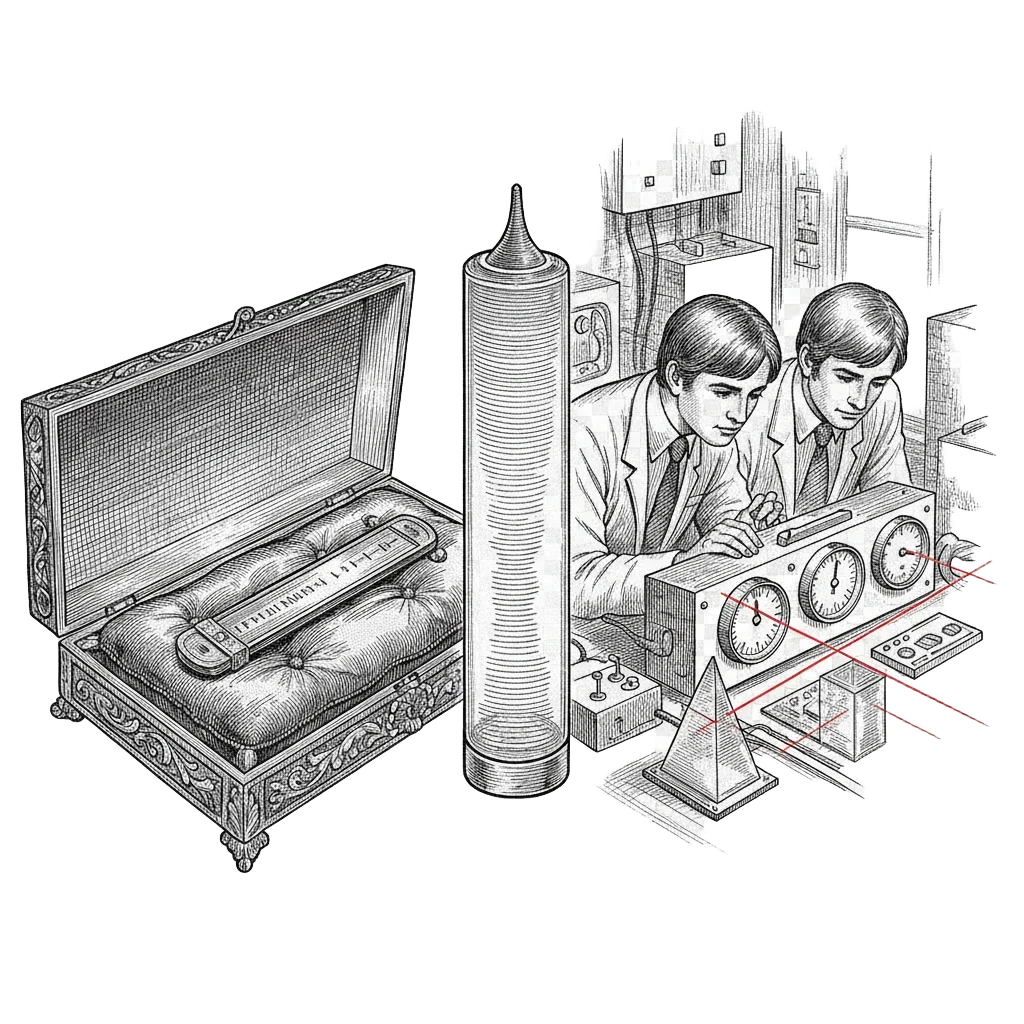
Then, in 1972, a team at the US National Bureau of Standards in Boulder, Colorado, led by Kenneth Evenson, used a laser to measure the speed of light more precisely than ever: 299,792,456.2 metres per second, uncertain by only about one metre per second.
Their measurement was so precise that the weak link was no longer light. It was the metre itself. The krypton definition was too fuzzy to keep up.
Scientists were measuring light with a ruler that was blurrier than the thing they were measuring.
Chapter 5
So the scientists did something extraordinary.
They stopped trying to measure the speed of light - and used it to define the metre instead.
In 1975, the international conference on weights and measures recommended one value for the speed of light in a vacuum: 299,792,458 metres per second.
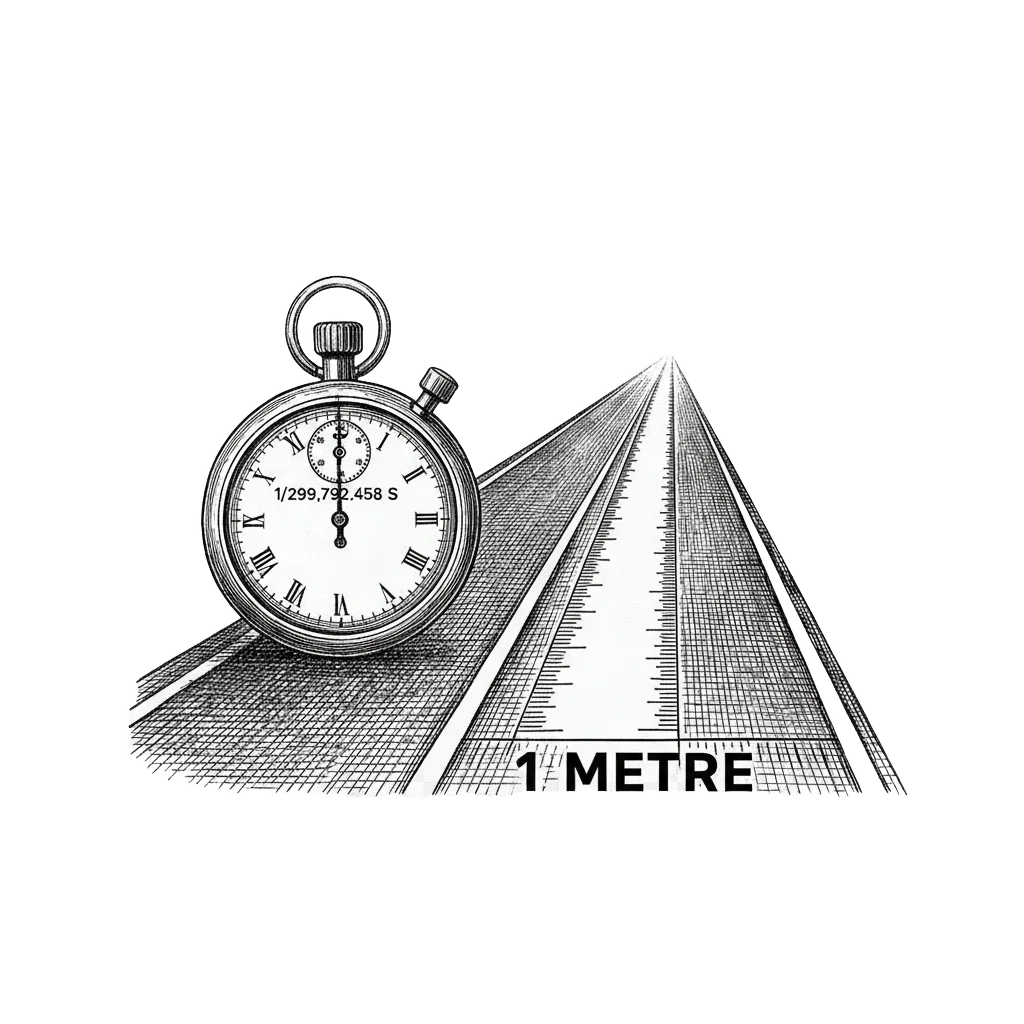
In 1983, it became official. The metre was redefined as:
The 1983 Definition
The metre is the distance light travels in a vacuum in
1 / 299,792,458
of a second.
From that moment, the speed of light stopped being something to discover. It became exact by definition.
If a future experiment ever seems to show light going at a different speed in a vacuum, it will not change that number. It will mean our metre sticks need recalibrating.
Chapter 6
Why 299,792,458, and not a neat round 300,000,000?
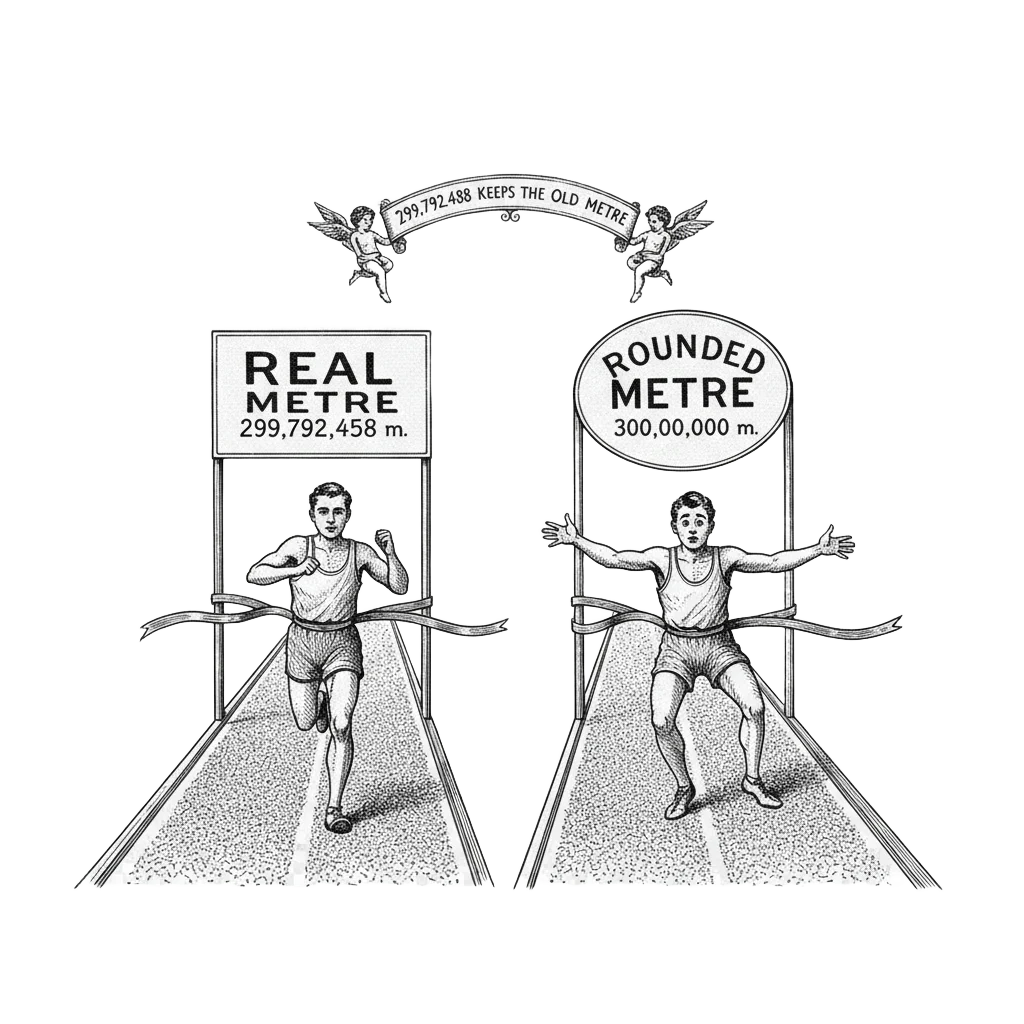
Because the new metre had to be the same length as the old one.
Every ruler, every map, every building plan and every running track in the world was already measured in metres. If the value had been rounded to 300 million, every metre would have shrunk by about 0.7 millimetres. That sounds tiny, but over a 100-metre sprint it adds up to nearly 7 centimetres - enough to throw off everything from engineering to athletics records.
So scientists chose the number that best matched the old, krypton-based metre and the best laser measurements of the day. The 1972 measurement had found 299,792,456.2, give or take about a metre per second; the value fixed for the future was 299,792,458.
The number looks untidy. That untidiness is the fingerprint of history - a promise that the metre you use today is the same metre your grandparents used.
0.7 mm
the shortfall per metre if rounded to 300,000,000
~7 cm
total shortfall over a 100-metre sprint
exact
status of 299,792,458 since 1983, by definition
Chapter 7
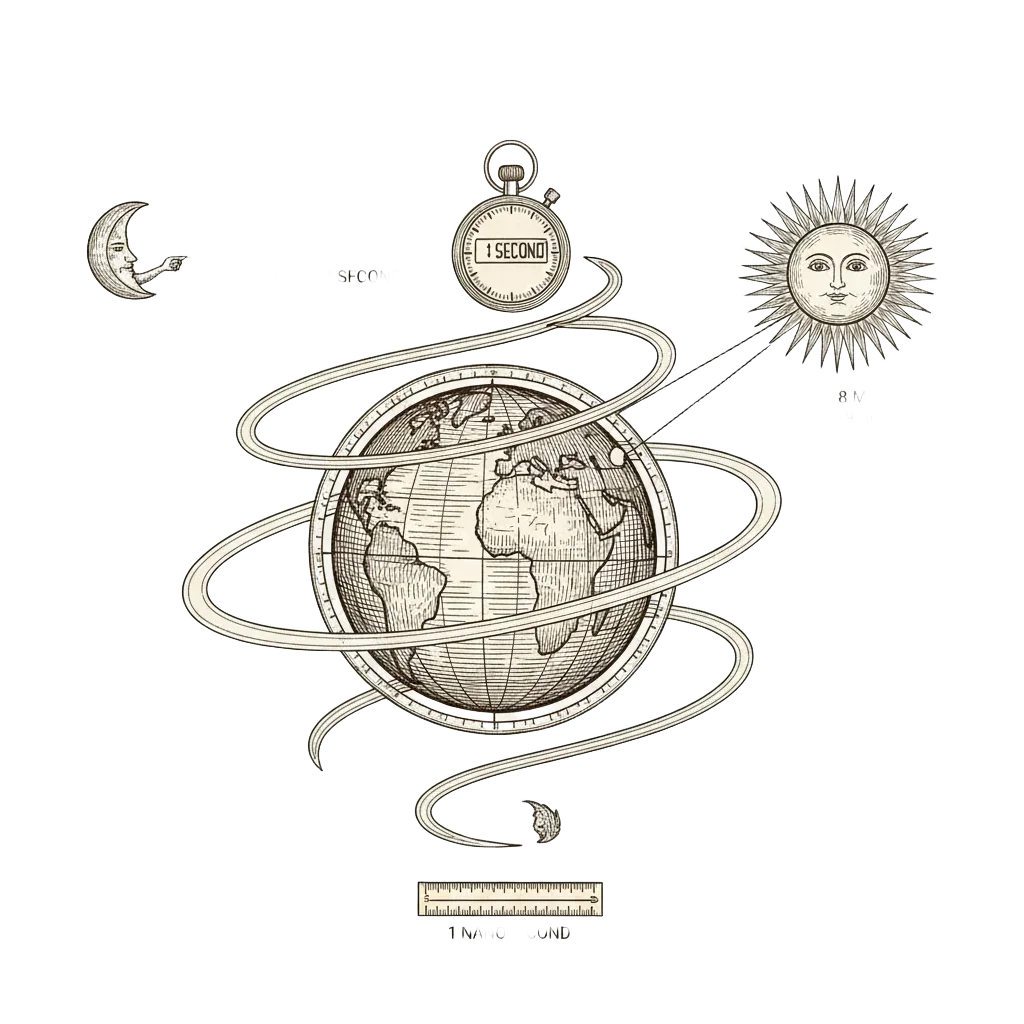
299,792,458 metres per second is hard to picture. Here are some ways to feel it.
7.5×
Around the world
Light could circle the Earth's equator about 7.5 times in one second.
1.3 s
To the Moon
Light from the Moon takes about 1.3 seconds to reach you. When you look at the Moon, you see it as it was just over a second ago.
8 min
19 s
From the Sun
Sunlight takes about 8 minutes and 19 seconds to reach Earth. If the Sun suddenly vanished, we would not know for over eight minutes.
30 cm
In a billionth of a second
In one nanosecond, light travels just under 30 centimetres - about the length of a school ruler.
Margin Note
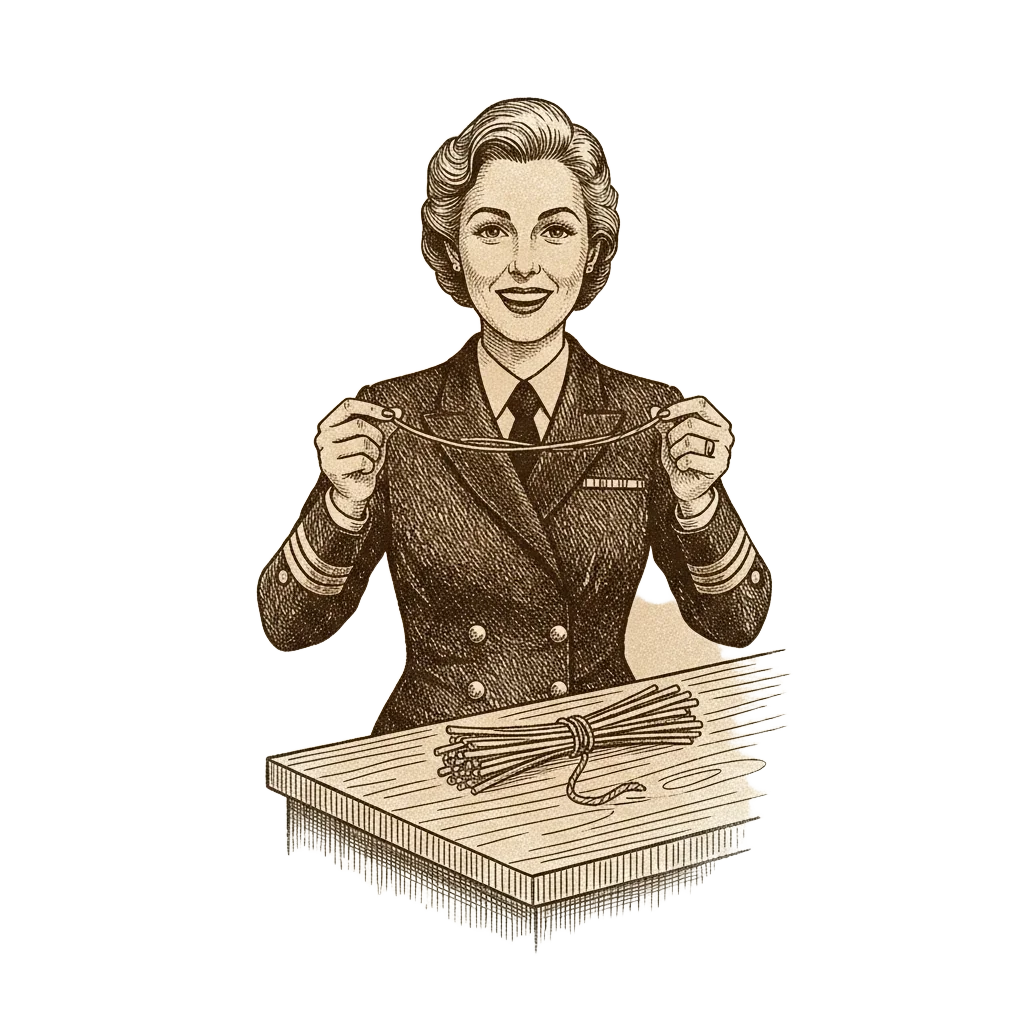
Grace Hopper's nanoseconds.
The computer pioneer Grace Hopper loved to hand out pieces of wire 11.8 inches long - about 30 centimetres, the distance light travels in a nanosecond. She used them to show why computers had to get smaller to get faster: signals simply cannot travel any quicker. A bundle of her "nanoseconds" is kept at the Smithsonian's National Museum of American History.
Chapter 8
Most numbers in science describe something we measured.
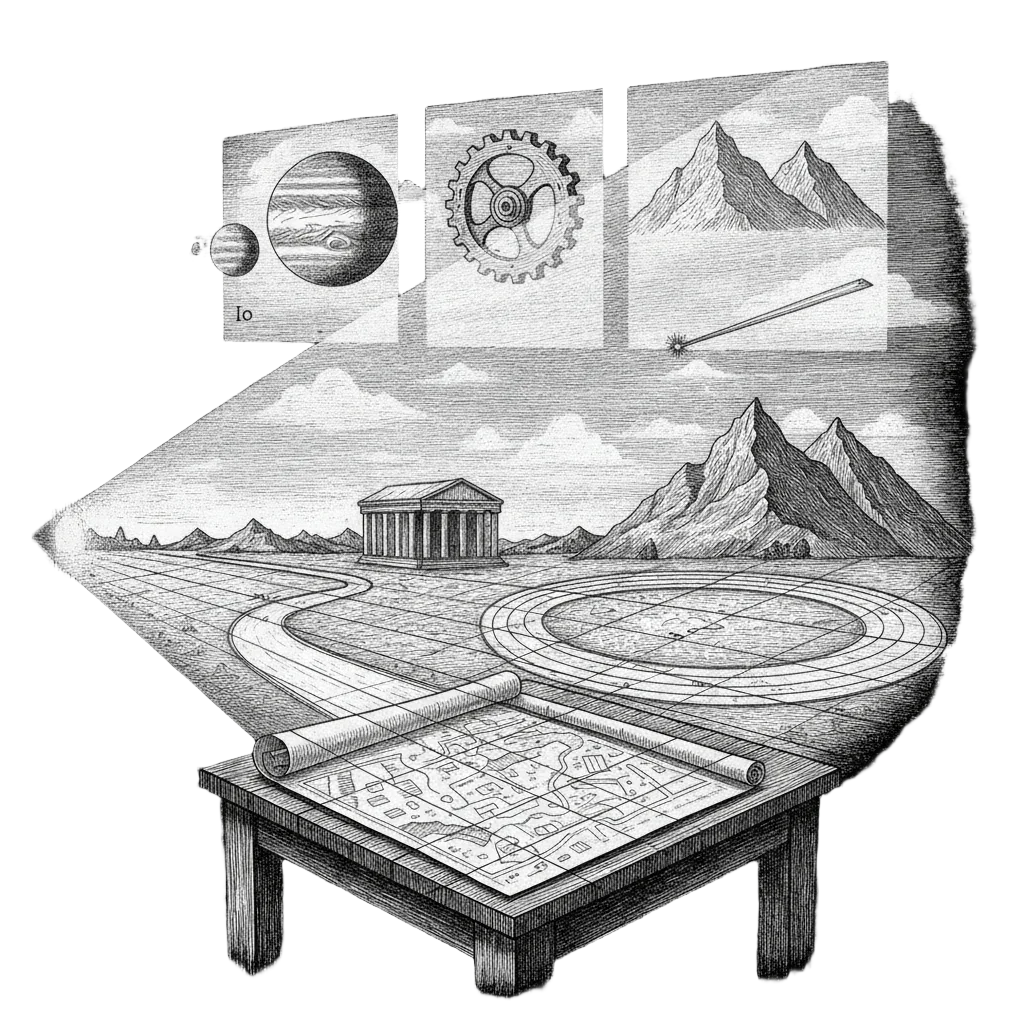
299,792,458 is different. It began as a measurement - the prize of three centuries of patient chasing, from a late moon, to a spinning wheel, to mountain tops, to lasers.
Then it became a foundation.
Today, every length you measure - every GPS position, every map, every centimetre on a tape measure - ultimately rests on light and a very precise clock.
It is a quietly beautiful idea: we did not invent our ruler. We borrowed it from the universe, and built the metre from the speed of light.
The Label
Here is why 299,792,458 matters:
Ole Rømer first showed light had a speed, from the late eclipses of Jupiter's moon Io.
Hippolyte Fizeau measured it on Earth with a spinning wheel of 720 teeth.
Albert Michelson spent a lifetime refining it, and won a Nobel Prize for his precision optical instruments.
Kenneth Evenson's team at the National Bureau of Standards measured 299,792,456.2 m/s - so precisely that the metre became the weak link.
The metre was redefined as the distance light travels in a vacuum in 1/299,792,458 of a second. The number became exact by definition. It is the speed of light in a vacuum, in metres per second - about 300,000 kilometres every second.
Light reaches us from the Moon in about 1.3 seconds and from the Sun in about 8 minutes 19 seconds. Every GPS position, every map, every centimetre on a tape measure ultimately rests on light and a very precise clock.
- closing thought
For three hundred years we chased it. Then we let it measure us.
299,792,458
The number we loved so much we redefined distance around it.
- The Oddly Specific Numbers Desk
Powered by DollarPageClub