Museum of Numbers
Mathematical Curiosities

Graham's
number

Too big for the universe - yet we know how it ends

There is a number so large that if you wrote down its digits, each one no bigger than the smallest size physics allows, the whole observable universe would not have room for them.

Not even close.

And yet mathematicians know, with total certainty, that it ends in …2464195387.

Meet Graham's number.

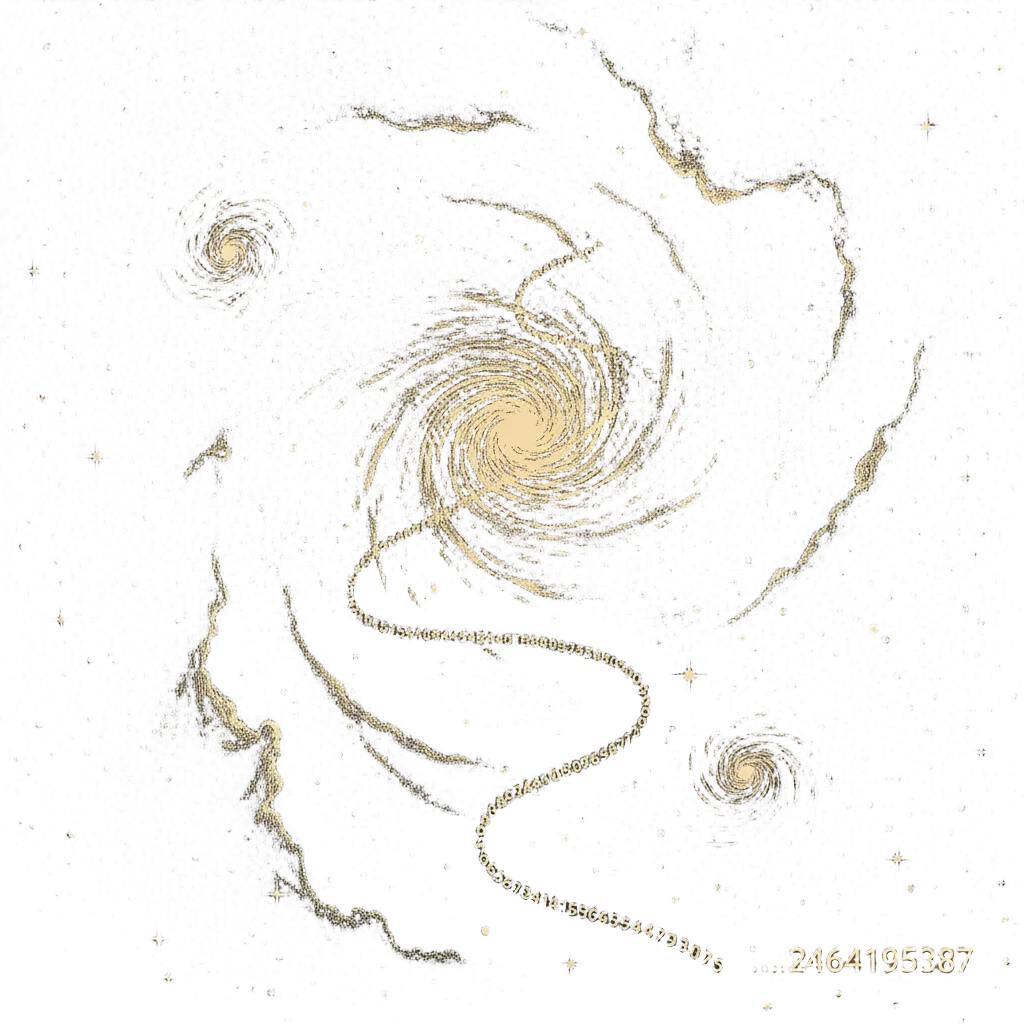
Deep space illustration of galaxies and stars, with a line of tiny digits stretching beyond the last galaxy, ending in …2464195387 lit in the corner

Section 1

A juggler at Bell Labs

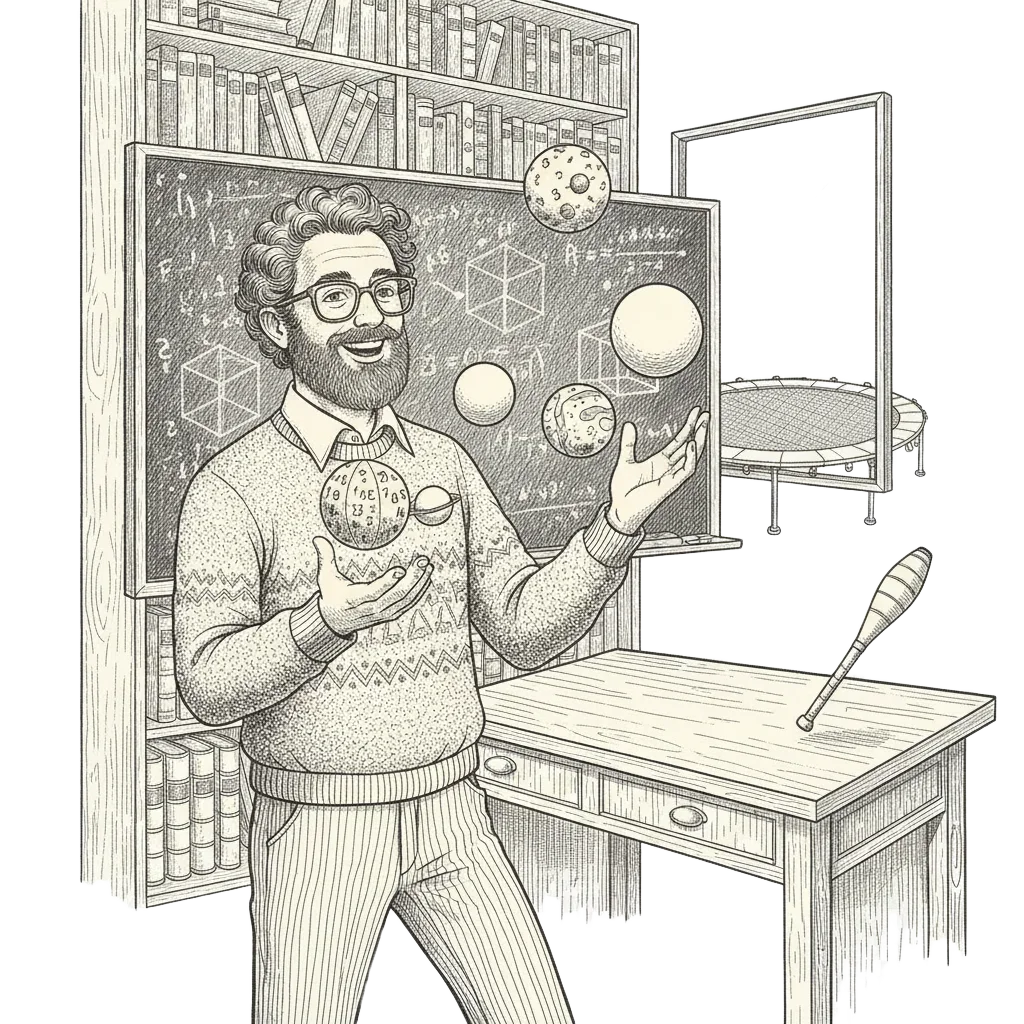
Ronald Graham was not a typical mathematician.

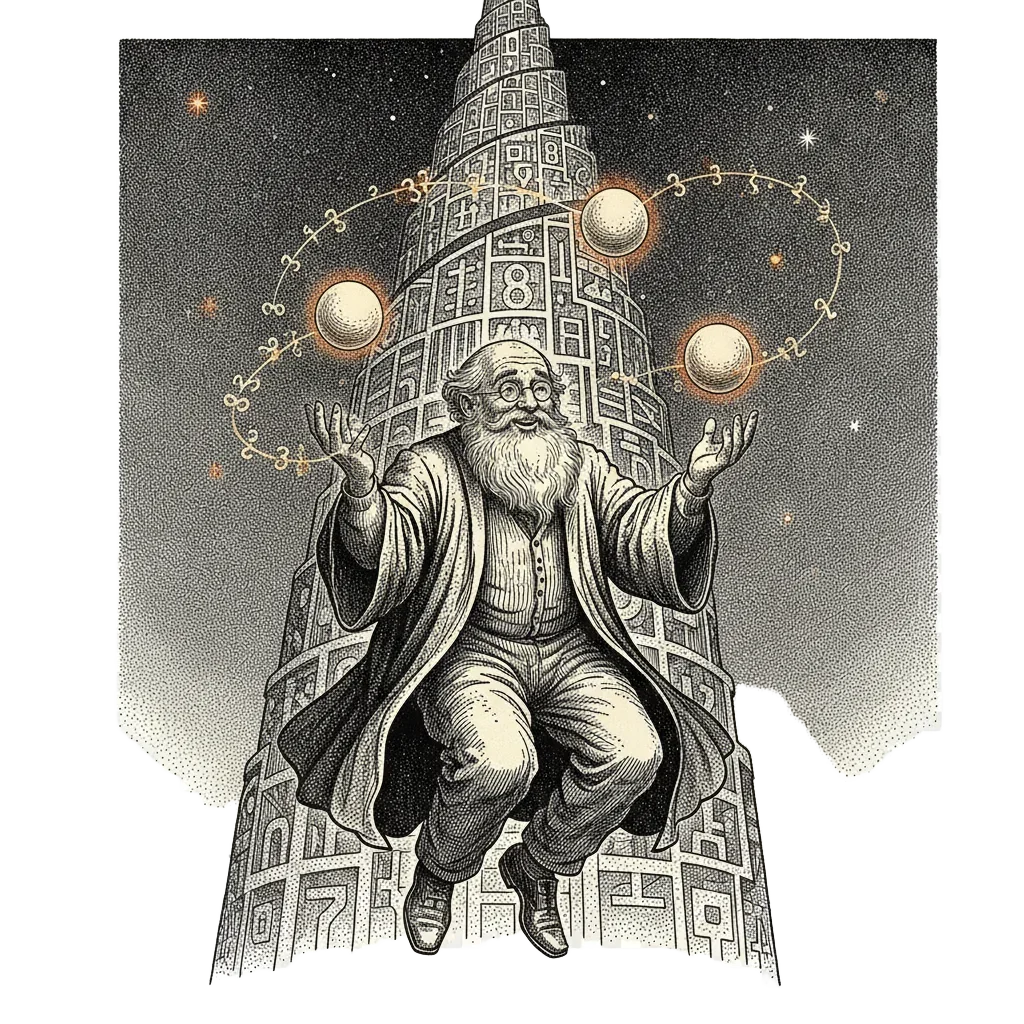
As a student, he had supported himself by performing on a trampoline in a circus. He could juggle six balls at once, and in 1972 he became president of the International Jugglers' Association.

He spent decades at Bell Labs in New Jersey, one of the most inventive research laboratories in the world, working on the mathematics of networks, patterns and scheduling.

He was also a close friend of the wandering Hungarian genius Paul Erdős, who never had a home of his own. Graham kept a room ready for him whenever he came to stay.

Graham loved a particular kind of question: in any big enough system, does order always appear somewhere, no matter how hard you try to avoid it?

One such question led him to a number bigger than anything anyone had needed before.

Ink illustration of Ron Graham juggling in a book-lined office with a blackboard of cube diagrams and a trampoline visible through the window

Section 2

The question that needed a giant

Here is the puzzle, in simple terms.

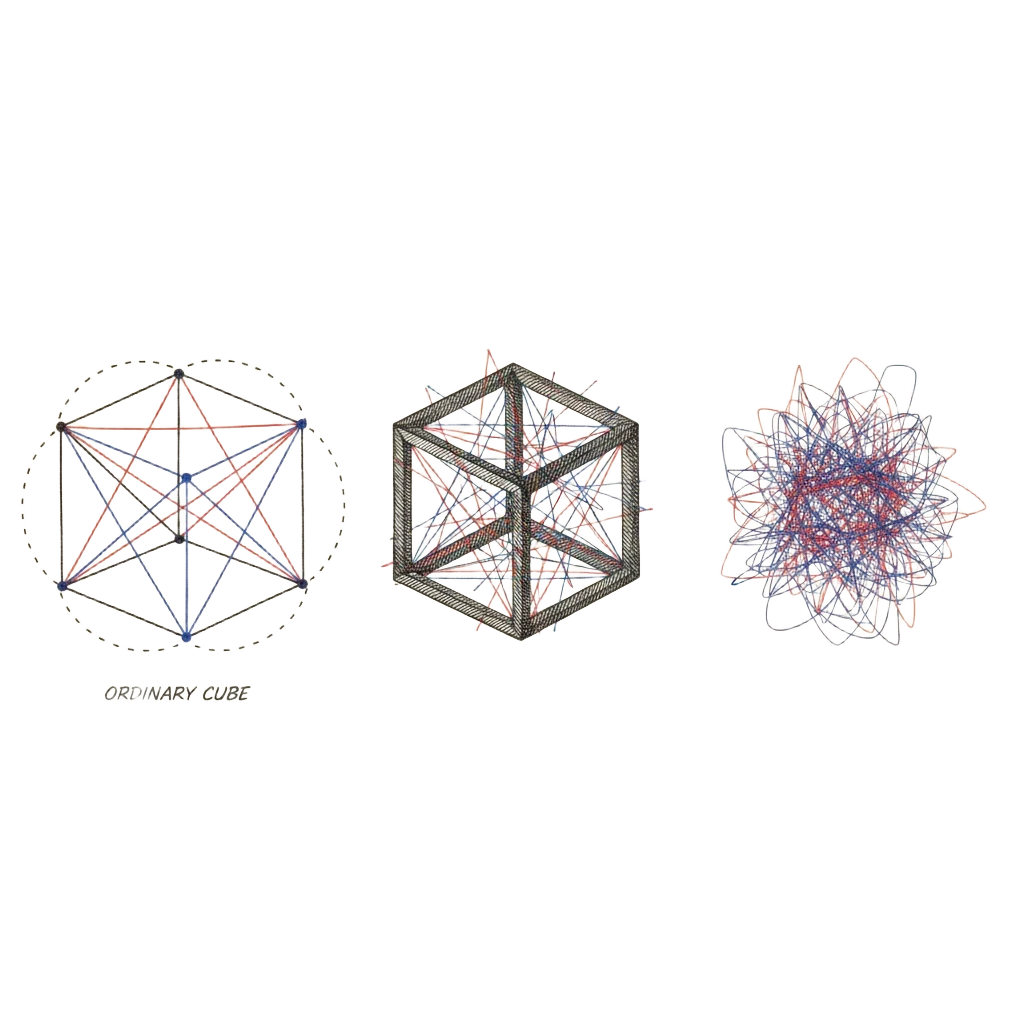
Take a cube. Now draw a line between every pair of its corners, and colour each line either red or blue.

Can you colour them so that you never get four corners, all lying flat on the same plane, joined entirely by lines of one colour?

For an ordinary cube, yes, you can dodge it.

But now imagine cubes in more dimensions - a four-dimensional cube, a five-dimensional one, and so on. Each has more corners, and far more lines. Eventually, there are so many lines that you cannot avoid a single-coloured group of four, however cleverly you colour.

The question is: how many dimensions does it take?

In 1971, Graham and his colleague Bruce Rothschild proved that there is such a dimension. But they could not pin it down. They could only say it was somewhere below an upper limit.

And that upper limit was mind-bogglingly large.
Ink diagram of a cube with red and blue lines between corners, four highlighted corners forming a flat square, and higher-dimensional cube sketches
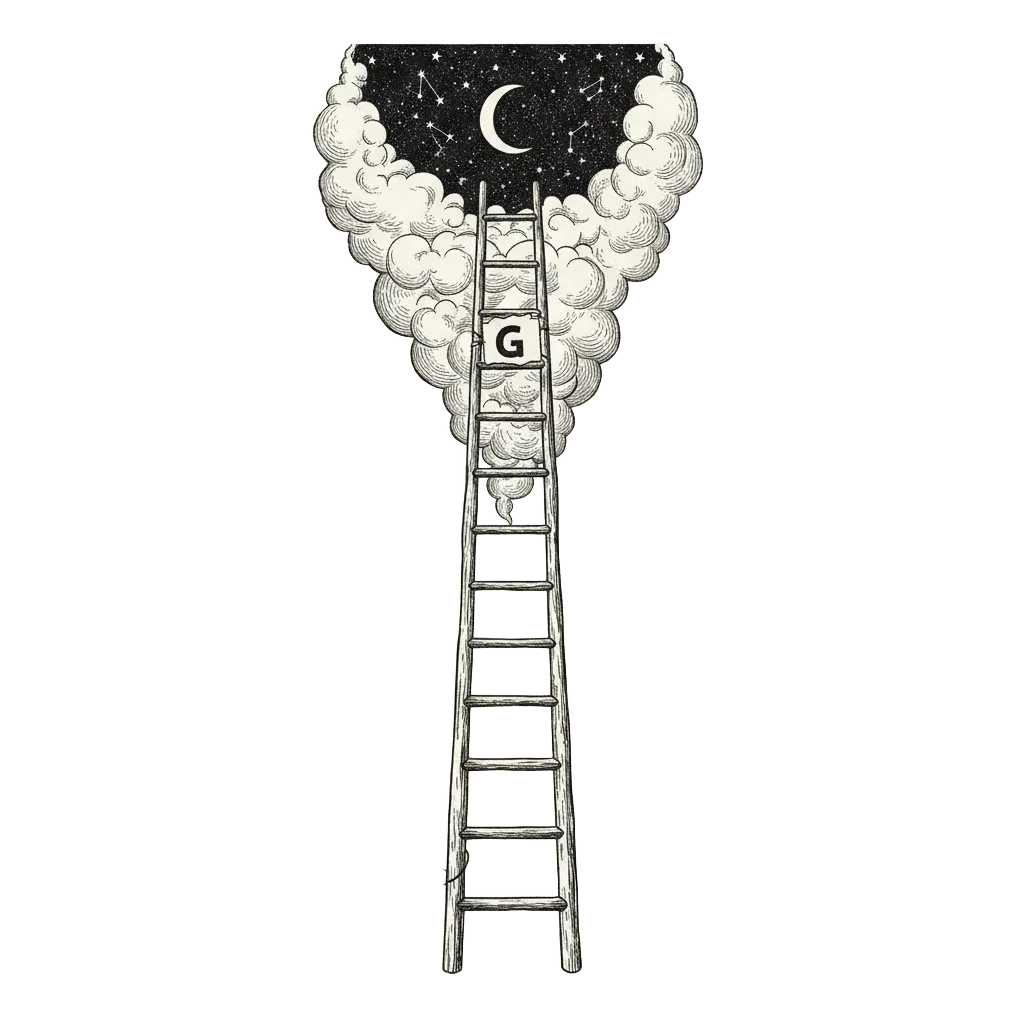
A tall ladder stretching into the clouds, with a tag near the bottom reading 13? and an arrow pointing far up labelled G

The answer might be tiny.

Here is the comic twist: the true answer could be quite small. Mathematicians have since shown it must be at least 13. Later work has also pulled the upper limit down enormously.

But for years, Graham's number stood as the famous ceiling - a bound so vast it made the question feel almost absurd.

Ink illustration of Graham explaining to a note-taking Gardner, with a 1977 magazine page and a thick record book open to a giant G

Section 3

From Martin Gardner to the record books

Graham's number might have stayed hidden in research papers.

But in the 1970s, Graham was explaining his work to Martin Gardner, the puzzle writer whose Scientific American column had already made numbers like 6174 famous around the world.

The number in Graham's formal proof was awkward to describe. So Graham came up with a related bound that was easier to explain - and even bigger.

In November 1977, Gardner described it in his column, telling readers that it held the record for the largest number ever used in a serious mathematical proof.

In 1980, the Guinness Book of World Records repeated the claim.

A number from an obscure corner of mathematics had become a celebrity.

- From the margins to the record books

A gentle pause

Enjoying this story?

OddlySpecificNumbers.com tells the stories behind remarkable numbers - the people, the accidents, and the surprises hiding inside them. Get the next one delivered to your inbox.

One new story a week, at most.

At most one email a week.

Section 4

A staircase of arrows

To see how big Graham's number is, we need a new kind of ladder. The computer scientist Donald Knuth invented one in 1976, made of arrows.

One arrow - ordinary powers

3↑3 = 3 × 3 × 3 = 27

Two arrows - towers of powers

3↑↑3 = 333 = 327 = 7,625,597,484,987

That is already more than seven trillion.

Three arrows - a tower 7,625,597,484,987 floors tall

3↑↑↑3

Nobody can write that number down. Nobody ever will.

And we have only just started.

Playful staircase illustration with three steps: 27, then a tower to 7,625,597,484,987, then a tower rising into space, golden arrows carved into each step
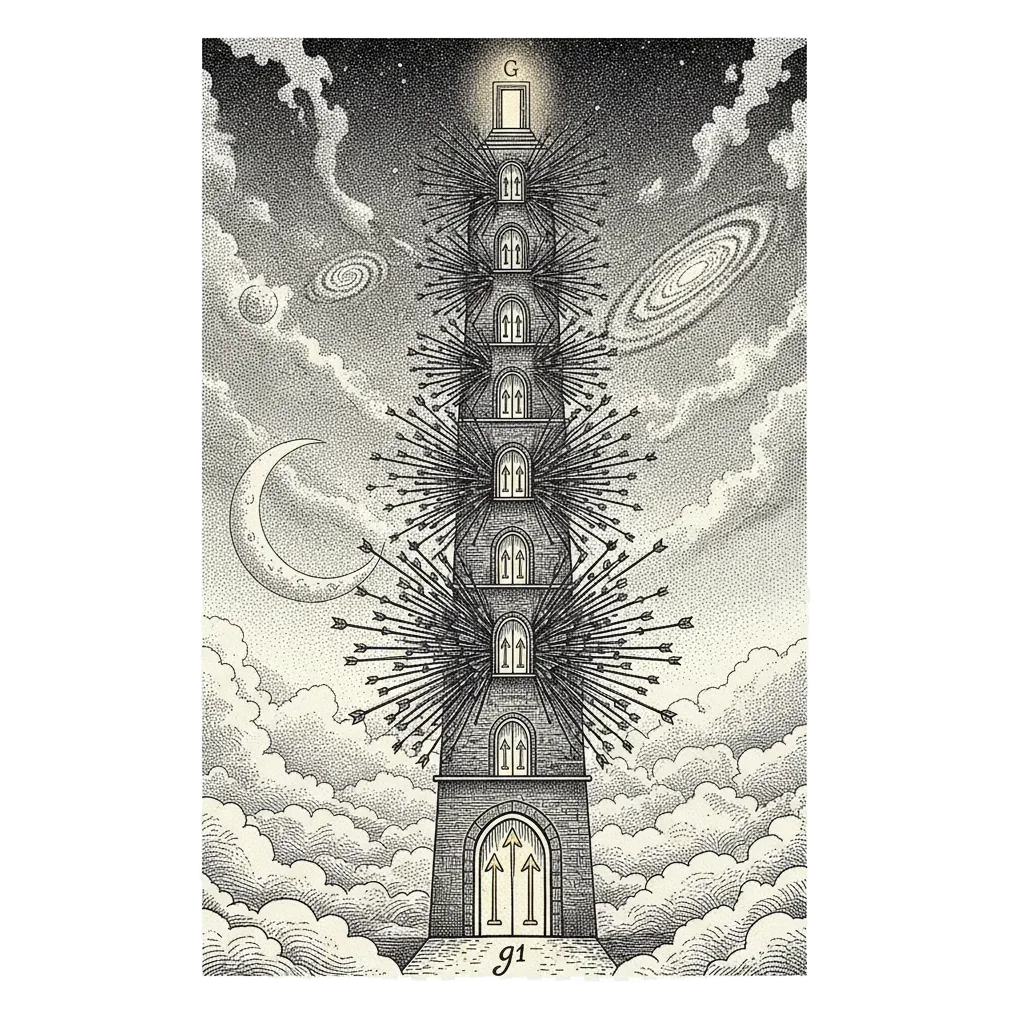
Dramatic symbolic 64-storey tower rising past the Moon and galaxies into space, ground floor labelled g1, top floor marked G

Section 5

Sixty-four floors up

Now add one more arrow: 3↑↑↑↑3, with four arrows.

This number is so large that the tower in the last section is a speck by comparison. Mathematicians call it g1. It is only the ground floor.

To build the next floor, g2, you take 3 and 3 again, but this time you put g1 arrows between them. Not four arrows. A g1 number of arrows.

To build g3, you use g2 arrows.

And so on, each floor using the previous floor's number as its count of arrows.

Keep going for 64 floors.

G

The number at the top is Graham's number.

Section 6

No room in the universe

Try to imagine writing Graham's number down.

Physics tells us there is a smallest meaningful size for anything: the Planck length, a tiny fraction of the width of an atom. A cube that size is a Planck volume.

The whole observable universe contains about 10185 of them - a 1 followed by 185 zeros.

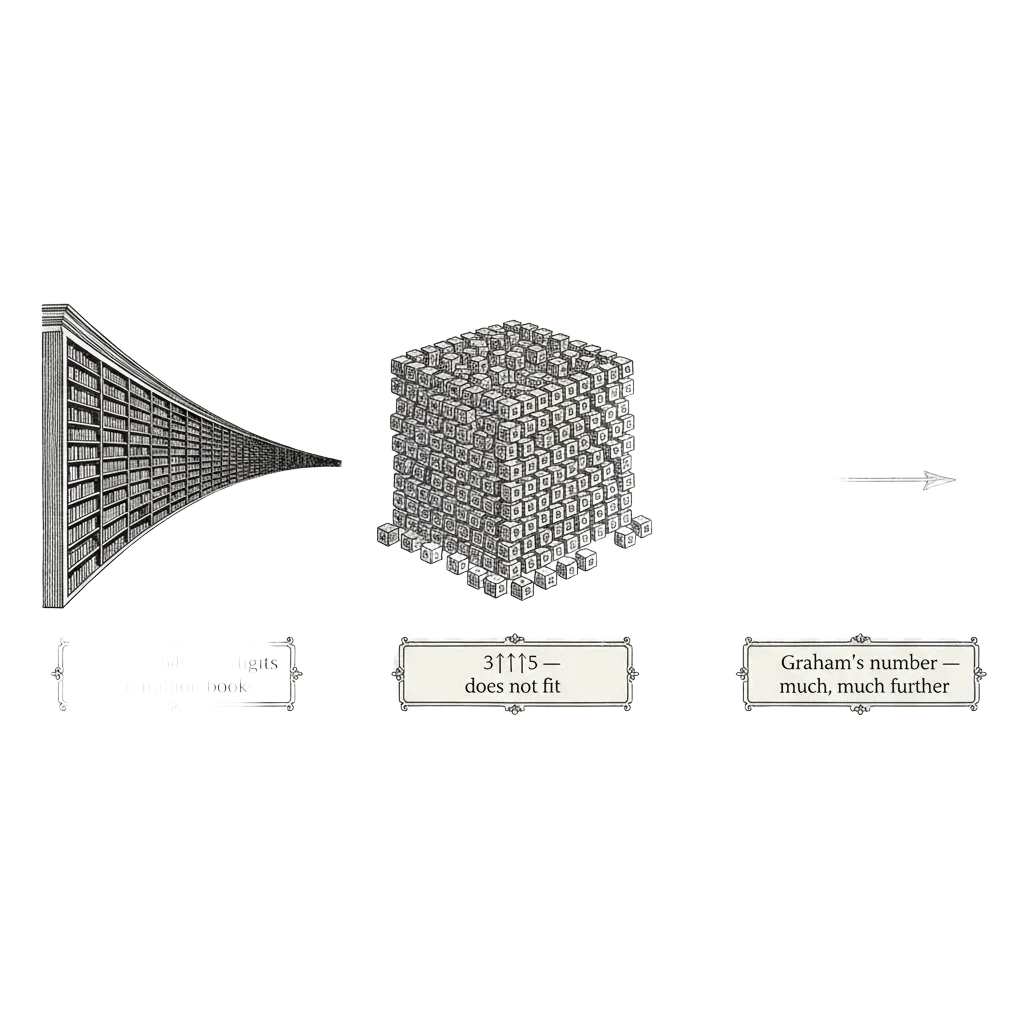
So suppose you wrote each digit in its own Planck volume, packing the entire universe with digits. You would run out of room before finishing even the fifth floor of the two-arrow tower, 3↑↑5 - a tower of just five 3s. The number of digits in 3↑↑5 is itself a number trillions of digits long.

For comparison, the fourth floor, 3↑↑4, is merely huge: it has 3,638,334,640,025 digits. Printed at 2,500 digits a page, in 400-page books, it would fill about 3.6 million books.

Graham's number is so far beyond these that there are no words for the gap.

Scale illustration: a library to the horizon for 3↑↑4, the universe packed with digits overflowing for 3↑↑5, then an arrow off the edge for Graham's number
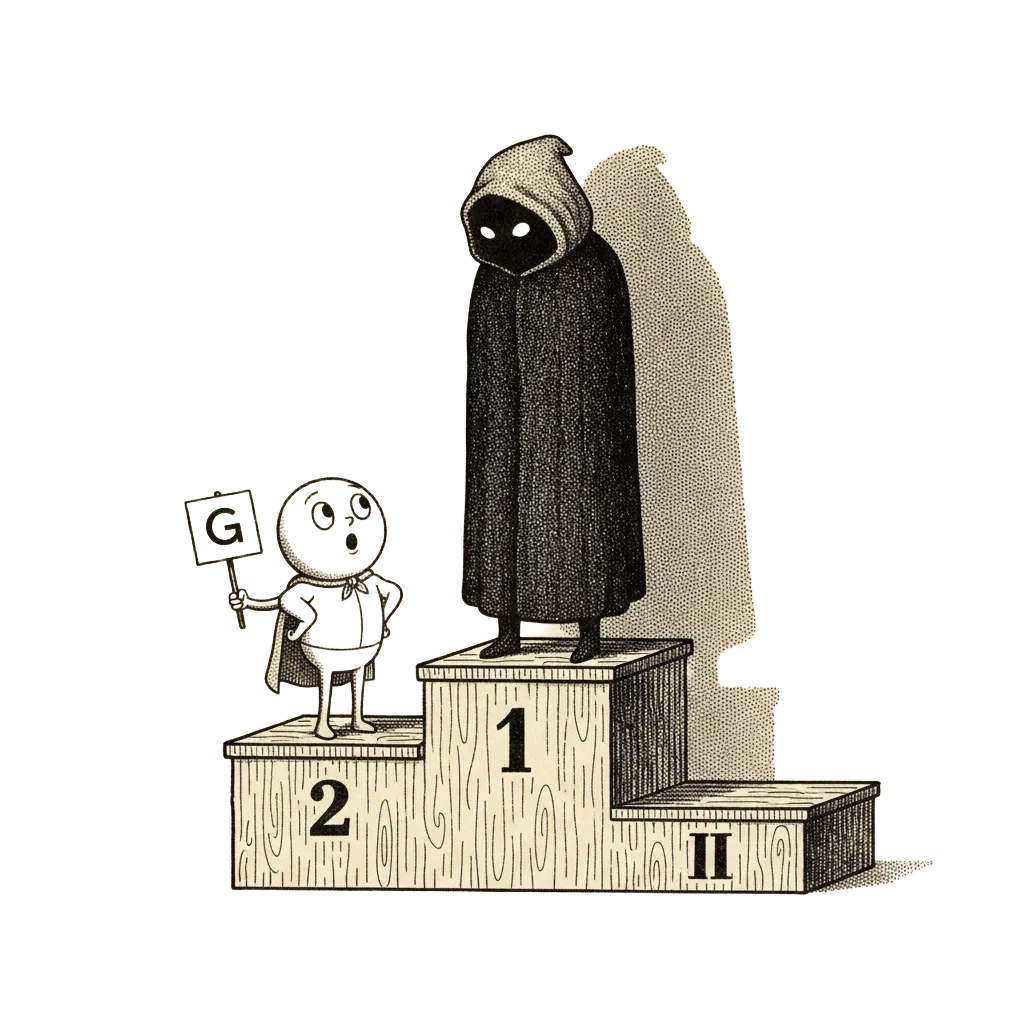
A podium where a figure labelled G stands on the second step, gazing up at a larger shadowy figure on the top step

The record has since been broken.

Graham's number is no longer the biggest number used in mathematics. Later proofs have needed numbers so large that they make Graham's number look small.

But it was the first giant to become famous - and still the one most people have heard of.

Section 7

The tail we can see

Here is the strangest part.

We will never know how Graham's number begins. We will never know how many digits it has, or what its first digit is.

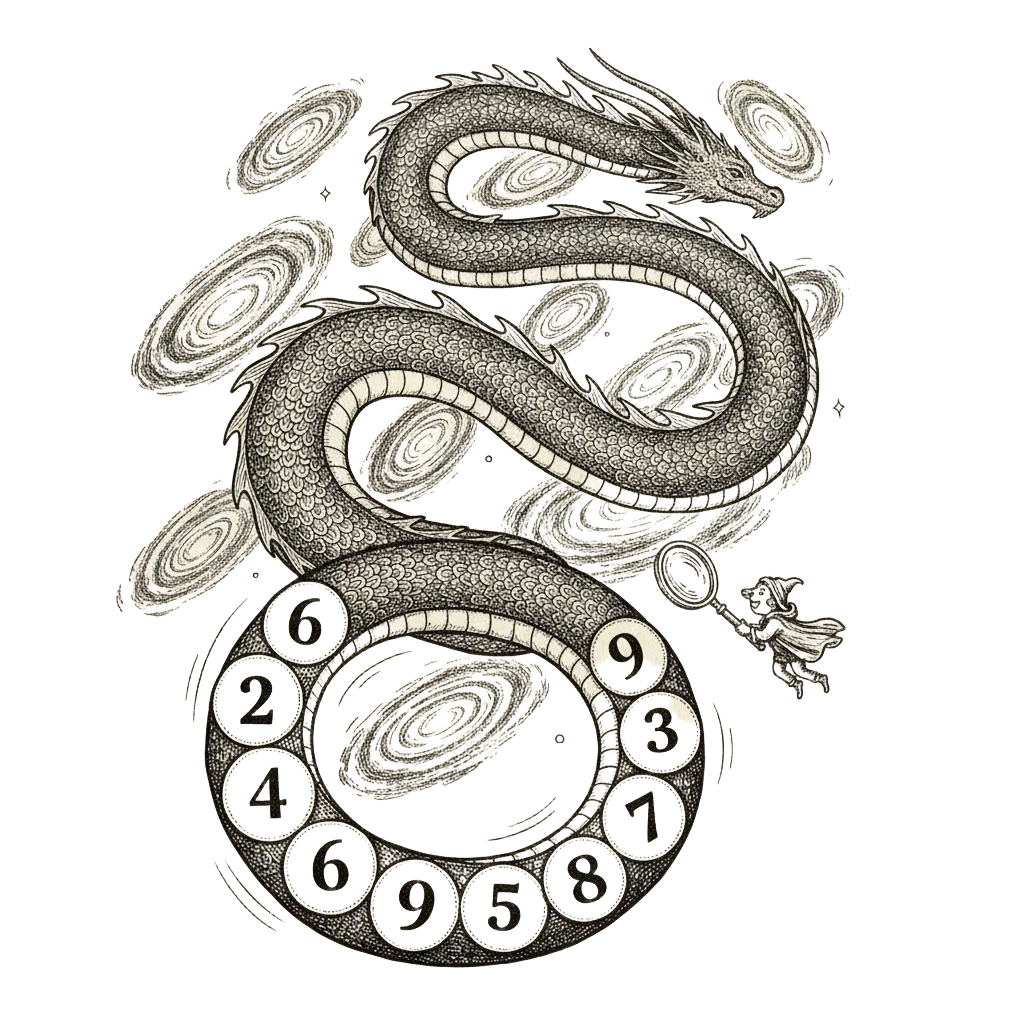
But we know exactly how it ends.

Graham's number is a gigantic tower of 3s. And when you keep piling 3s higher and higher, something magical happens to the last few digits: they stop changing. Once the tower is tall enough, adding another 3 on top leaves the final digits exactly as they were.

Graham's number is far taller than it needs to be for that to happen. So its final digits are locked in:

…2464195387

Mathematicians can compute as many of these last digits as they like, and it takes a laptop only a moment.

It is like being unable to see the head of a dragon so long it stretches beyond the stars - and yet being able to count the scales at the tip of its tail.

A dragon whose body winds through space with its head lost in the distance; its tail has ten visible scales labelled 2, 4, 6, 4, 1, 9, 5, 3, 8, 7; a small figure reads the digits with a magnifying glass
Reflective ink illustration of an older Ron Graham juggling glowing balls that trail streams of tiny 3s, with a 64-floor tower rising into a starry sky behind him

Section 8

Why a number this big matters

Graham's number is not useful for measuring anything in the real world.

It is famous for a different reason: it shows how far pure thought can reach.

No one could ever see it, count to it, or write it down. And yet a few lines of reasoning can define it exactly, prove things about it, and even tell us its final digits.

It also carries Ron Graham's favourite idea - that in any big enough world, complete disorder is impossible. Somewhere, a pattern must appear.

Graham died in 2020, aged 84. His number lives on in record books, classrooms, and the imaginations of anyone who has ever tried to picture the biggest number there is.

- Wonder, carried by a single letter

The full story, quickly

Graham's number in a nutshell

  • It comes from a question in the mathematics of patterns: when colouring the lines of a many-dimensional cube, how many dimensions force a single-coloured group of four?

  • Ronald Graham - mathematician, juggler and trampolinist - worked on it with Bruce Rothschild, proving in 1971 that such a dimension exists.

  • Martin Gardner described it in Scientific American in November 1977, and it entered the Guinness Book of World Records in 1980.

  • It is built with Knuth's up-arrows: 3↑3 = 27, 3↑↑3 = 7,625,597,484,987, and then 64 dizzying floors of arrows.

  • Even writing one digit in each Planck volume, the observable universe cannot hold it.

  • We can never know its first digit - but it ends in …2464195387.

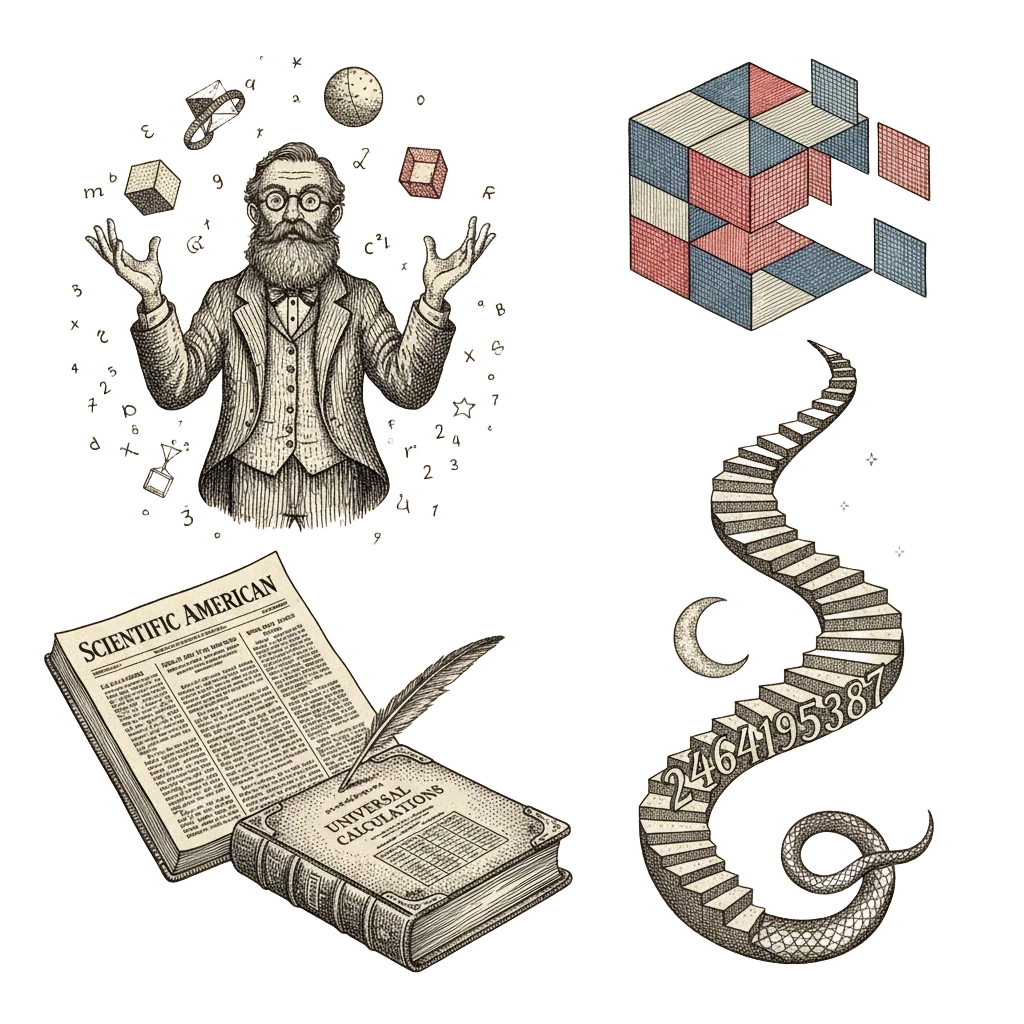
Recap panel illustration combining Graham juggling, the red-and-blue cube, the magazine and record book, the staircase of arrows, and the dragon tail of final digits
G ↳ …2464195387 3↑↑3 64 floors g1 g64

Too big for the universe to hold.

Graham's number is the giant whose head we will never see, and whose tail we can read.

There are infinitely many numbers. This may take a while. ↓

Panoramic ink illustration of deep space with digits trailing into infinity and the final digits …2464195387 visible in the corner, with a small red accent marker

Powered by DollarPageClub