The Hardy-Ramanujan Number
A taxi-cab number with two ways to be expressed as the sum of two cubes. The most famous unremarkable number in mathematics.
→The sum a schoolboy refused to add up
Add up every number from 1 to 100.
One by one, it takes most people a quarter of an hour - and a few mistakes along the way.
A nine-year-old boy in 18th-century Germany is said to have done it in seconds.
He got the right answer - 5050 - and he never added the numbers in order.
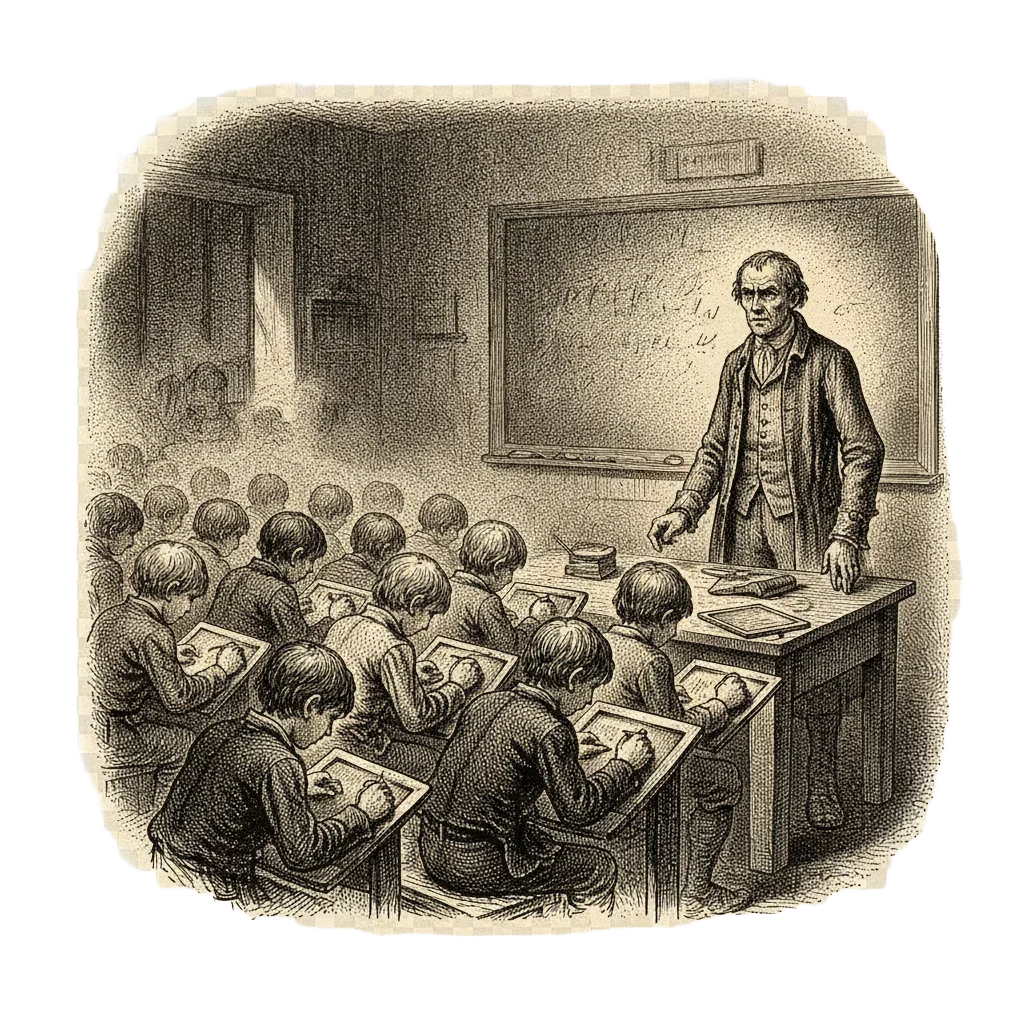
Around 1786, in the town of Brunswick in Germany, a schoolmaster named Büttner faced a noisy classroom full of boys. He wanted some peace and quiet.
So he gave them a task that should have kept them busy for a very long time: add up a long list of numbers - in the version everyone remembers, every number from 1 to 100.
The boys bent over their slates and began: 1 plus 2 is 3. Plus 3 is 6. Plus 4 is 10…
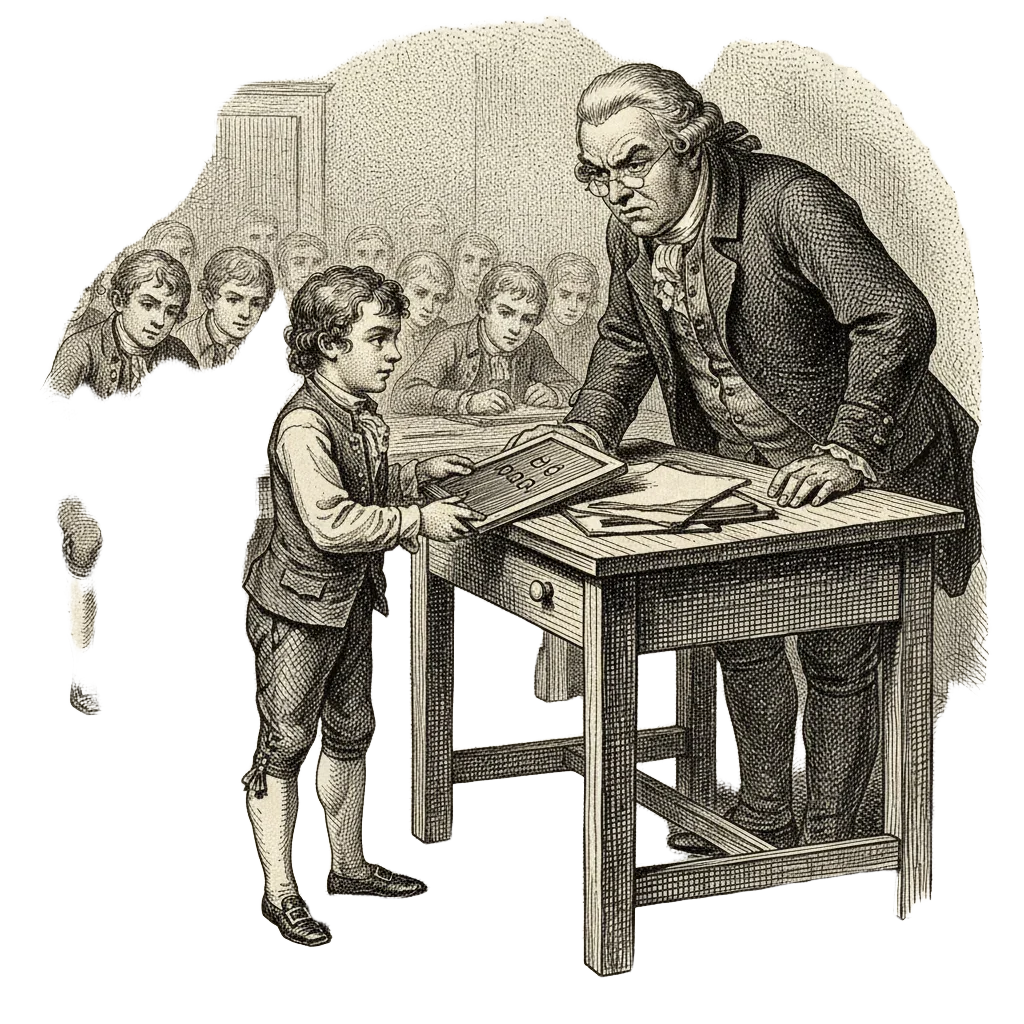
But one small boy - Carl Friedrich Gauss, the son of a poor bricklayer - thought for a moment, wrote a single number, walked to the front, and placed his slate on the teacher's desk.
"Ligget se." - There it lies.
Then he sat down and waited, while everyone else kept scribbling for the rest of the hour.
When Büttner finally turned the slates over, most were wrong. Gauss's slate held just one number, with no working at all. It was 5050. And it was correct.

What happened next
The teacher changed his mind about the boy. Büttner was so impressed that he sent away to Hamburg for a better arithmetic book, just for Gauss. His young assistant, Martin Bartels, began studying mathematics alongside the boy - the start of a path that would lead Gauss to become one of the greatest mathematicians who ever lived.
Gauss did not add faster than everyone else. He simply refused to add in order.
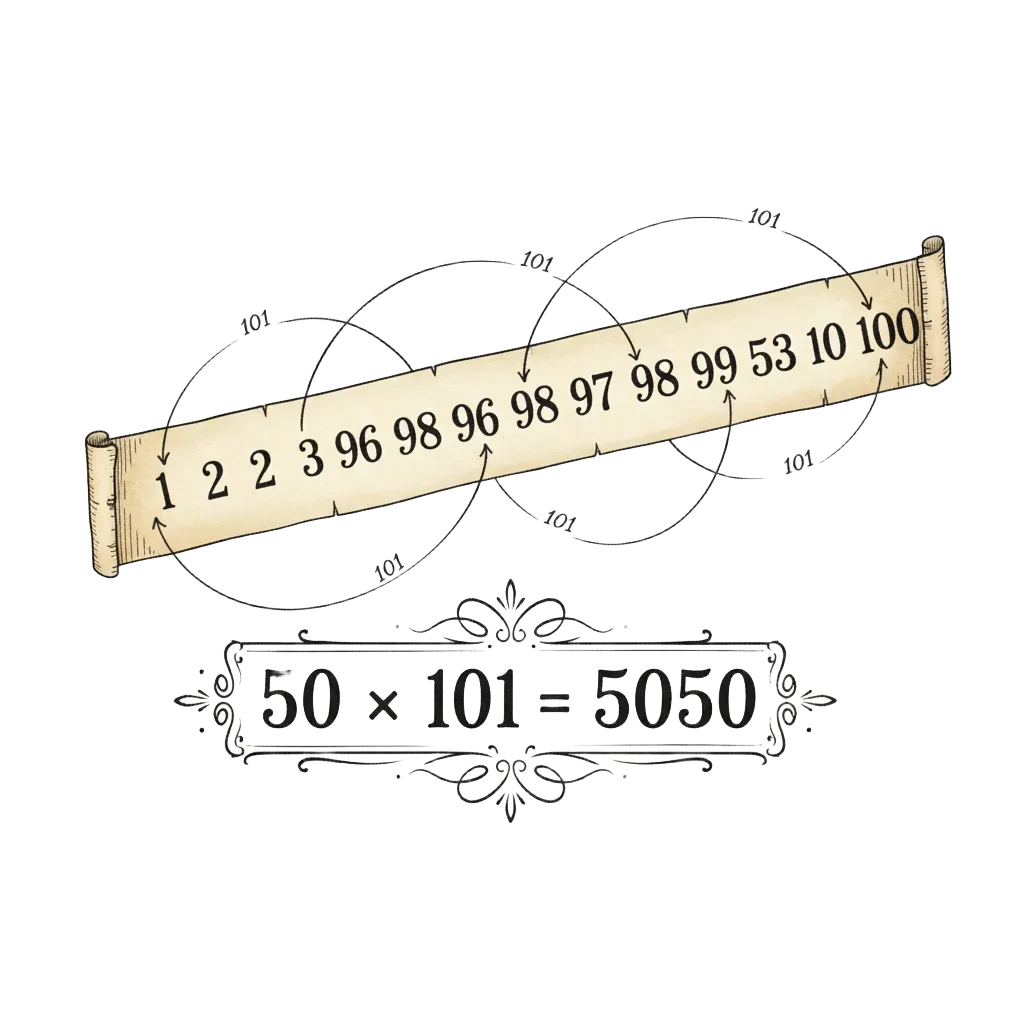
Instead, imagine the numbers 1 to 100 written in a long line - and then fold the line in half, so the first number sits against the last:
1 + 100 = 101
2 + 99 = 101
3 + 98 = 101
4 + 97 = 101
… all the way to …
50 + 51 = 101
Every pair adds up to exactly the same thing: 101.
And how many pairs are there? A hundred numbers make 50 pairs.
So the whole long sum becomes one small multiplication:
50 × 101 = 5050
A task meant to take an hour - turned into a few seconds of thought.
There is another beautiful way to see why the answer is exactly 5050.
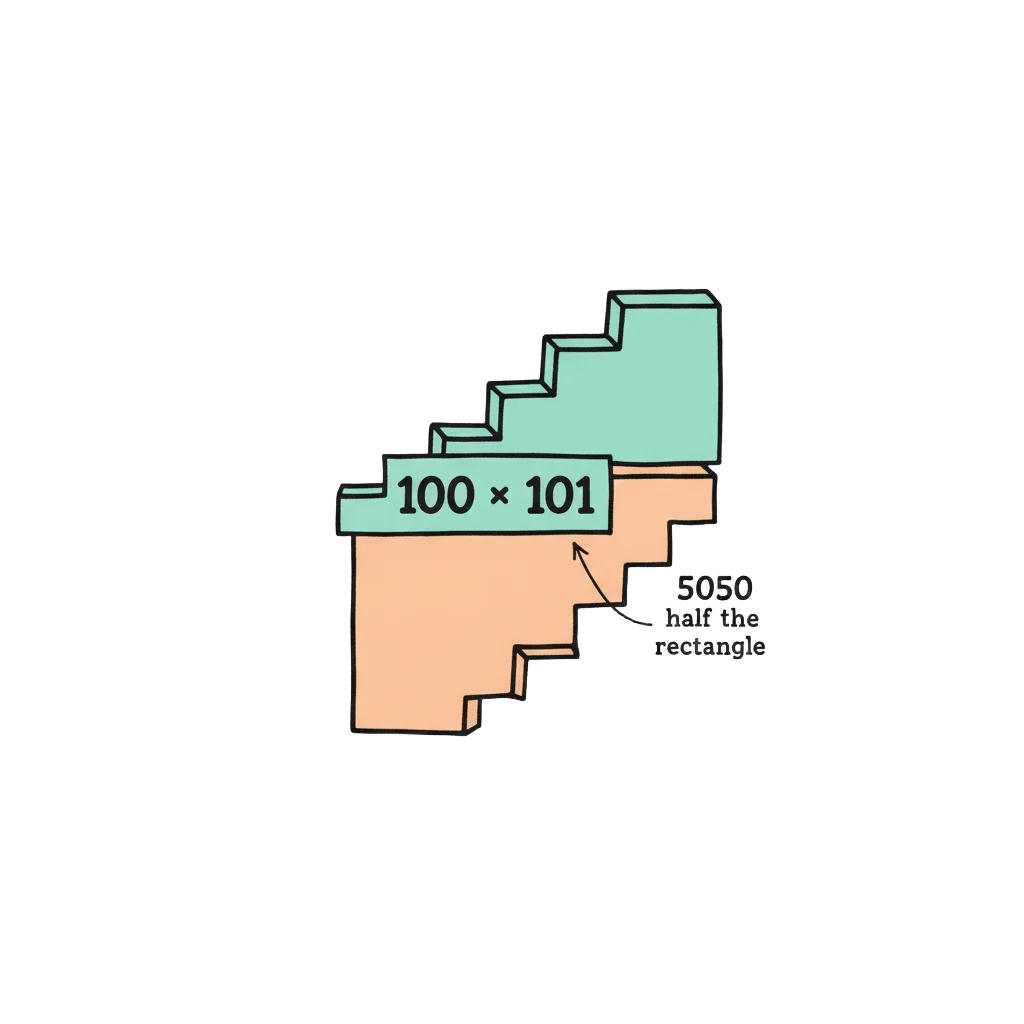
Imagine building a staircase out of blocks: 1 block, then 2, then 3, all the way up to 100 blocks. Now make a second, identical staircase, turn it upside down, and slide it onto the first.
The two staircases fit together perfectly into a rectangle - 100 blocks tall and 101 blocks wide. That rectangle holds 100 × 101 = 10,100 blocks. One staircase is exactly half of it:
10,100 ÷ 2 = 5050
This works for any staircase, not just one of 100 steps. To add up every number from 1 to any number you like, there is one simple rule: multiply the last number by the next number, then halve it.
Written the way mathematicians write it:
n × (n + 1) ÷ 2
For 1 to 100: 100 × 101 ÷ 2 = 5050
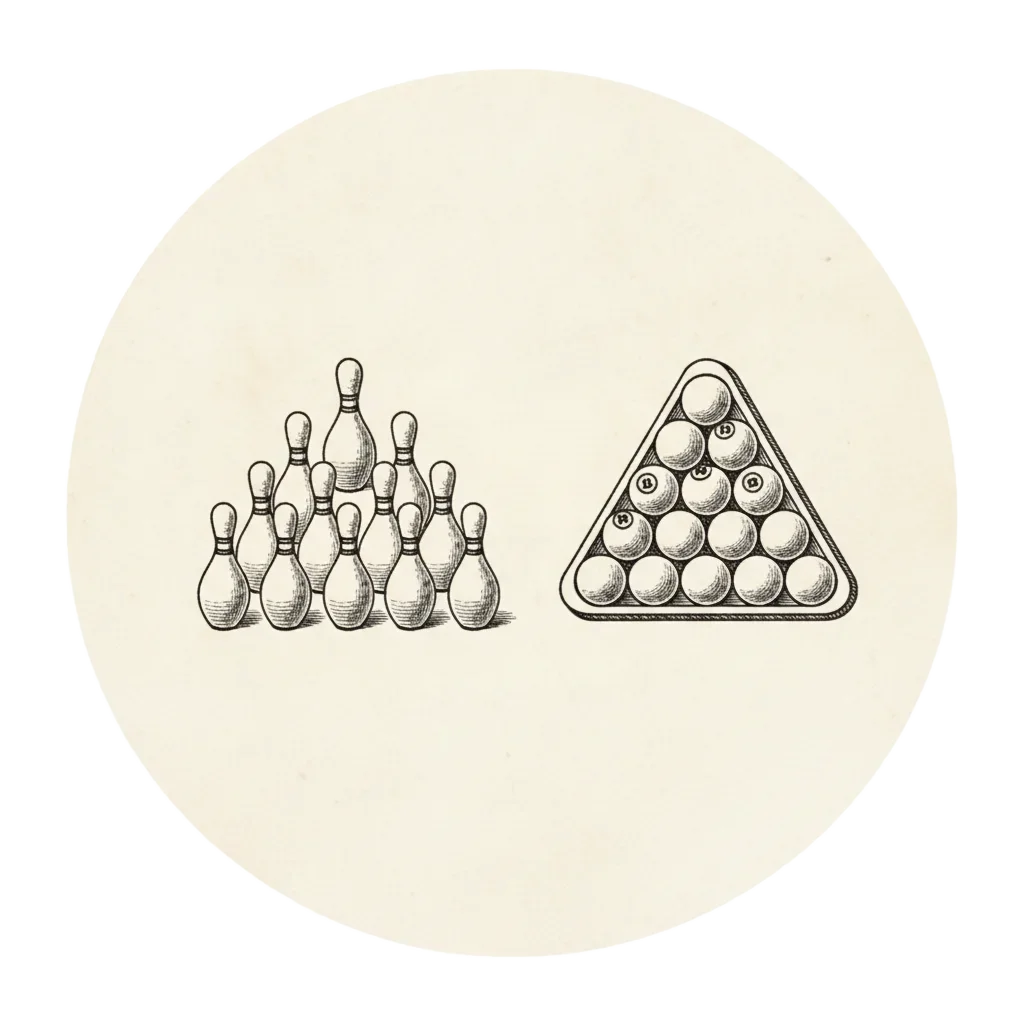
Numbers made this way are called triangular numbers, because you can arrange them as dots in a perfect triangle. 5050 is the 100th of them: the number of dots in a triangle 100 rows tall.
You have seen triangular numbers before
The 10 pins at the end of a bowling lane are arranged in a triangle. So are the 15 red balls at the start of a game of snooker. 5050 is the same idea - just a much bigger triangle.
A party
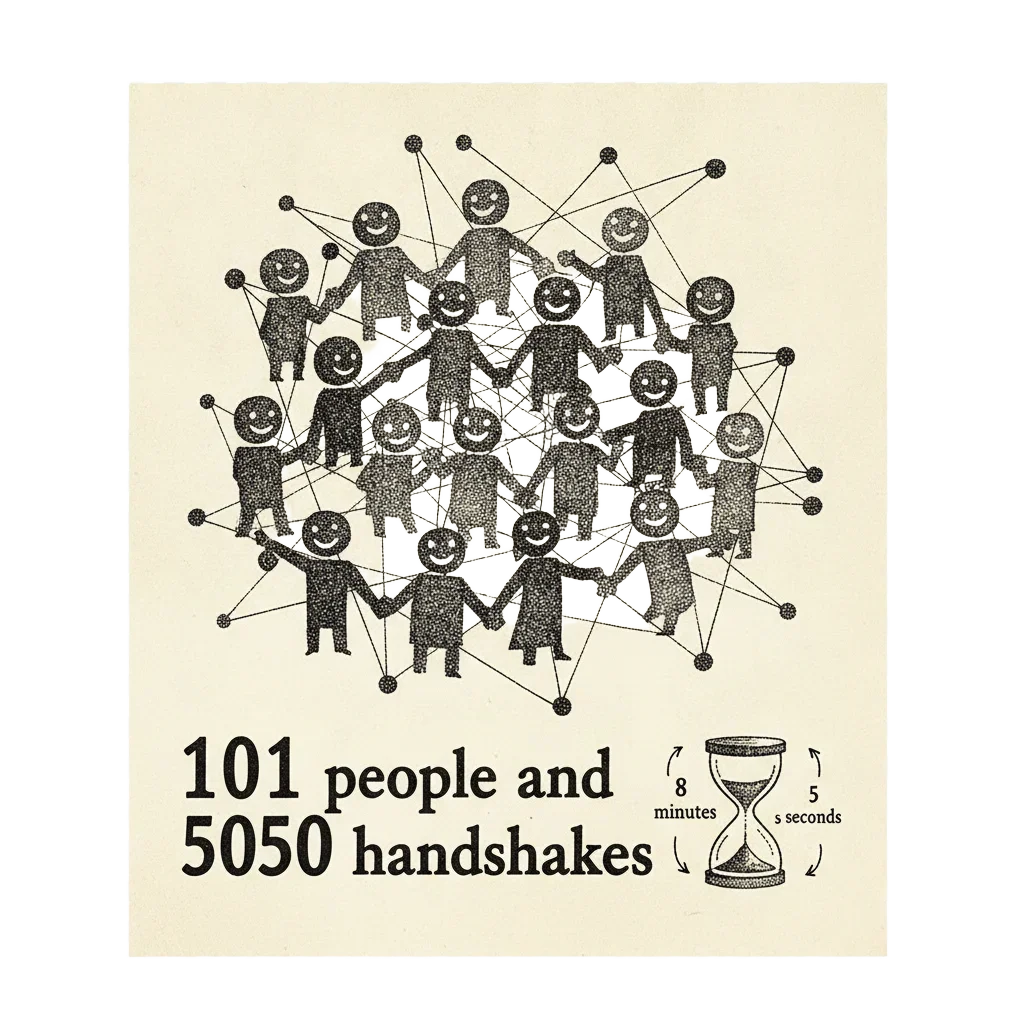
Invite 101 people to a party. If every guest shakes hands with every other guest exactly once, there will be exactly 5050 handshakes.
A league
Put 101 teams into a league where every team plays every other team once. That is 5050 matches.
A race against the clock
Adding the numbers 1 to 100 one at a time, at about five seconds per step, takes roughly eight minutes - if you make no mistakes. Gauss's fold takes about five seconds.
It is the same pattern every time: whenever everything is paired with everything else, triangular numbers appear.
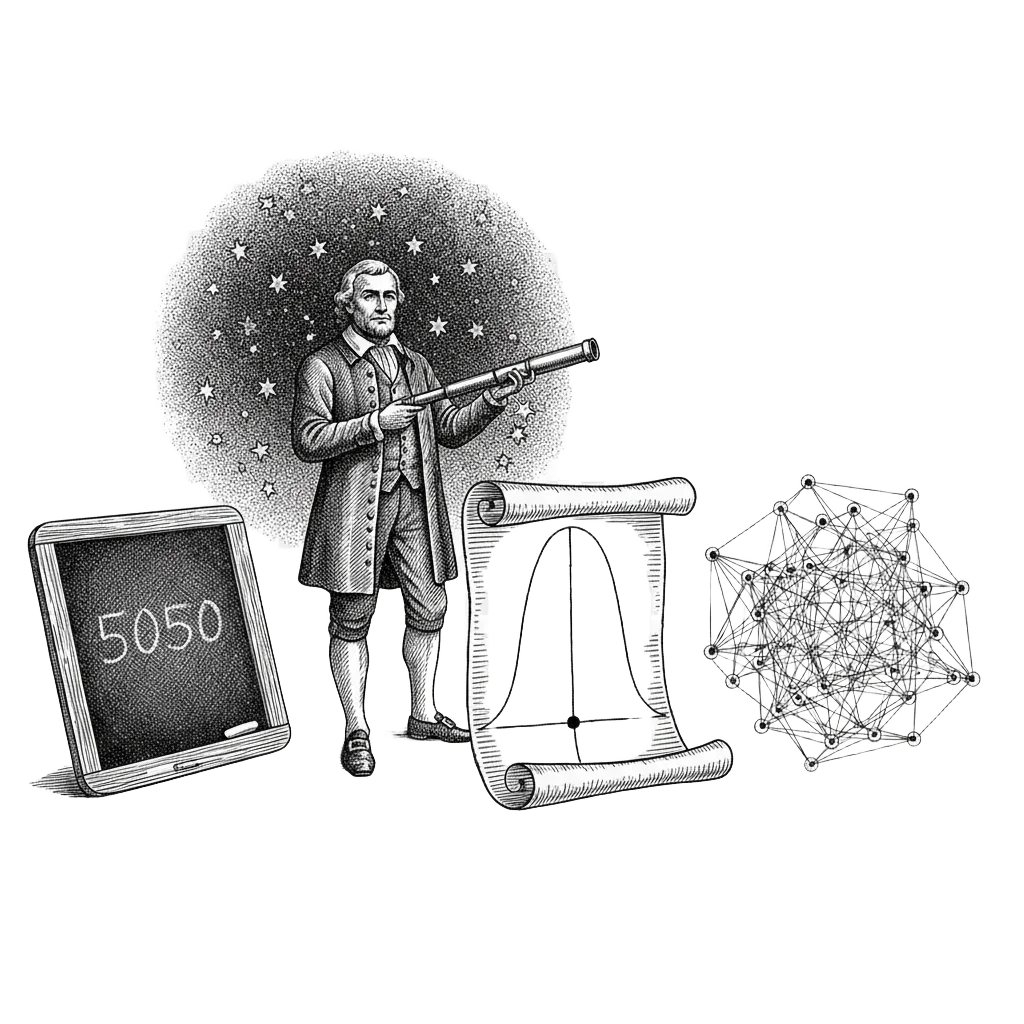
The boy with the slate grew up to be one of the most important mathematicians in history. He was later called the "Prince of Mathematicians."
Gauss made discoveries about prime numbers, helped astronomers find a lost planet-like object in the night sky, studied magnetism, and helped build the mathematics of chance. The famous bell-shaped curve used in statistics is still often called the Gaussian curve in his honour.
And the little pairing trick never went away either.
It is how we count connections in a network, how we plan tournaments where everyone plays everyone, and how computer scientists estimate how long simple sorting methods take - because comparing every item with every other item builds exactly the same kind of triangle.
Now for a confession: the story may not have happened quite like that.
The earliest written version comes from a friend and colleague of Gauss, published in 1856, shortly after Gauss died. It says the class was given a long sum of numbers that rose by the same amount each step - but it does not say 1 to 100.
Over the next century and a half, as the tale was retold in books and classrooms, it grew. The numbers became 1 to 100. The teacher became crueller. The details became sharper. The writer Brian Hayes went hunting for versions of the story and found more than a hundred of them, all slightly different.
And there is one more surprise.
The trick itself is about a thousand years older than Gauss.
Around the year 800, the English scholar Alcuin of York wrote a book of puzzles for young students. One of them describes a ladder with 100 rungs: 1 pigeon on the first rung, 2 on the second, 3 on the third, all the way to 100 on the top. How many pigeons are there altogether? Alcuin's solution pairs the rungs up from the ends toward the middle - the same folding idea - and arrives at the very same answer: 5050.
The details might be a legend. The trick is forever.
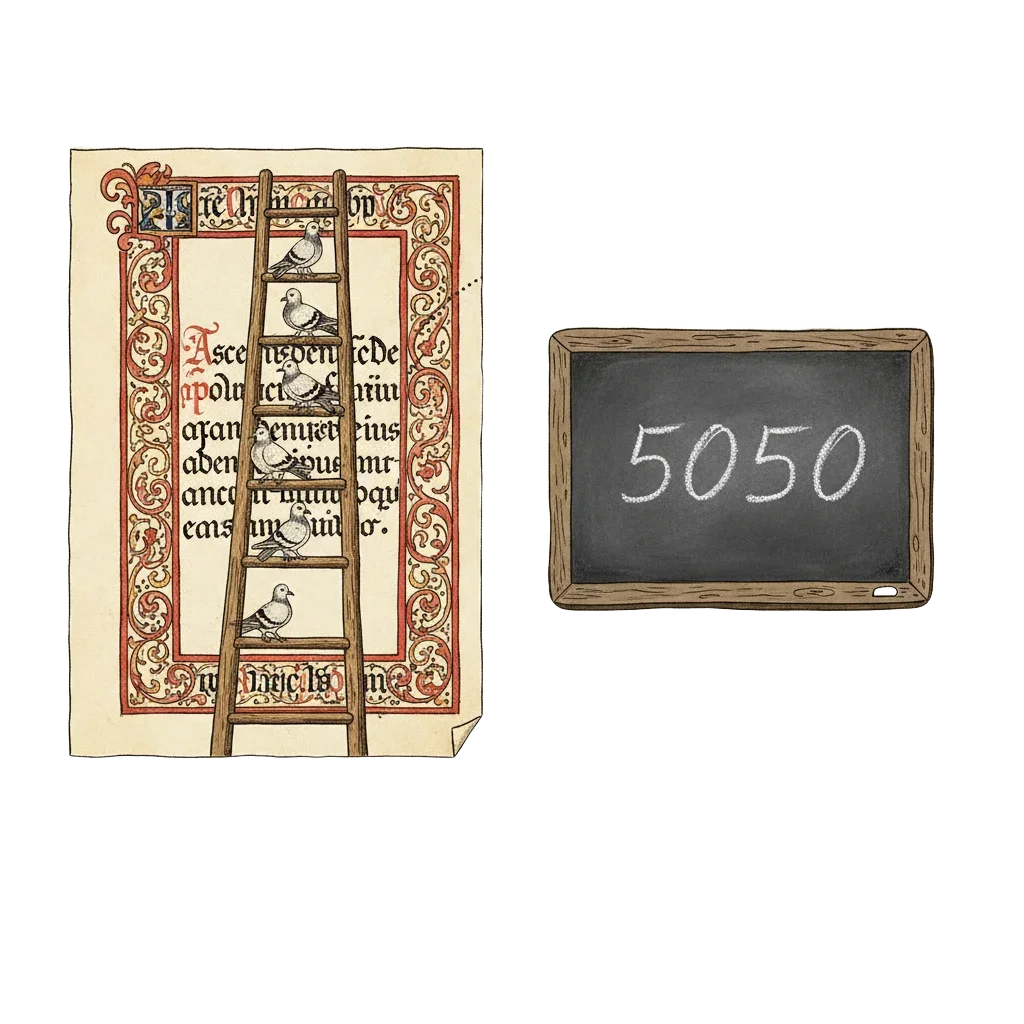
The same idea, a thousand years apart.
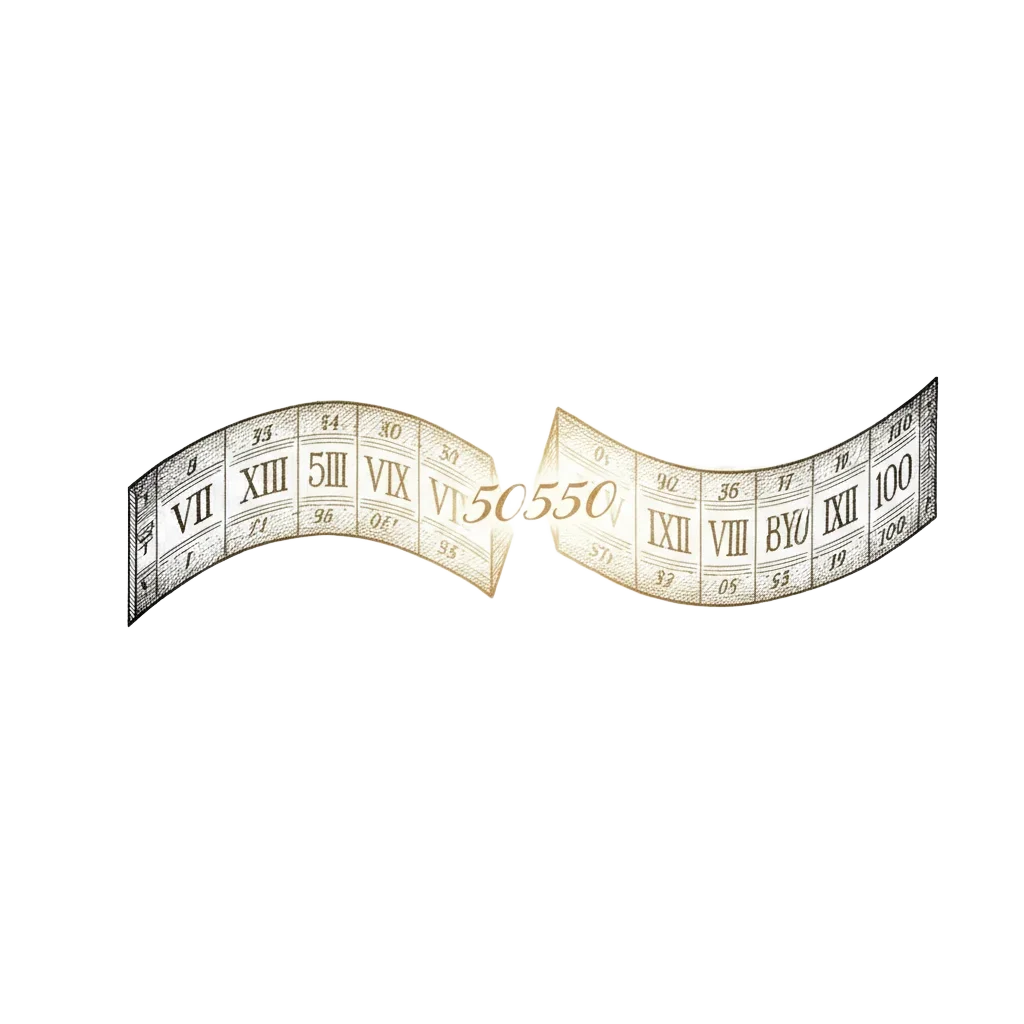
More than two centuries later, people everywhere still tell the story of the boy and the slate.
Partly because it is the first "aha" moment many of us ever meet in mathematics. Partly because anyone can check it with a pencil in a minute. Partly because we love an underdog - the poor bricklayer's son who outsmarted the schoolmaster.
But mostly because of what it teaches.
The other boys worked harder. Gauss looked differently.
He saw that a long, tiring line of numbers was secretly a fold - fifty identical pairs waiting to be noticed. That is one of the deepest habits in all of mathematics: before you work harder, look for the pattern that makes the work disappear.
The exhibit label
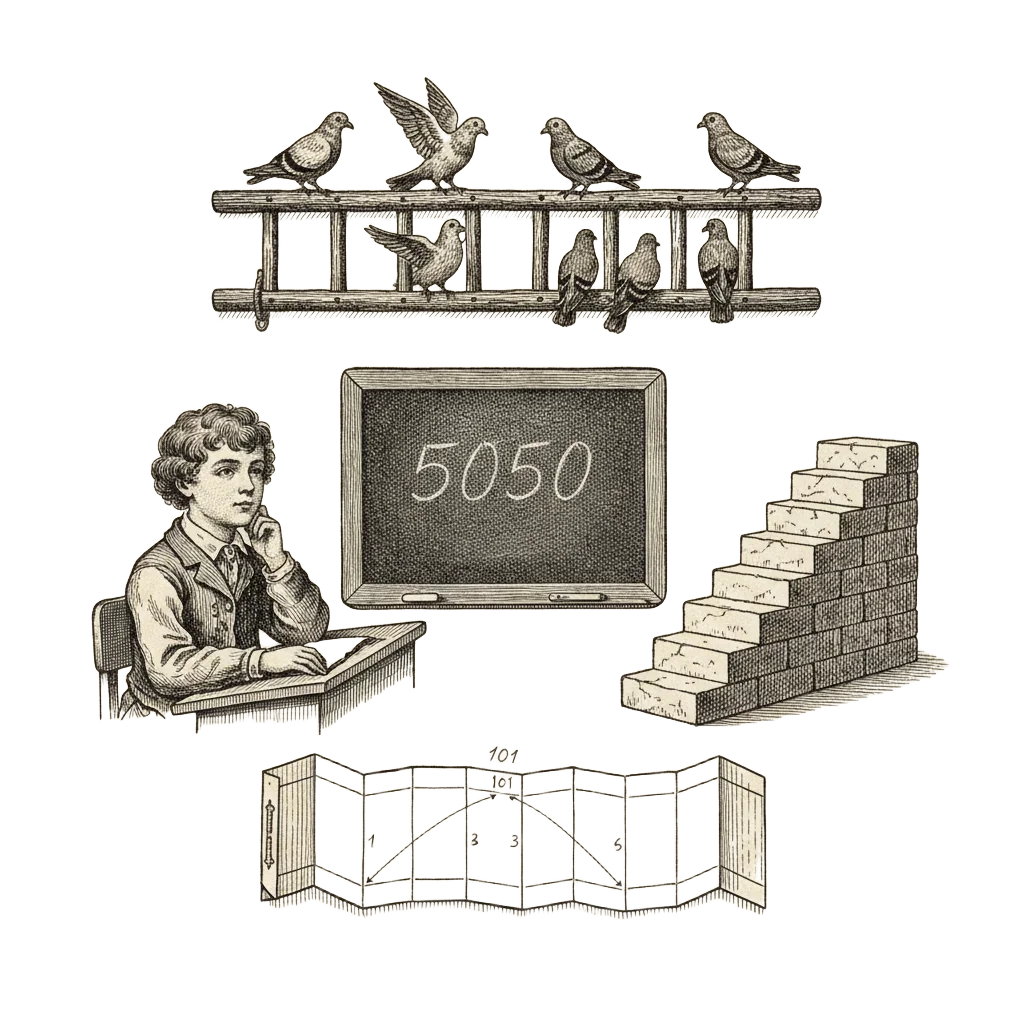
That little slate turned 5050 into one of the most famous sums in the world.
Some numbers are famous for how big they are.
5050 is what you get when you stop adding and start looking.
Powered by DollarPageClub