Physics & Constants
299,792,458
The speed of light in metres per second. Once measured, now defined. The number that set its own ruler.
→Exhibit No. α
The number physics can measure but cannot explain
There is a number hidden inside every flash of light, every spark, every glowing screen. It decides how strongly light and matter grab hold of each other. Change it by a little, and stars, atoms and chemistry itself would behave very differently. Physicists have measured it to about a dozen digits. Not one of them can tell you why it is what it is.
It is very close to 1/137.
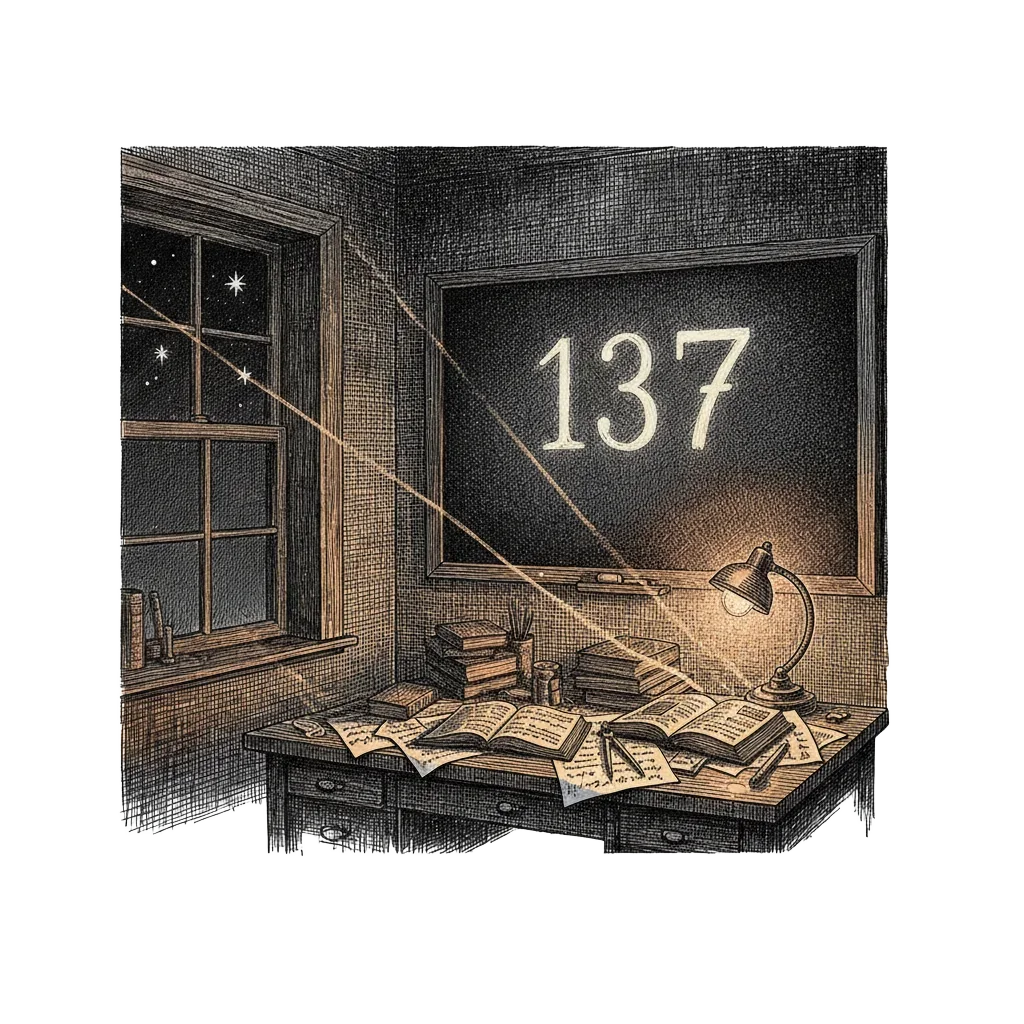
A number without units, without origin, without explanation. ↓
The first obsession
In the late 1920s, one of the most famous scientists in the world became fascinated by this number.
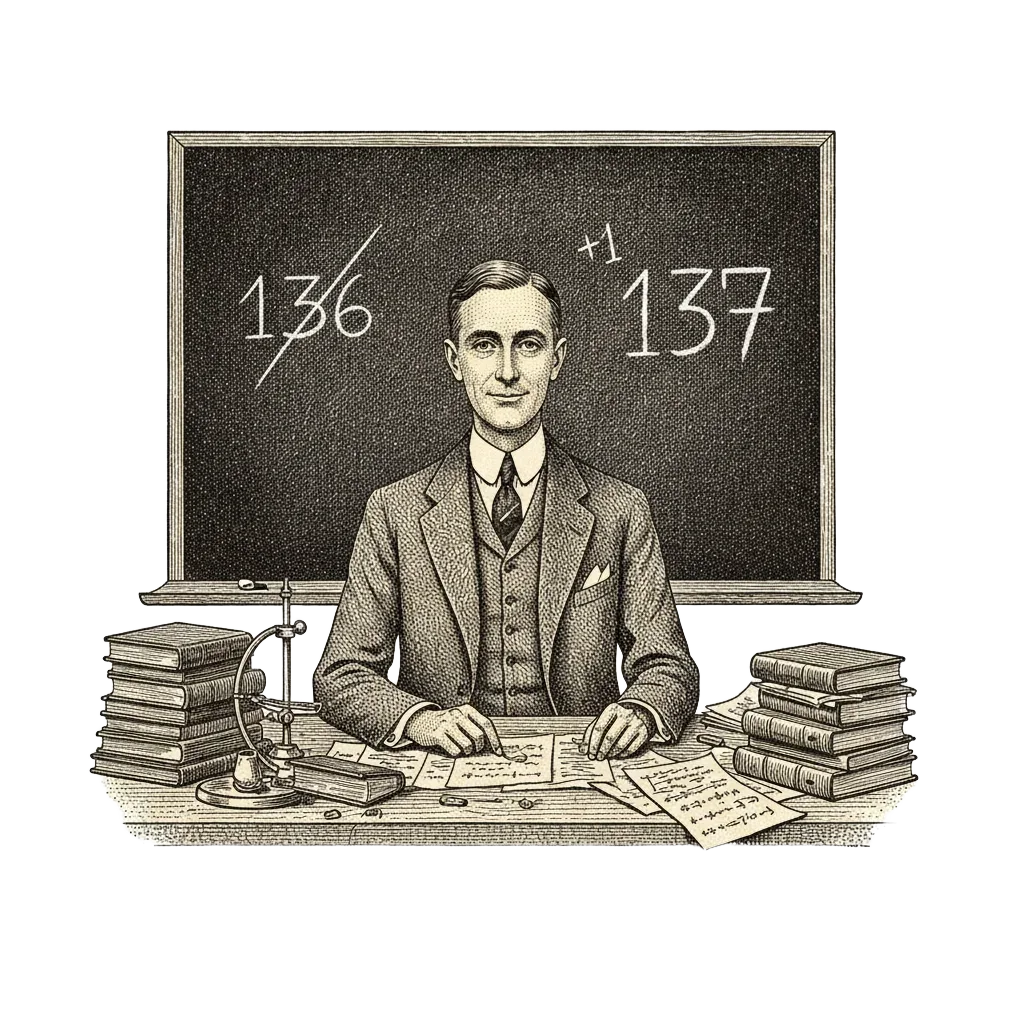
Sir Arthur Eddington was the English astronomer who, in 1919, had helped confirm Einstein's theory of gravity by photographing stars during a total eclipse. He was brilliant, celebrated, and very sure of himself.
Experiments at the time put the number at roughly 1/136. Eddington decided that this could not be an accident. In 1929 he announced that the value must be exactly 1/136 - and that he could work it out from pure reasoning, without any experiment at all.
He went even further. Using the same ideas, he claimed to know the exact number of protons in the entire universe: 136 × 2²⁵⁶ - a number 80 digits long.
Then the measurements improved.
The number was not 1/136 after all. It was closer to 1/137. So Eddington went back to his argument, found a reason to add one, and announced that the true value was exactly 1/137. He stuck to it for the rest of his life, insisting he had obtained it "by pure deduction."
Other scientists were not convinced. The wits of the day gave him a new name:
Sir Arthur Adding-One.
A prank in a serious journal
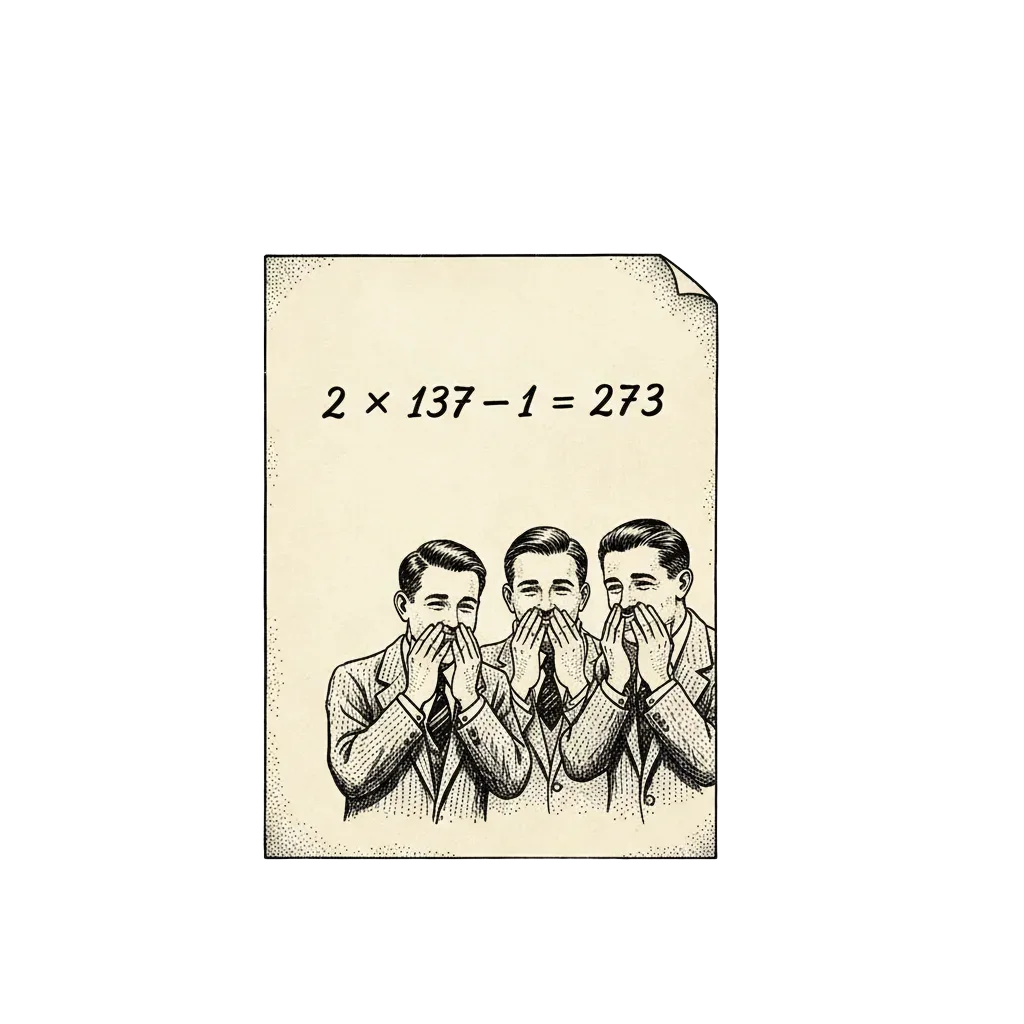
In 1931, three young physicists - Guido Beck, Hans Bethe and Wolfgang Riezler - decided to poke fun at number-guessing like Eddington's.
They wrote a mock-serious paper "deriving" the temperature of absolute zero from the number 137: take 2 × 137, subtract 1, and you get 273 - which just happens to be the number of degrees below freezing where absolute zero sits.
The respected journal Die Naturwissenschaften published it. It was a joke - and Bethe went on to win a Nobel Prize.
The science
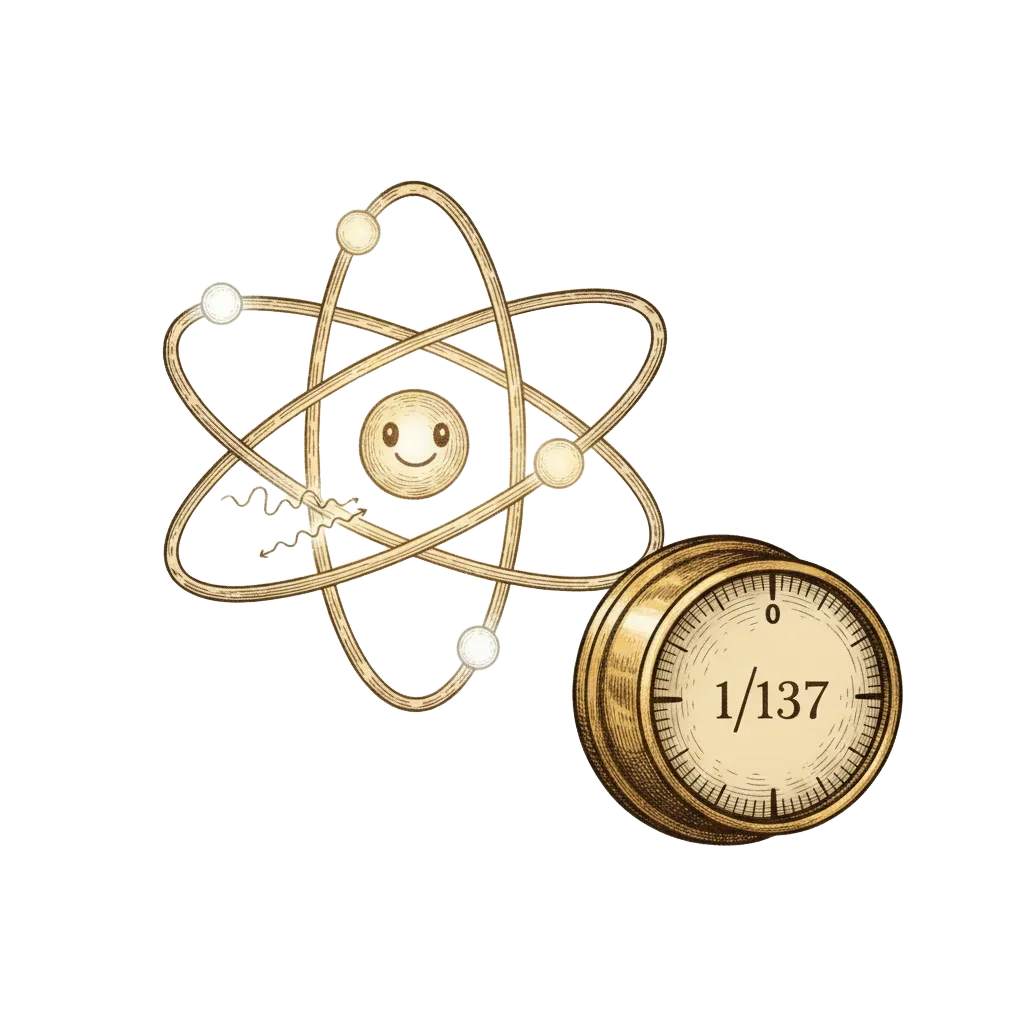
Everything you can see comes down to one simple event, repeated trillions of times: an electron - a tiny charged particle inside every atom - catches or throws off a particle of light, a photon.
That is how a lamp glows, how your eyes see, how a phone screen lights up, and how atoms hold themselves together.
The fine-structure constant tells you how strong that handshake is.
Think of it as a kind of volume knob for electricity and light. At about 1/137, the knob is turned down low - which is why the handshake is gentle, why atoms are the size they are, and why light and matter behave the way they do.
Here is one way to picture it. In the simplest picture of a hydrogen atom, the electron whirls around the centre at about 1/137 of the speed of light - roughly 2,188 kilometres every second.
Fast by our standards. Slow and steady by the universe's.
The mystery
This is where the story stops being a story and becomes a mystery.
Most numbers in physics come with units: metres, seconds, kilograms. Change the units, and the number changes. The fine-structure constant is different. It is a pure number. It has no units at all.
It comes out the same whether you measure in metres or miles, on Earth or on Mars, today or in a distant galaxy.
That makes it feel less like a human measurement and more like a setting built into nature itself.
And the best measurements today put it at:
1/137.035999177…
Not exactly 1/136. Not exactly 1/137. Something stubbornly in between, with no obvious pattern in the digits.
Nobody has found a way to calculate it from first principles. We can only measure it - and wonder.
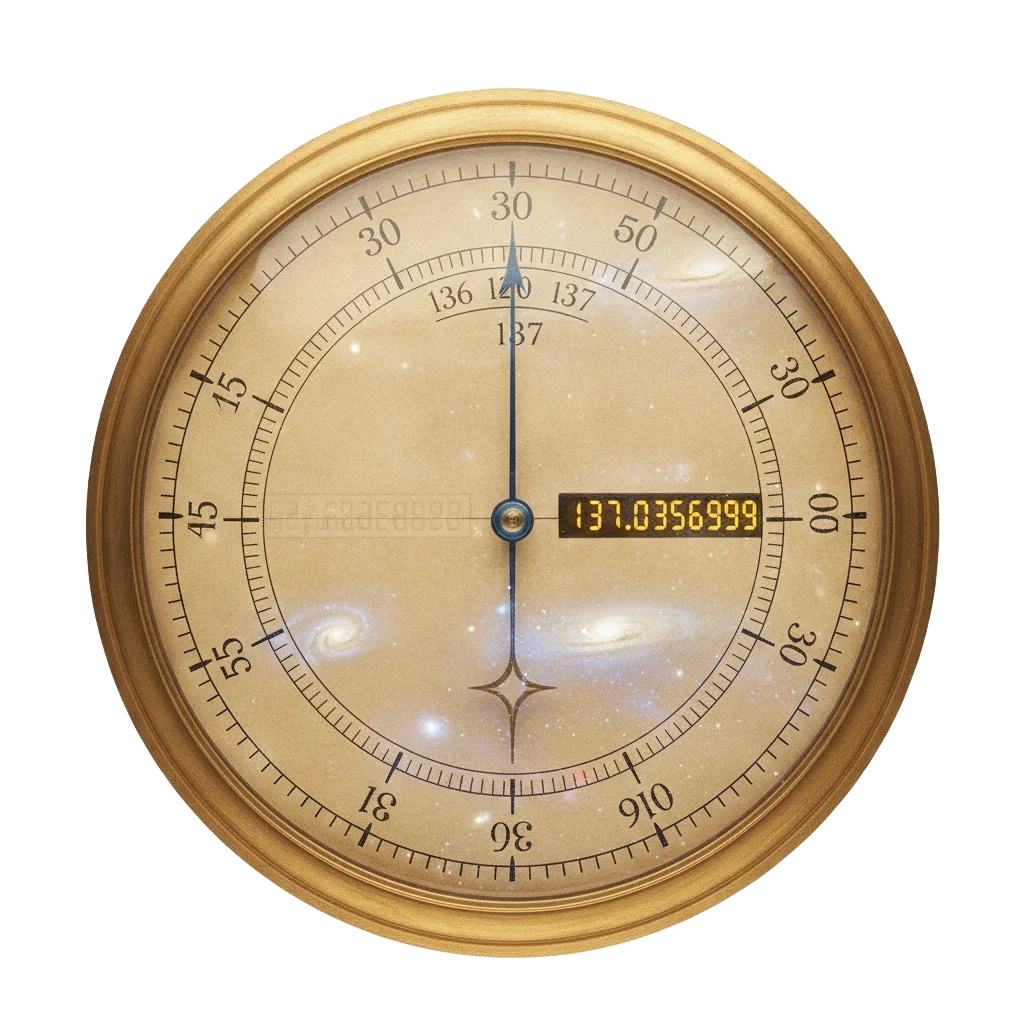
Is it exactly 1/137?
No. Using the best current value:
Close enough to fool a hopeful theorist. Different enough that experiments can tell.

The confession
Half a century later, the great physicist Richard Feynman - a man famous for explaining hard ideas simply - admitted he could not explain this one.
In his 1985 book QED: The Strange Theory of Light and Matter, he wrote that the number has been a mystery ever since it was discovered, and that "all good theoretical physicists put this number up on their wall and worry about it."
Then he added:
"It's one of the greatest damn mysteries of physics: a magic number that comes to us with no understanding by man."
He even joked that you might say the "hand of God" wrote that number, "and we don't know how He pushed His pencil."
For a scientist, that is quite a confession.
The most repeated story in physics
No one was more haunted by the number than Wolfgang Pauli, one of the founders of quantum physics and a Nobel Prize winner.
Pauli was famously sharp-tongued and famously practical - yet 137 fascinated him. He spent years discussing it, and the deeper meaning of numbers in nature, with his friend, the psychologist Carl Jung.
In December 1958, Pauli fell seriously ill and was taken to the Red Cross Hospital in Zurich.
The story goes that when he saw the number on the door of his hospital room, he was shaken.
It was room 137.
Pauli died there on 15 December 1958, at the age of 58.
It is one of the most repeated stories in physics. Whether it means anything is, of course, another matter - but it is hard to forget.

The bigger picture
Why does it matter that the knob is turned to about 1/137?
Because the universe seems to depend on it.
If the number were noticeably different, the balance inside atoms and stars would change. Physicists who explore these "what if" universes find that small changes could affect how stars burn and how atoms like carbon - the stuff of life - are made.
No one knows whether it could ever have been different, or why it landed where it did.
Some think one day a deeper theory will produce 137.035999… as neatly as 50 × 101 produces 5050. Some suspect it is simply how our universe happened to turn out.
For now, it is the same thing Feynman called it: a number we can measure beautifully, and explain not at all.

Still open
Plenty of numbers in physics are important. Very few have a fan club.
1/137 has one because of its stories: the famous astronomer who "added one," the young physicists who pranked a serious journal, the Nobel laureate in room 137, and the great explainer who pinned it to his wall.
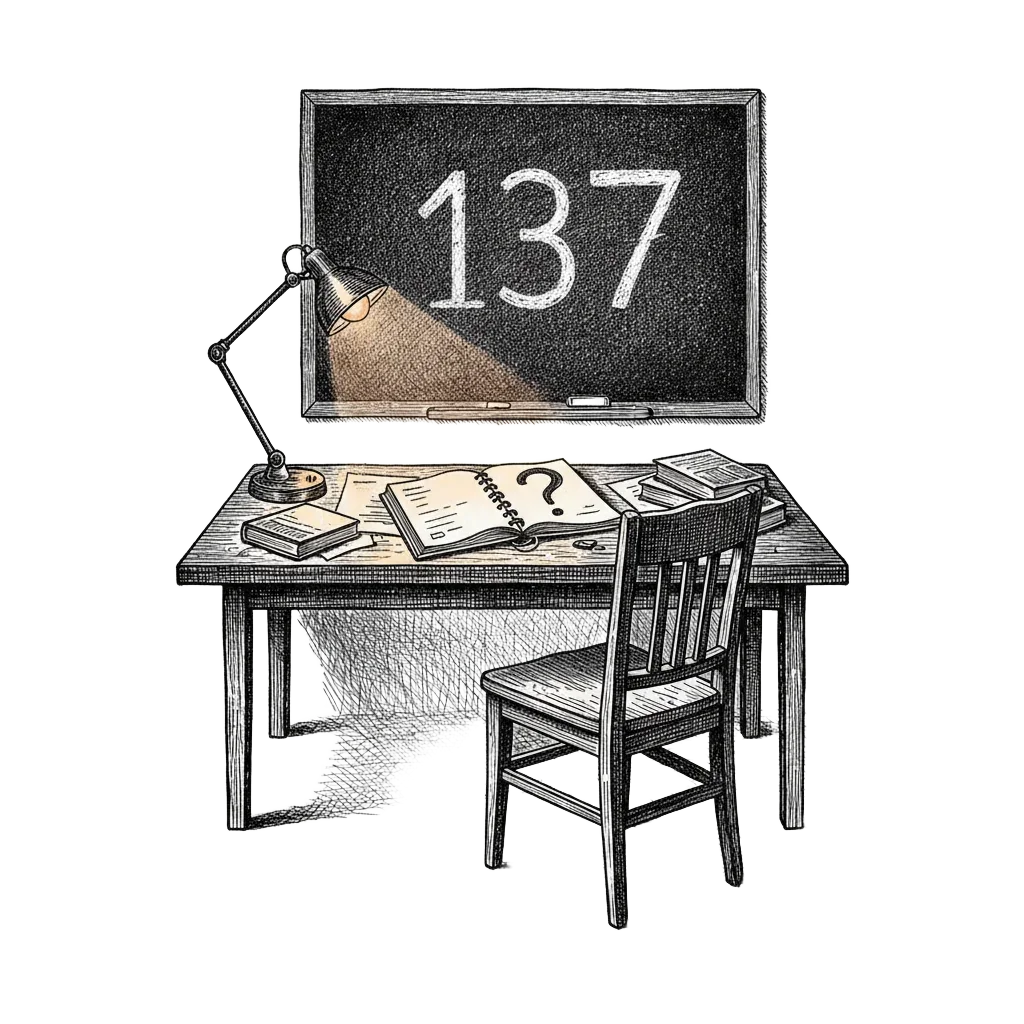
But mostly it is remembered because it is still open.
Every other number in this museum has an explanation waiting at the end of the story. This one does not. Not yet.
The summary
Here is why 1/137 matters:
It is the fine-structure constant: a measure of how strongly light and electrically charged matter interact.
It is a pure number, with no units - the same in every system of measurement.
Its best measured value is about 1/137.035999177.
Arthur Eddington tried to prove it was exactly 1/136, then exactly 1/137 - earning the nickname "Sir Arthur Adding-One."
In 1931, three young physicists published a spoof paper using 137 to "derive" absolute zero.
Richard Feynman called it "one of the greatest damn mysteries of physics."
Wolfgang Pauli, who was fascinated by 137, died in room 137 of a Zurich hospital in 1958.
Nobody yet knows why it has the value it does.
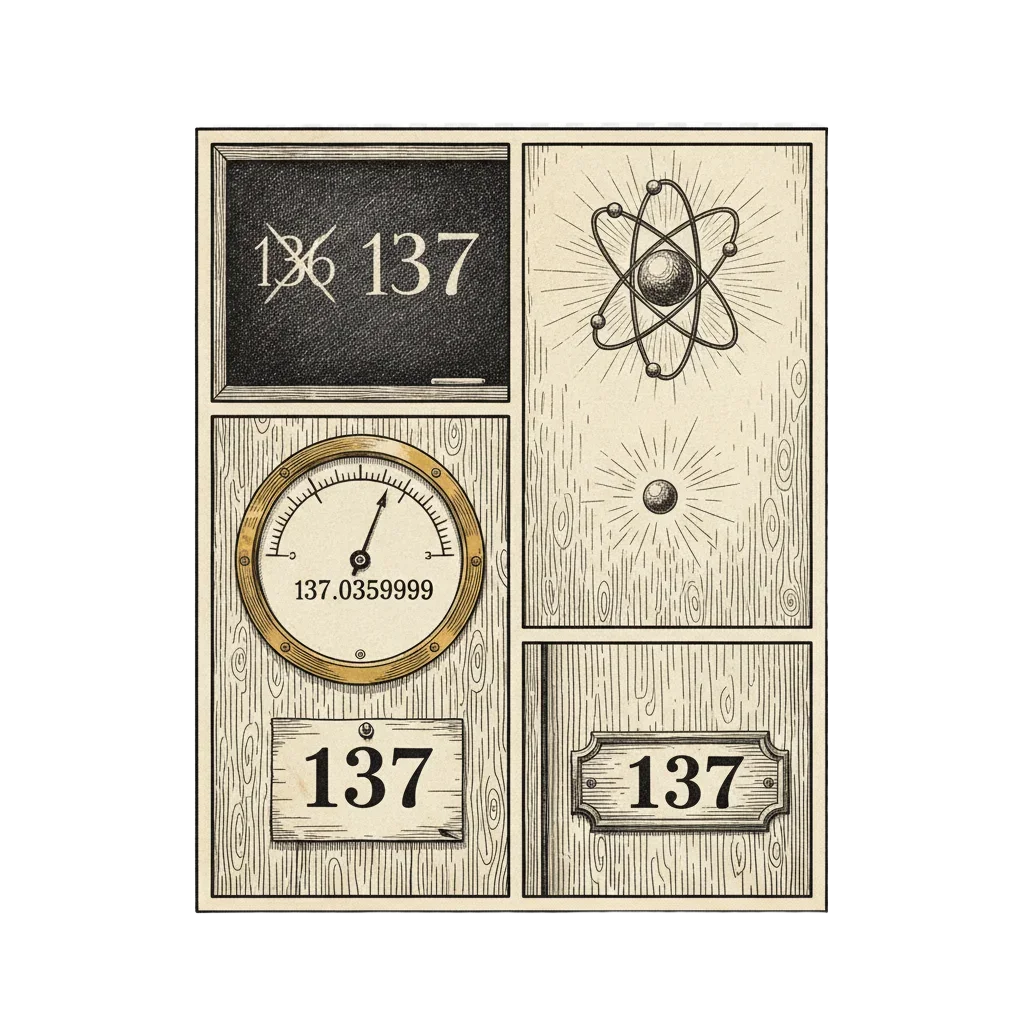
We can measure it to a dozen digits. We still cannot say why.
The numbers people are reading, arguing about and sending to friends this month.
+5.0%
1729
+3.6%
5050
+5.2%
299,792,458
+18.4%
1/137
+6.3%
2,147,483,647
+5.7%
0.999…
+6.5%
42
+5.23%
6174
No syllabus. No signup. Just exhibits. Pull open a drawer, read a label, follow whichever footnote looks most suspicious, and let the collection take you somewhere you did not plan to go.
Powered by DollarPageClub