5050
The schoolboy shortcut that Gauss used to add 1 through 100 in seconds - and the triangular trick behind the number of pairs in a room of 23.
Read the exhibitHow many people do you need in a room before two of them probably share a birthday? There are 365 days in a year, so most people guess something big. A hundred. Maybe 180.
The real answer is 23.
Just 23 people - the players and the referee on a football pitch - and it is more likely than not that two of them blow out their candles on the same day.
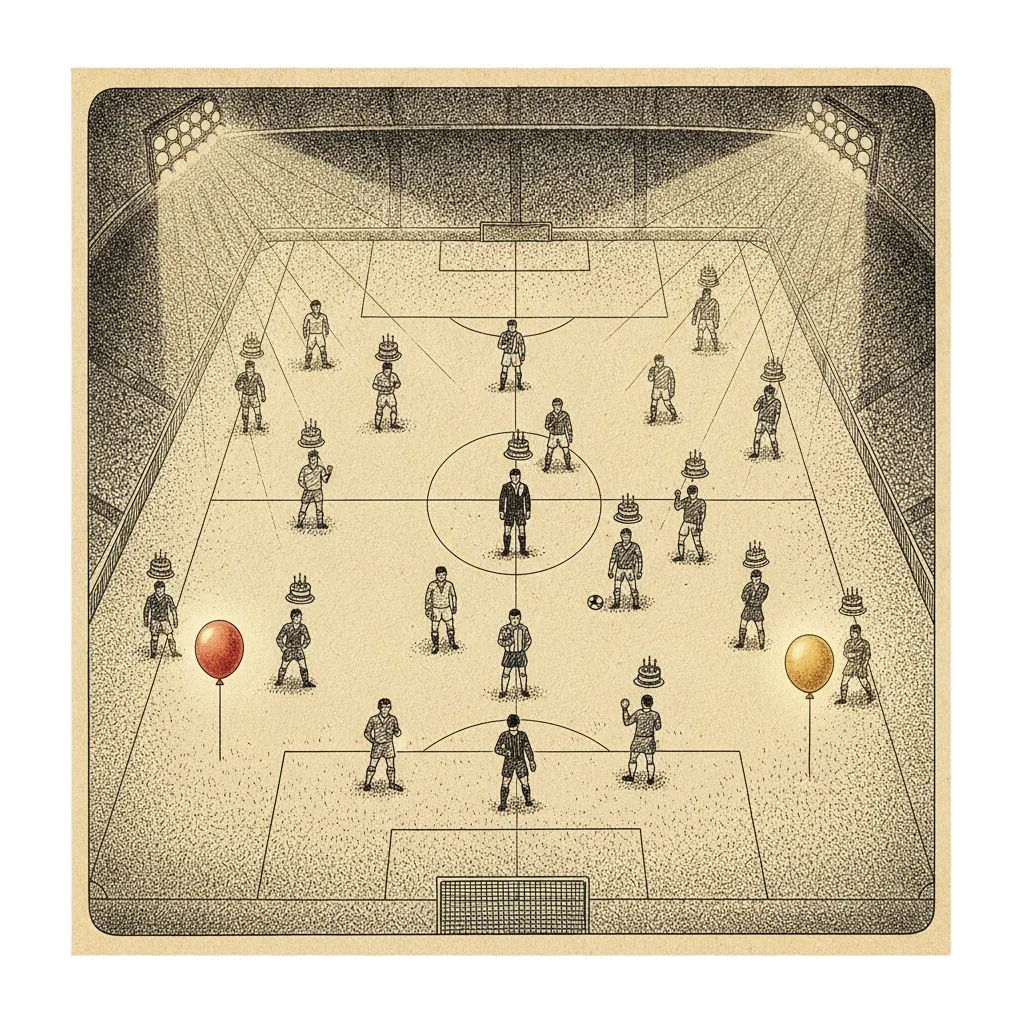
Exhibit 23 / Birthday Paradox
Before reading on, make a guess.
Imagine a party where guests keep arriving, one at a time. Each time someone walks in, everyone compares birthdays. At what point does it become a better-than-even bet that two guests share one?
Most people's instinct says it should take a crowd of well over a hundred. After all, there are 365 possible birthdays, and a room of 23 people barely covers a few weeks of the calendar.
Here is what actually happens as the room fills up:
By the time 70 people are in the room, a shared birthday is almost certain. Only one room guarantees it outright: 366 people, when there are more guests than days - or 367 if you count 29 February.
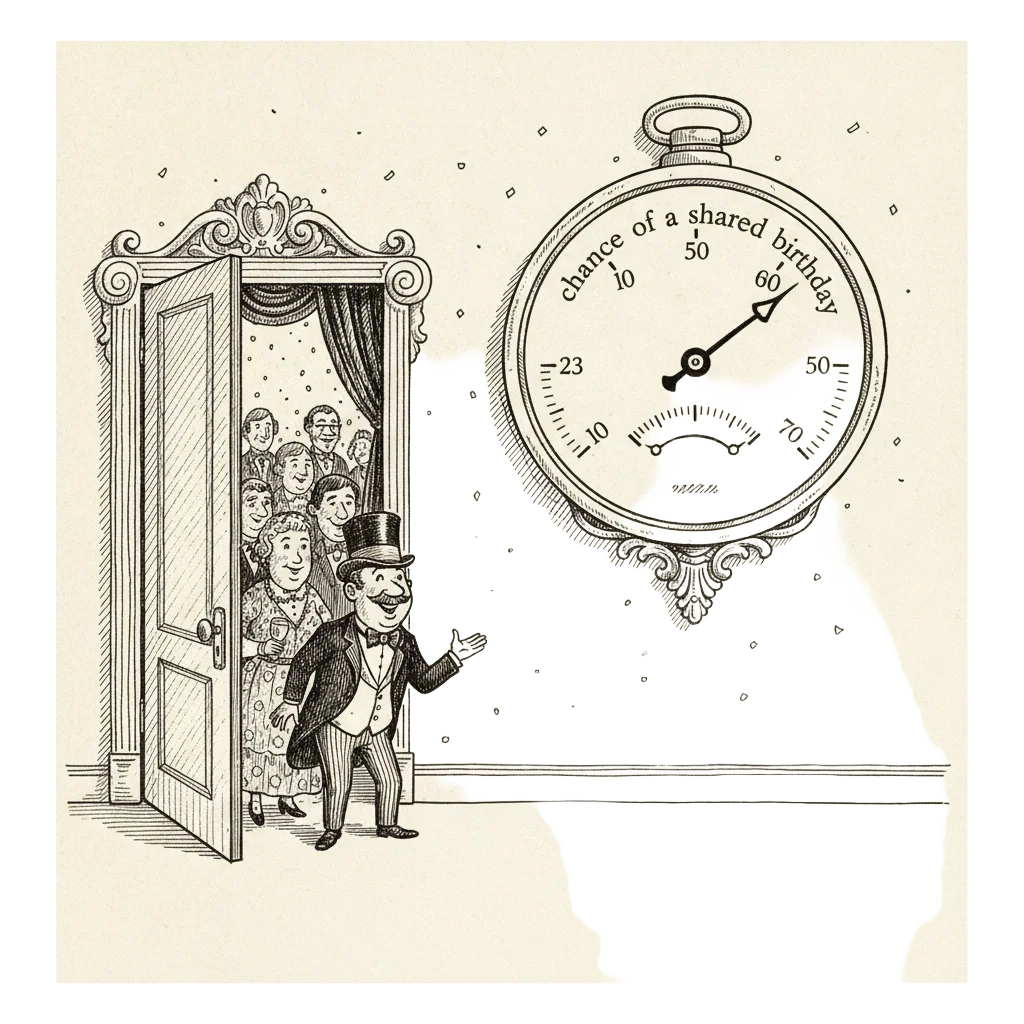
The needle tips over at 23.
A famous mistake
Even very clever people trip over this one.
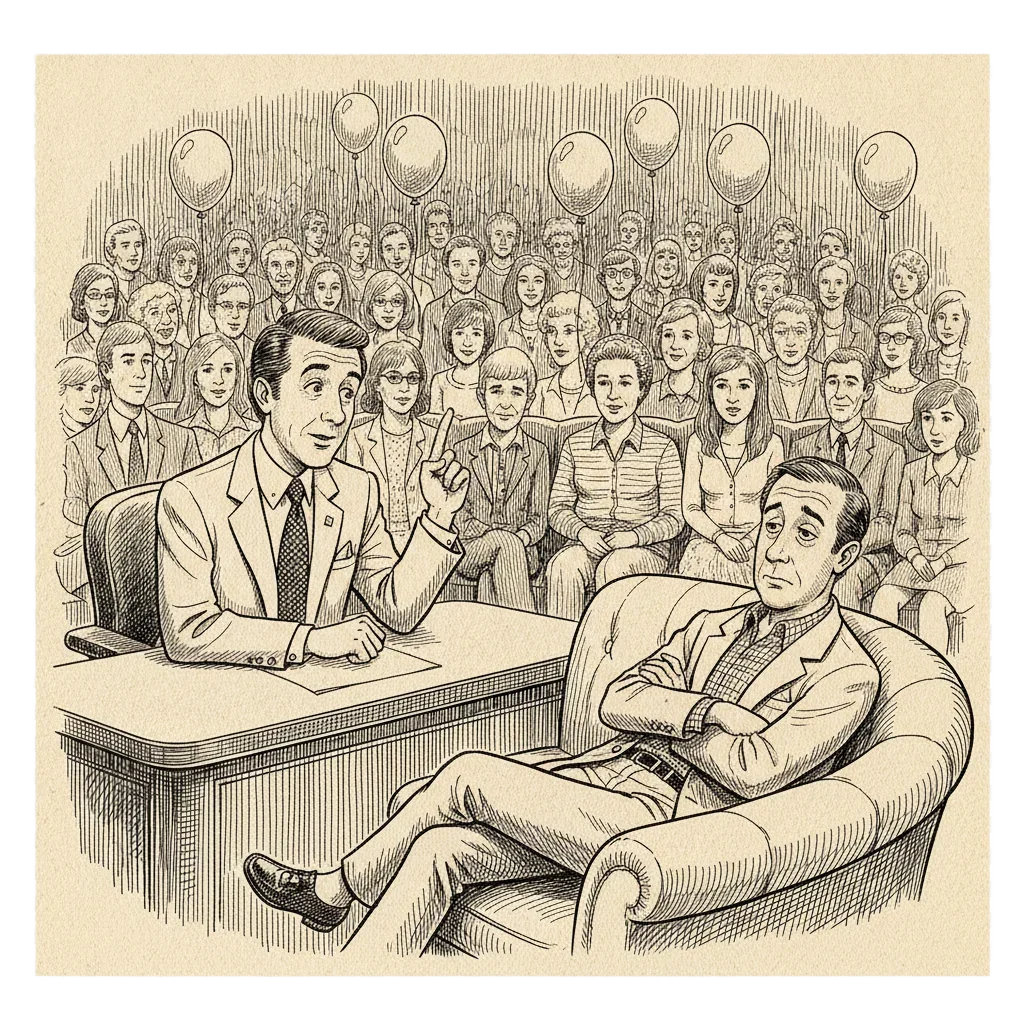
In February 1980, on The Tonight Show, America's most famous talk-show host, Johnny Carson, and his sidekick Ed McMahon got talking about the birthday problem. It sounded like nonsense to them. So Carson decided to test it on his studio audience - a crowd of a few hundred people, far more than 23.
But instead of asking whether any two people in the room shared a birthday, he picked out particular birthdays and asked whether anyone in the audience matched them. When the first matches didn't turn up, he and McMahon were unconvinced by the whole thing.
Carson had fallen into exactly the trap that makes this puzzle so famous. Matching one particular birthday is hard. Matching any two birthdays is easy. They are completely different questions.
(As it happens, Carson's own birthday was 23 October.)
The key insight
Here is the key that unlocks the puzzle.
A birthday match does not need to involve you. It can happen between any two people in the room.
So the question is not "how many people are there?" but "how many pairs of people are there?"
With 23 people, the first person can be paired with 22 others. The second with 21 more. The third with 20 more… and so on, down to the last pair.
Add them all up: 22 + 21 + 20 + … + 1 = 253 pairs.
That is eleven times as many chances as there are people. Each of those 253 pairs is a small lottery ticket with a 1-in-365 chance of matching. With that many tickets, the odds of at least one winner climb to just over a half.
Our intuition quietly counts people. The mathematics counts pairs. That is the whole surprise.

23 people, 253 pairs.
A familiar shape
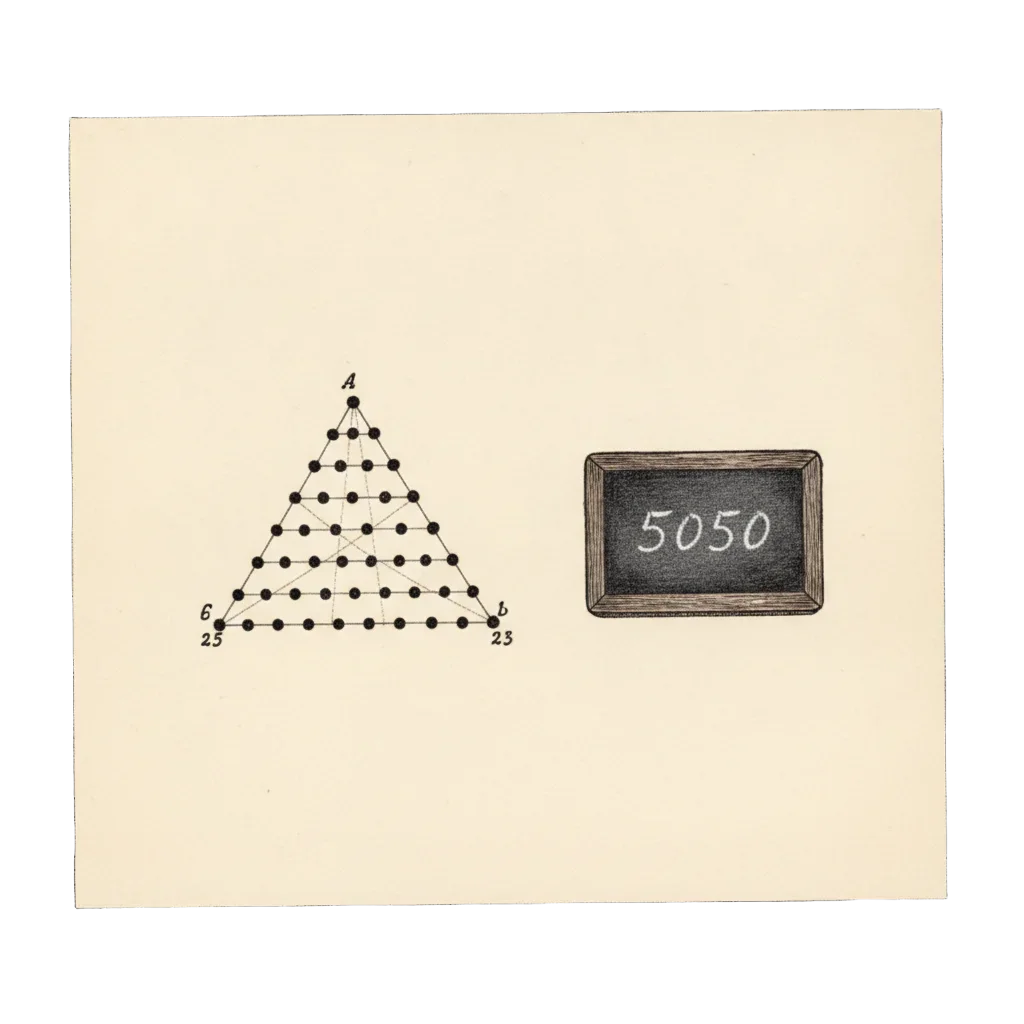
Adding up 1 + 2 + 3 + … is exactly the trick young Gauss used in the story of 5050. Using his rule - multiply the last number by the next one, then halve it - the pairs among 23 people come to 22 × 23 ÷ 2 = 253.
253 is a triangular number, a smaller cousin of 5050. Every time everyone is paired with everyone, triangles appear.
Read about 5050The calculation
Why does the tipping point land on 23, and not 20 or 30?
Think of it the other way round: what is the chance that nobody shares a birthday?
The first person can have any birthday. The second must avoid one day: 364 out of 365 chances. The third must avoid two days: 363 out of 365. The fourth, 362 out of 365. And so on.
Each new guest has to dodge every birthday already in the room, and the room keeps getting more crowded. Multiply all those chances together, and the chance of no match shrinks with every arrival.
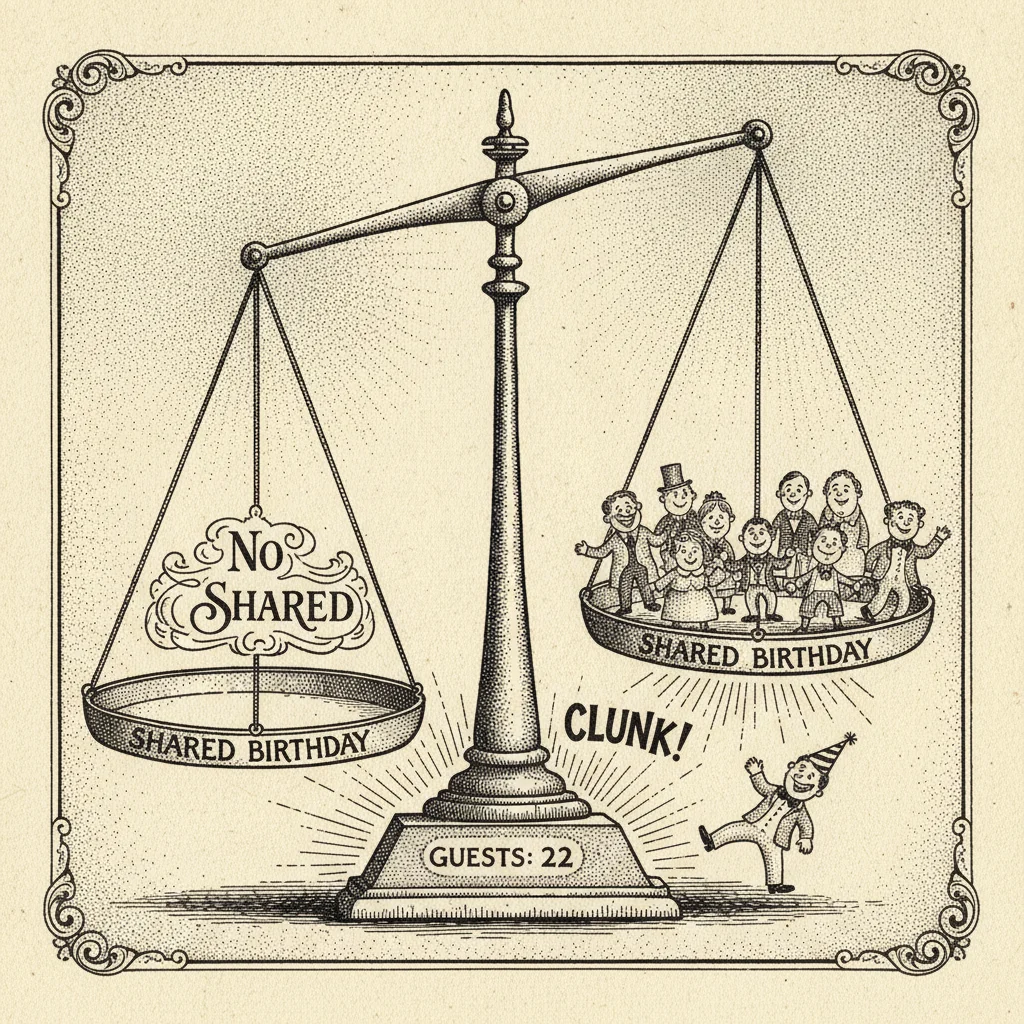
23 is simply the first crowd where the scales tip.
The small print
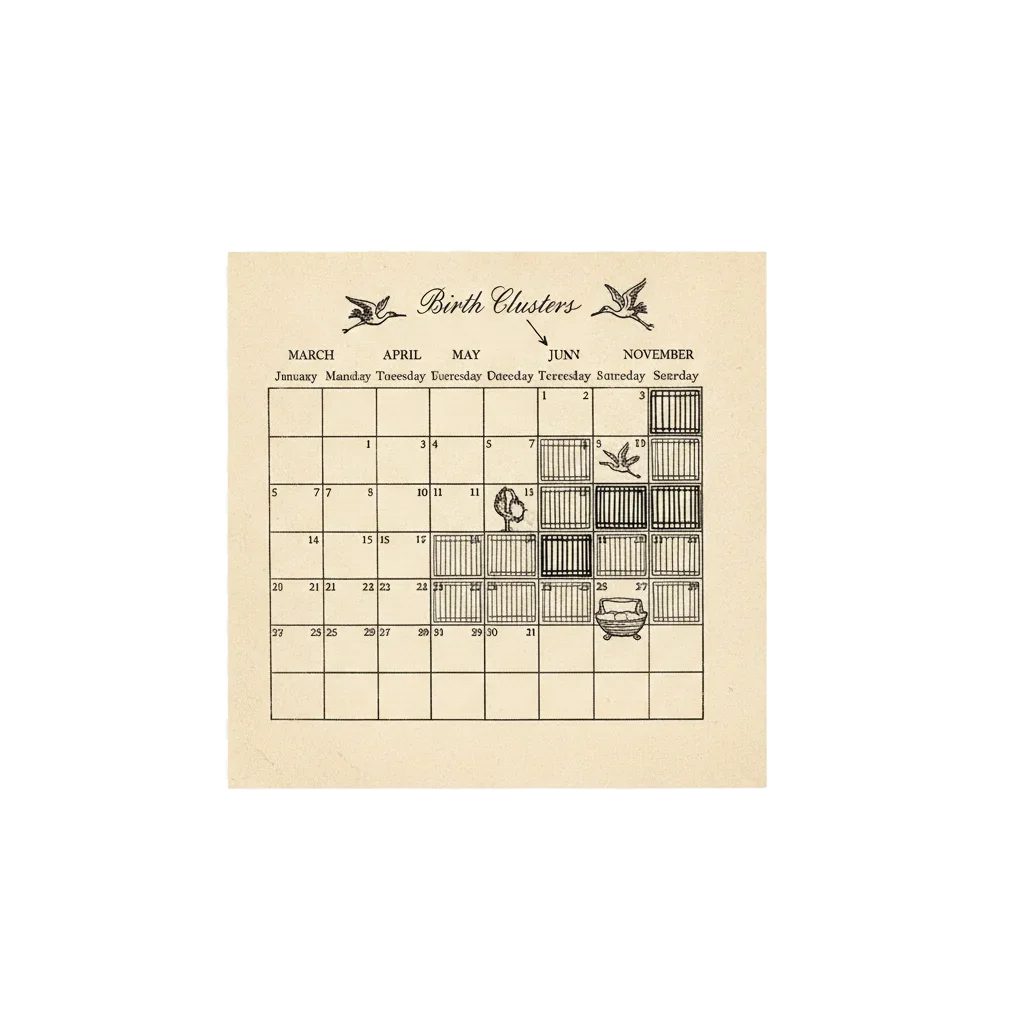
This calculation assumes every birthday is equally likely and ignores 29 February. In real life, birthdays are not perfectly spread out - some times of year are more popular than others. That actually makes shared birthdays slightly more likely, not less.
Real-world proof
Real life can test this for us, and football is perfect for it.
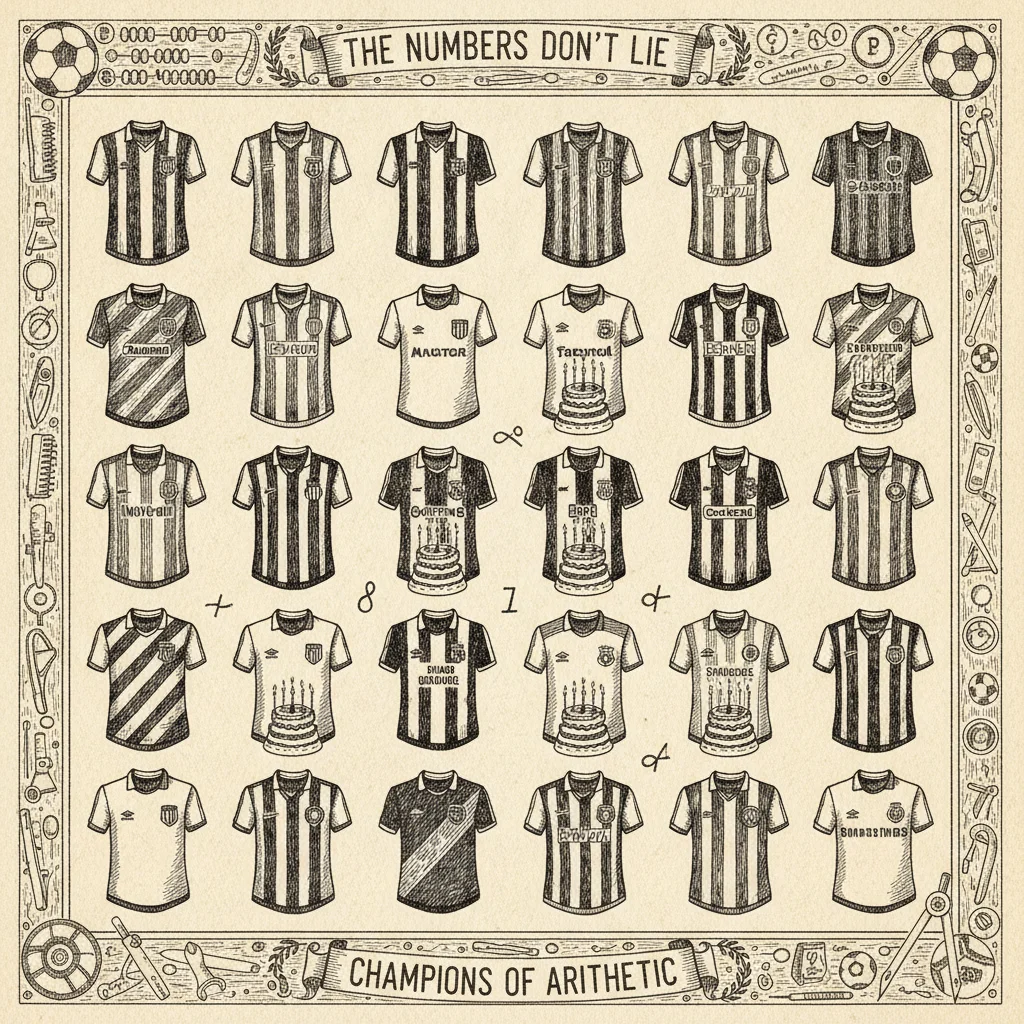
At the 2014 World Cup in Brazil, each of the 32 teams brought a squad of exactly 23 players. The BBC checked the official squad lists. The birthday paradox says that roughly half of the teams should contain a shared birthday.
The count: 16 teams out of 32. Exactly half.
Five of those teams even had two separate pairs of birthday twins.
Next time you watch a football match, count the people on the pitch: 22 players and one referee. Twenty-three. The odds are slightly better than a coin toss that two of them share a birthday.
The other question
Here is where Johnny Carson went wrong - and where most of us go wrong too.
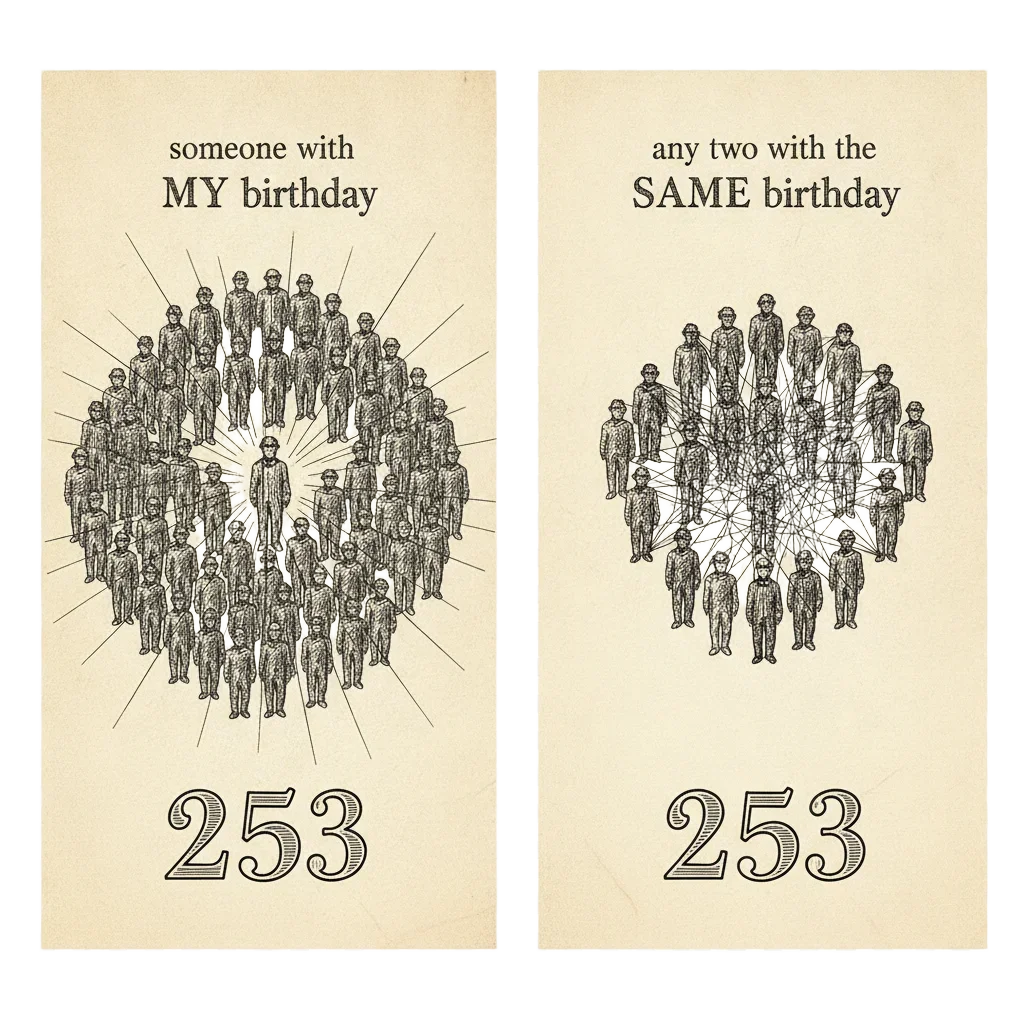
Ask a different question: how many people would you need before it becomes more likely than not that someone shares your own birthday?
Now there are no pairs to help you. Every other person has only a 1-in-365 chance of matching you.
The answer is 253 people.
That is the very same number as the count of pairs in a room of 23. And it is no coincidence: each of those 253 pairs is a fresh 1-in-365 chance, much like 253 strangers each being checked against you.
So when your gut says "you need a big crowd", it is answering the second question - someone matching me - when the puzzle is really asking the first - anyone matching anyone.
The bigger picture
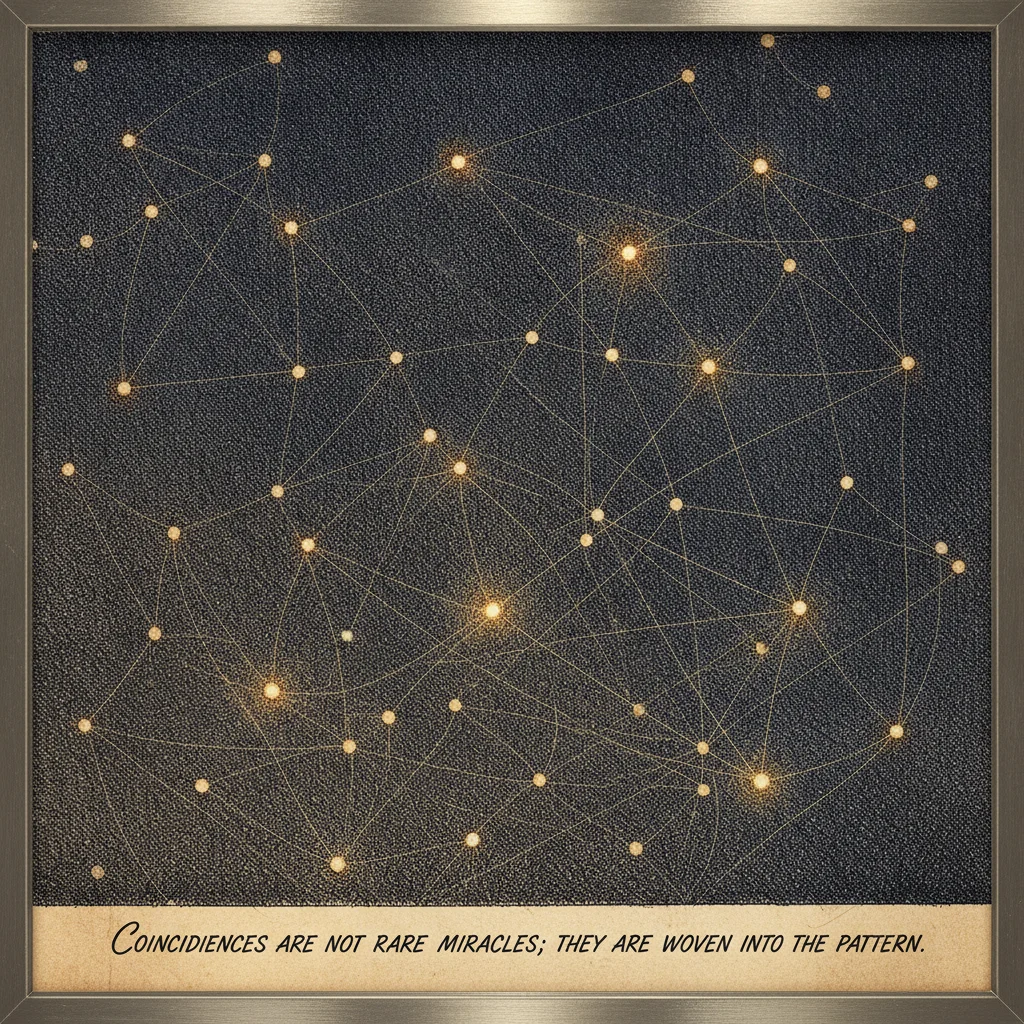
The birthday paradox is not really about birthdays. It is about coincidences.
Whenever there are lots of things that could match each other, matches become far more common than our instincts expect - because the number of possible pairs grows much faster than the number of things.
It is why you bump into a friend-of-a-friend on holiday. Why two people at a wedding turn out to share a hometown. Why "what are the odds?" moments happen so often.
The same maths protects our digital lives. Computer security experts use it to work out how long a secret code needs to be, because attackers can use the birthday trick to find two matching codes far faster than you might expect. They even call one method a "birthday attack".
The odds of any one particular coincidence are small. The odds of some coincidence, somewhere, are enormous.

The exhibit in brief
In a group of just 23 people, there is a 50.7% chance that two share a birthday.
With 70 people, the chance is 99.9%.
The secret is pairs: 23 people make 253 pairs - 22 × 23 ÷ 2, a triangular number like 5050.
Johnny Carson famously tested it on The Tonight Show in 1980 by looking for matches to particular birthdays, which is a different question.
To have an even chance that someone shares your birthday, you need 253 people.
At the 2014 World Cup, 16 of the 32 squads of 23 players had a shared birthday.
23 is exactly the number of people on a football pitch during a match: 22 players and a referee.
We count people. Chance counts pairs.
23 is the smallest crowd where coincidence stops being a surprise.
Keep exploring
No syllabus. No signup. Just exhibits. Pull open a drawer, read a label, follow whichever footnote looks most suspicious, and let the collection take you somewhere you did not plan to go.
Inspired by
Powered by DollarPageClub