Museum of Numbers
Oddly Specific Numbers / Mathematical Curiosities

358

The years it took to fill a margin

Around 1637, a French lawyer scribbled a note in the margin of an old book.
He claimed he had found a marvellous proof - but the margin was too small to hold it.
Then he never wrote it down anywhere else.

For 358 years, some of the greatest minds in history tried to find what he said he had found. The answer finally arrived in 1995 - and it ran to more than a hundred pages.
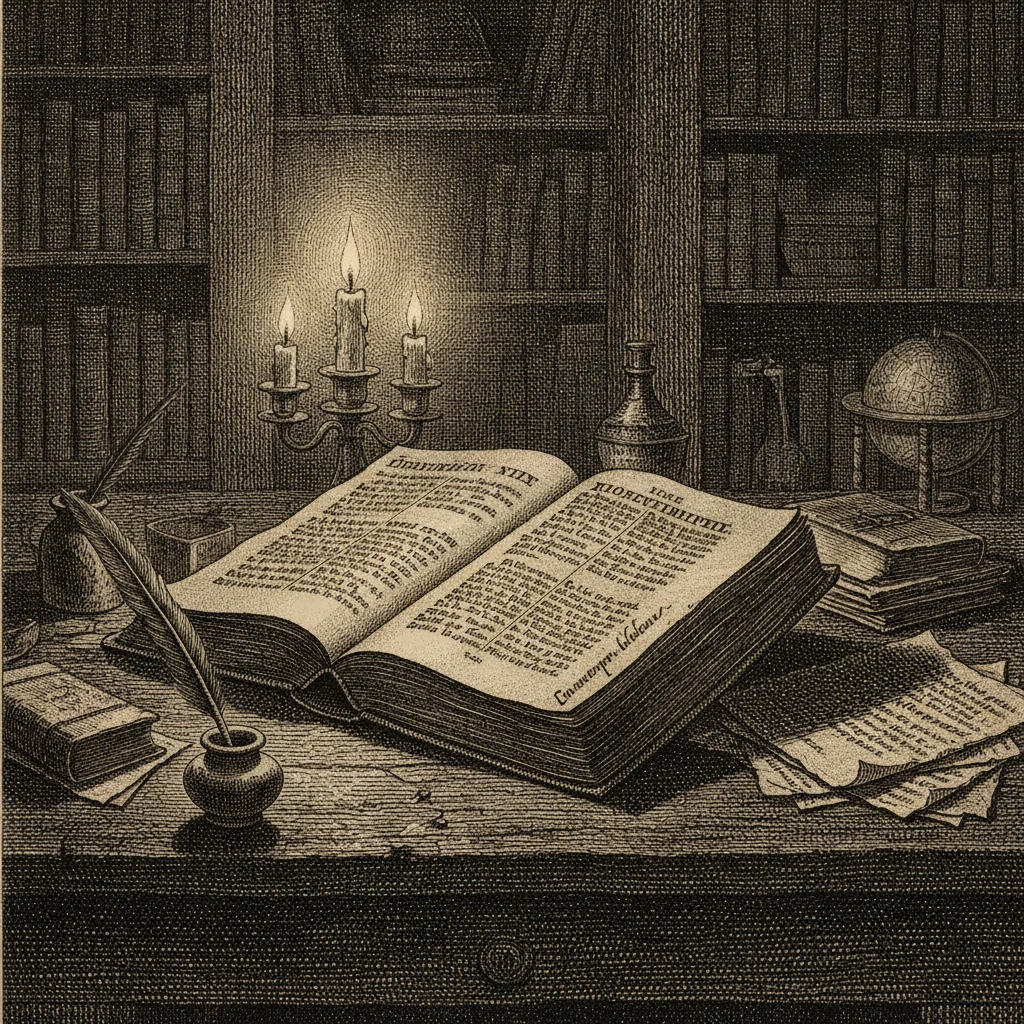
Atmospheric 17th-century study at night, candlelight on an old open book with mysterious cramped handwriting in the margin

As seen in the wild

Math notes Lab notebooks Museum labels Encyclopedia margins Terminal screens Old textbooks Postcards Receipt math

Section 1

A note in the margin

Pierre de Fermat was not a professional mathematician. By day, he was a lawyer and magistrate at the parlement of Toulouse in the south of France. Mathematics was his passion in his spare time - and he was one of the finest mathematicians of his century.

Fermat liked to read Arithmetica, a book of number puzzles written by Diophantus of Alexandria more than a thousand years earlier. As he read, he jotted his own thoughts in the margins.

Beside one puzzle, around 1637, he wrote a short note in Latin. In English, it says roughly this:

"It is impossible to separate a cube into two cubes, or a fourth power into two fourth powers, or in general, any power higher than the second, into two like powers. I have discovered a truly marvellous proof of this, which this margin is too narrow to contain."

That was all.

Fermat died in 1665. Five years later, in 1670, his son Samuel published a new edition of Arithmetica that included his father's margin notes. The world had been handed a promise - with no proof attached.

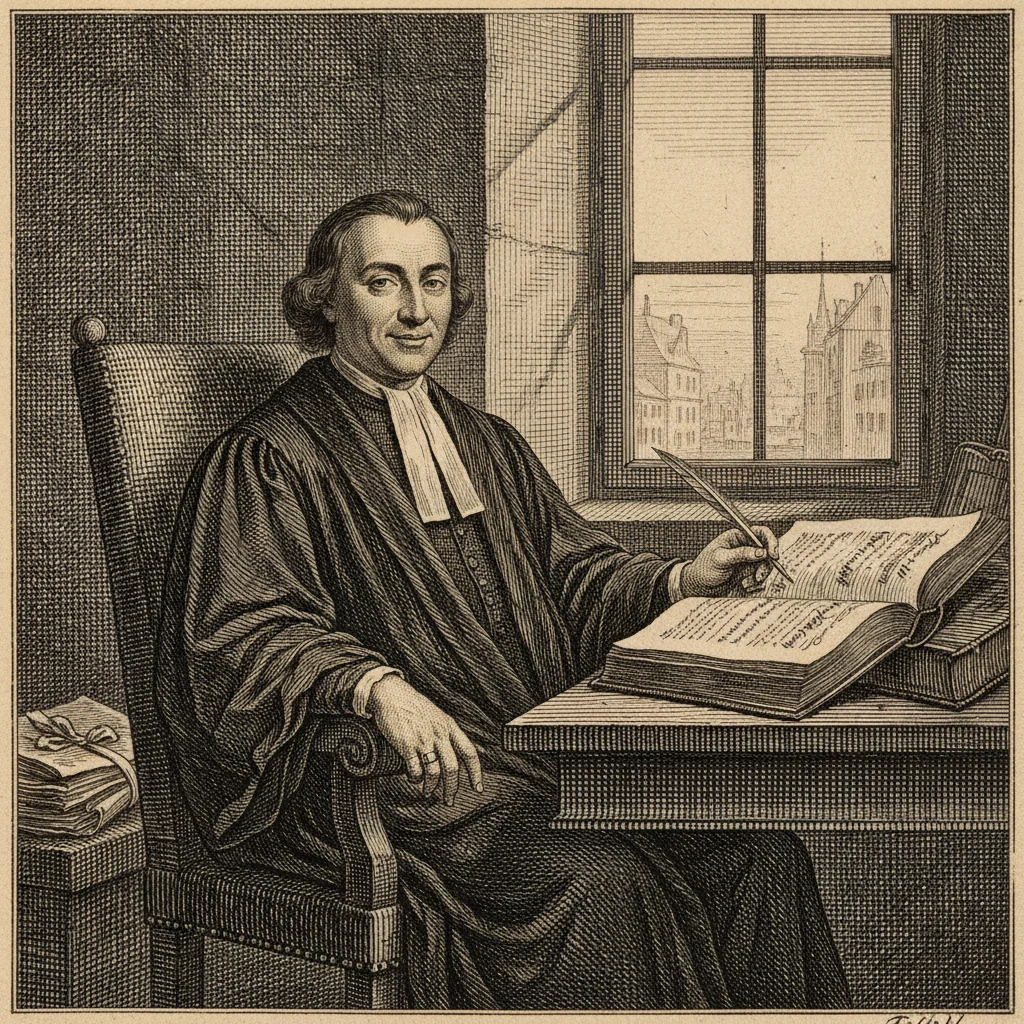
Fermat, a 17th-century French magistrate in dark robes, writing in the margin of a book by a window with a knowing half-smile

Fermat at his leisure, 1637 - approximately.

A row of old letters and notes, all but one stamped solved, the last one still sealed

Aside

Why "Last"?

Fermat made many bold claims about numbers without showing his proofs. One by one, later mathematicians proved them - or showed they were wrong. This one held out longest. It became known as Fermat's Last Theorem: not the last thing he wrote, but the last of his claims left standing.

Section 2

What did Fermat claim?

Here is the idea, gently.

You may remember a famous pattern from school: some pairs of square numbers add up to another square.

3² + 4² = 5²

That is, 9 + 16 = 25. There are endless examples like this.

Fermat said that as soon as you move beyond squares - to cubes, or fourth powers, or any higher power - this never, ever happens again.

In the language of mathematicians:

aⁿ + bⁿ = cⁿ has no whole-number solutions when n is bigger than 2.

It is a statement a child can understand. And it would take 358 years to prove.

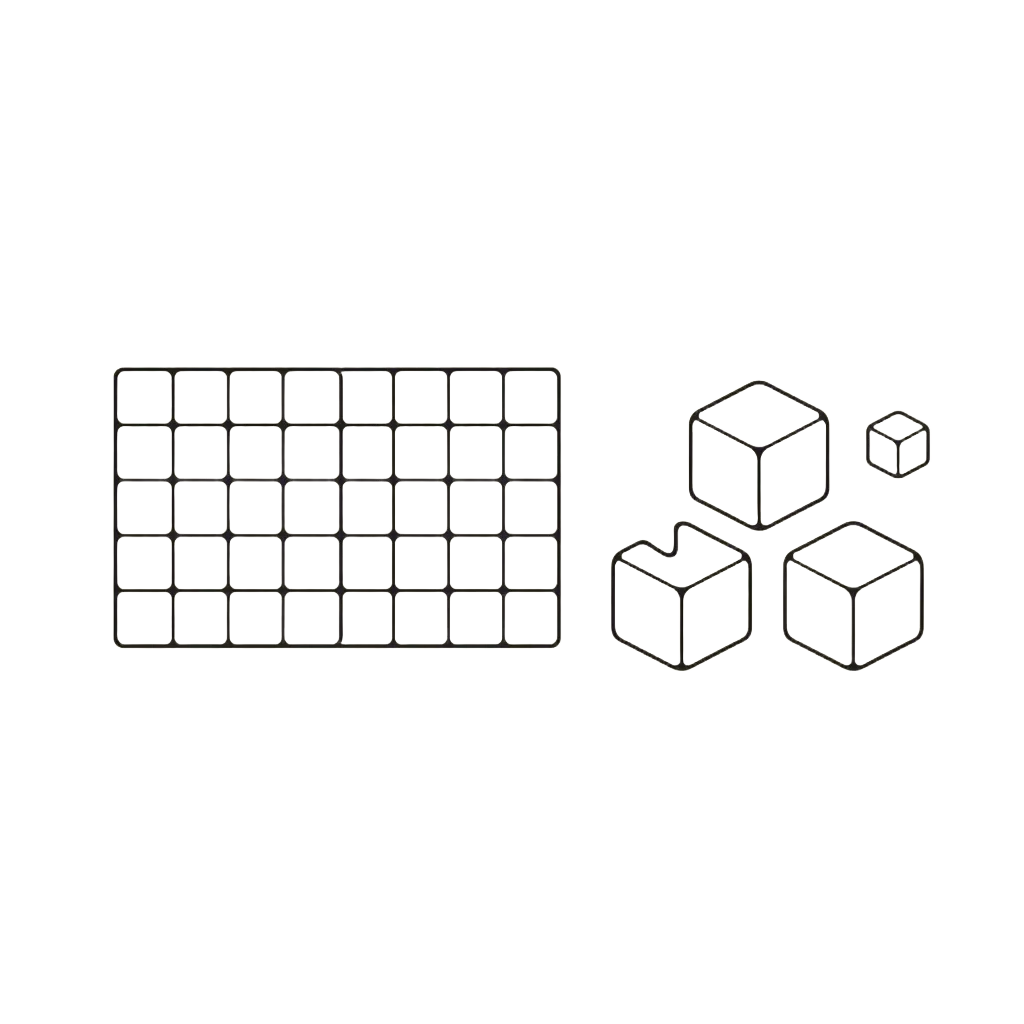
Friendly building-block puzzle: squares fitting together perfectly, and cubes that don't quite add up
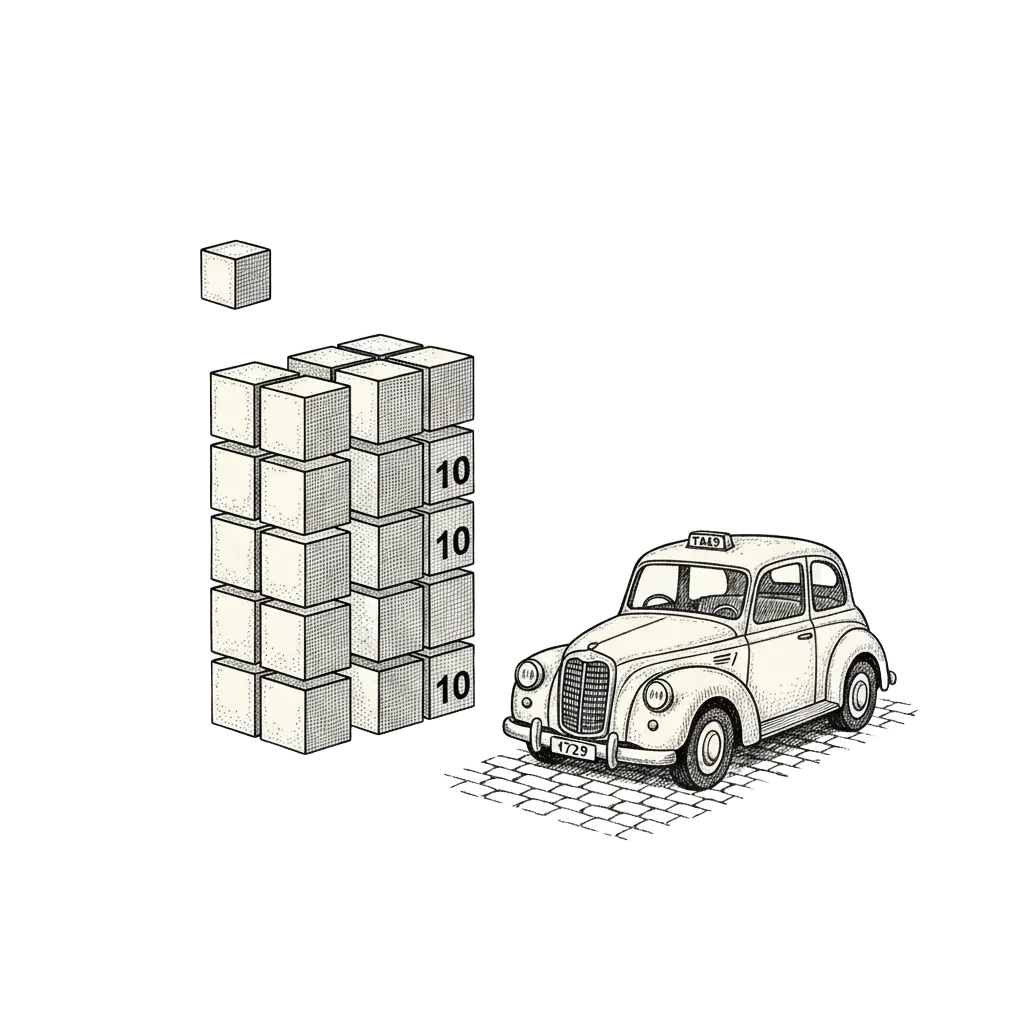
Two stacks of cubes nearly forming a larger cube, with one tiny cube left over, and a vintage taxi marked 1729

Near miss

So close, and yet…

A famous number in this museum comes tantalisingly close to breaking Fermat's rule. 1729 is 9³ + 10³ - and it is also 12³ + 1. So 9³ + 10³ misses being a perfect cube by exactly one. Ramanujan's taxi number is a near miss. Fermat's promise holds.

Read about 1729

Section 3

Three centuries of trying

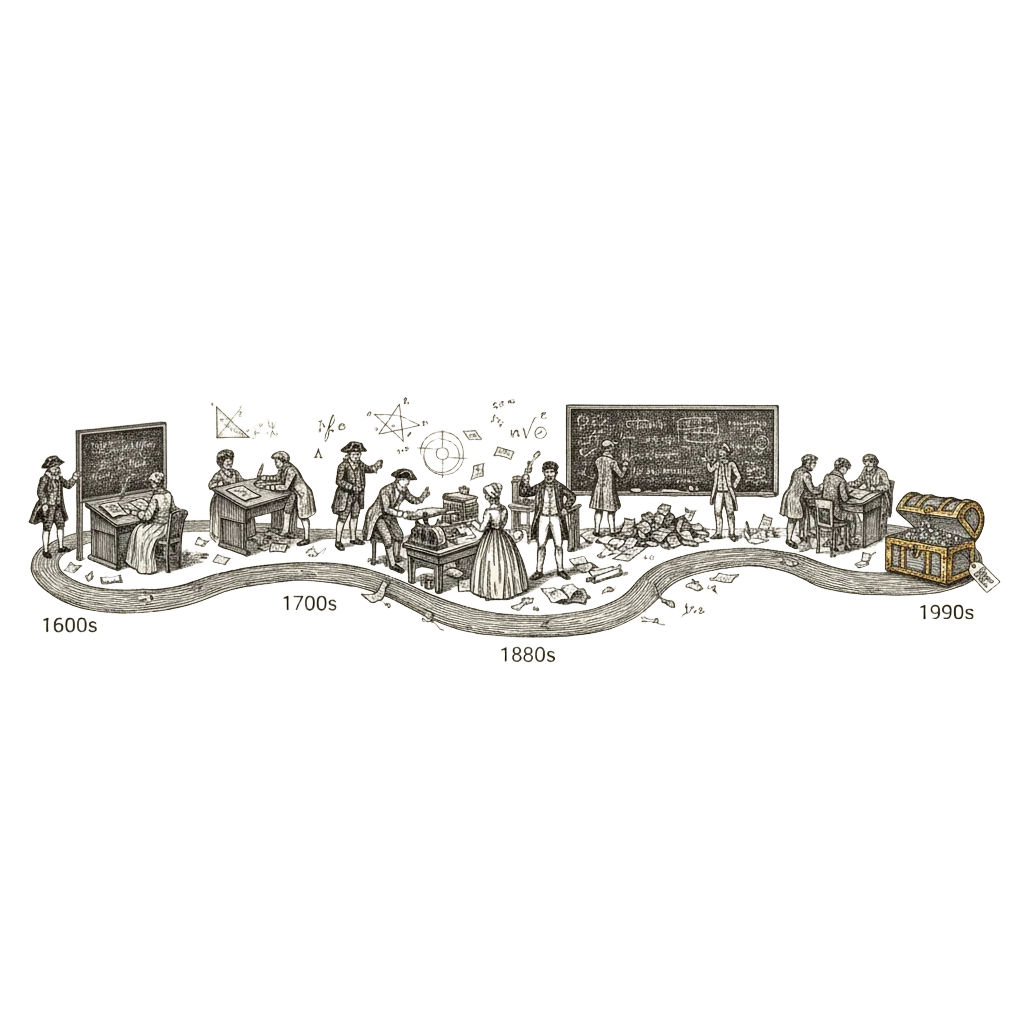
Fermat himself left a proof for fourth powers. About a century later, the great Leonhard Euler tackled cubes. Others chipped away at more cases, power by power. But there are infinitely many powers, and no one could find an argument that covered them all.

Over the centuries, the problem grew into a legend.

In 1908, a German benefactor, Paul Wolfskehl, left 100,000 marks as a prize for whoever could prove it. Proofs poured in - thousands of them. Almost all came from amateurs. Every one was wrong.

The margin note had become the most famous unsolved problem in mathematics.

Sweeping timeline illustration of a long road through centuries, small figures bent over blackboards, piles of discarded papers, and a prize chest unclaimed at the end

From the Desk

Enjoying this story?

NumberMuseum tells the stories behind remarkable numbers - the people, the accidents, and the surprises hiding inside them. Get the next one delivered to your inbox.

One new story a week, at most.

At most one email a week.

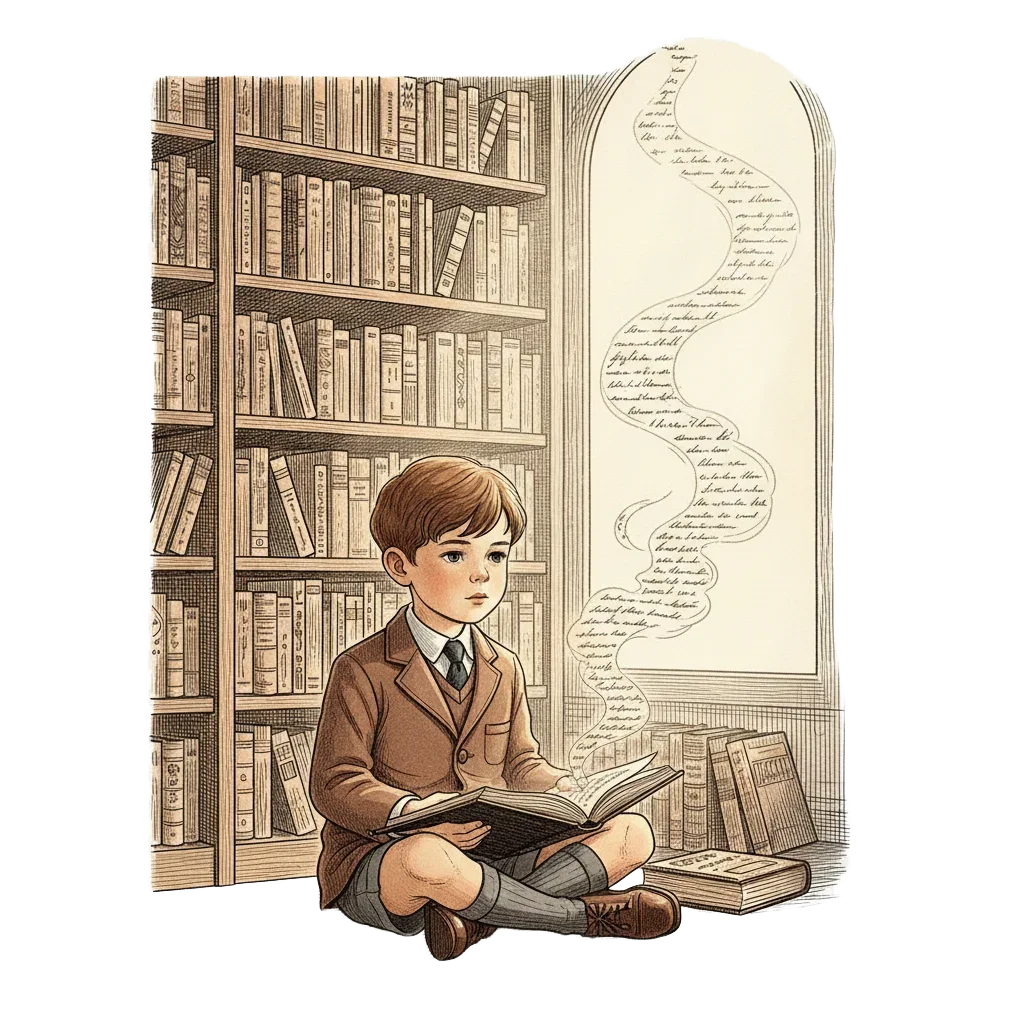
A small boy in 1960s school uniform sitting in a library, a book open on his knees, light through a tall window, ghostly handwriting drifting up from the pages

Section 4

The boy in the library

In 1963, a ten-year-old boy called Andrew Wiles was walking home from school in Cambridge, England. He stopped at his local library on Milton Road and picked up a book called The Last Problem, by Eric Temple Bell.

It told the story of Fermat's note.

"Here was a problem that I, a ten-year-old, could understand, that none of the great mathematicians in the past had been able to resolve."

He decided he would be the one to solve it.

Section 5

Seven years in secret

Wiles grew up to become a mathematician, and a professor at Princeton University in the United States.

For years, Fermat seemed out of reach. Then, in 1986, another mathematician showed that Fermat's claim would follow if someone could prove a different, deep idea connecting two distant corners of mathematics.

Wiles was 33. His childhood dream was suddenly back within reach.

He decided to work on it alone - and in secret. For about seven years, he told almost no one except his wife. He later explained, in effect, that talking about Fermat attracted too much attention, and that you cannot concentrate on one problem for years without undivided focus.

In June 1993, he gave a series of three lectures at the Isaac Newton Institute in Cambridge - the city where he had found Bell's book as a boy. He did not say where they were heading.

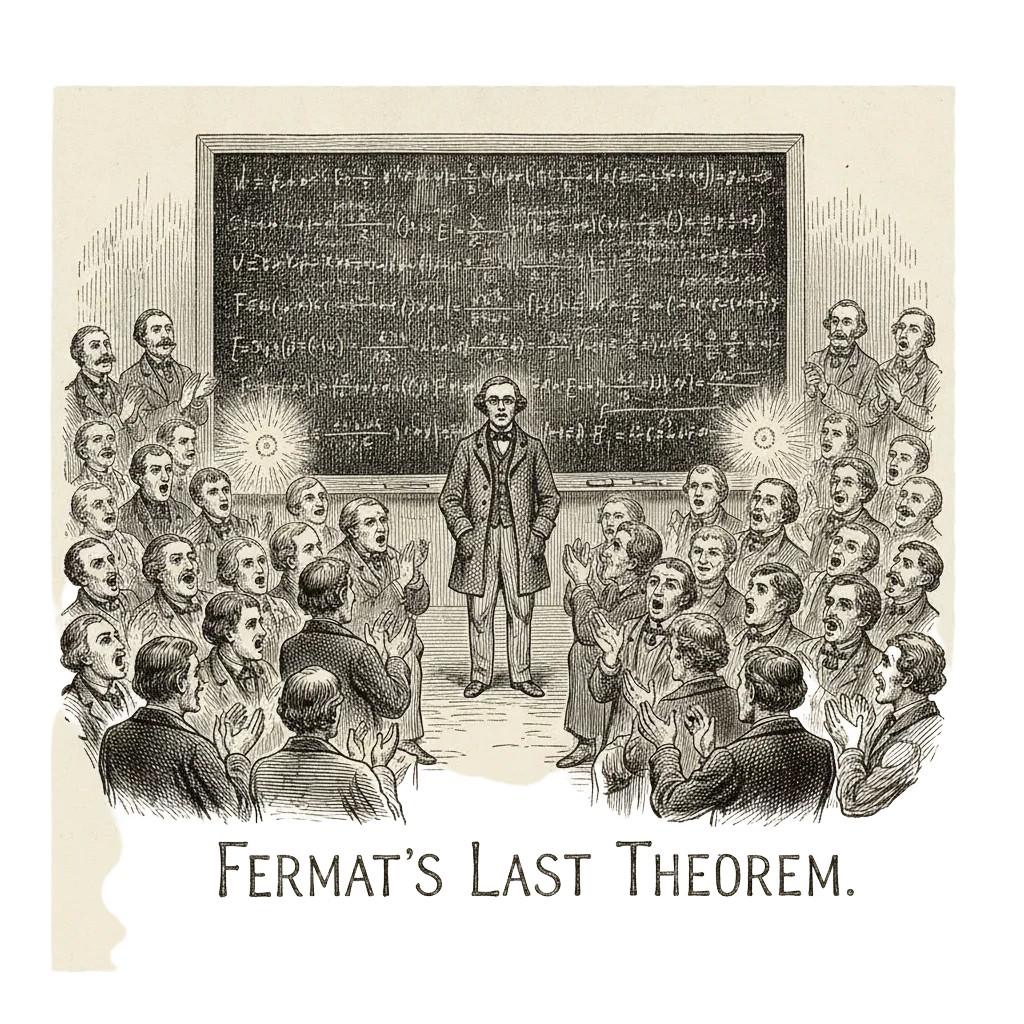
At the end of the last lecture, on 23 June 1993, he wrote Fermat's Last Theorem on the blackboard and announced that he had proved it.

Then, in words usually remembered as "I think I'll stop here," he sat down.

The room burst into applause.

A packed lecture hall of mathematicians, a quiet bespectacled man at a blackboard covered in equations, faces breaking into astonished applause

Isaac Newton Institute, Cambridge - 23 June 1993.

Section 6

A crack in the proof

But the story was not over.

Wiles' proof was more than a hundred pages long, and experts began checking it line by line. In the summer of 1993, one of the checkers, Nick Katz, found a gap - a single step that did not work.

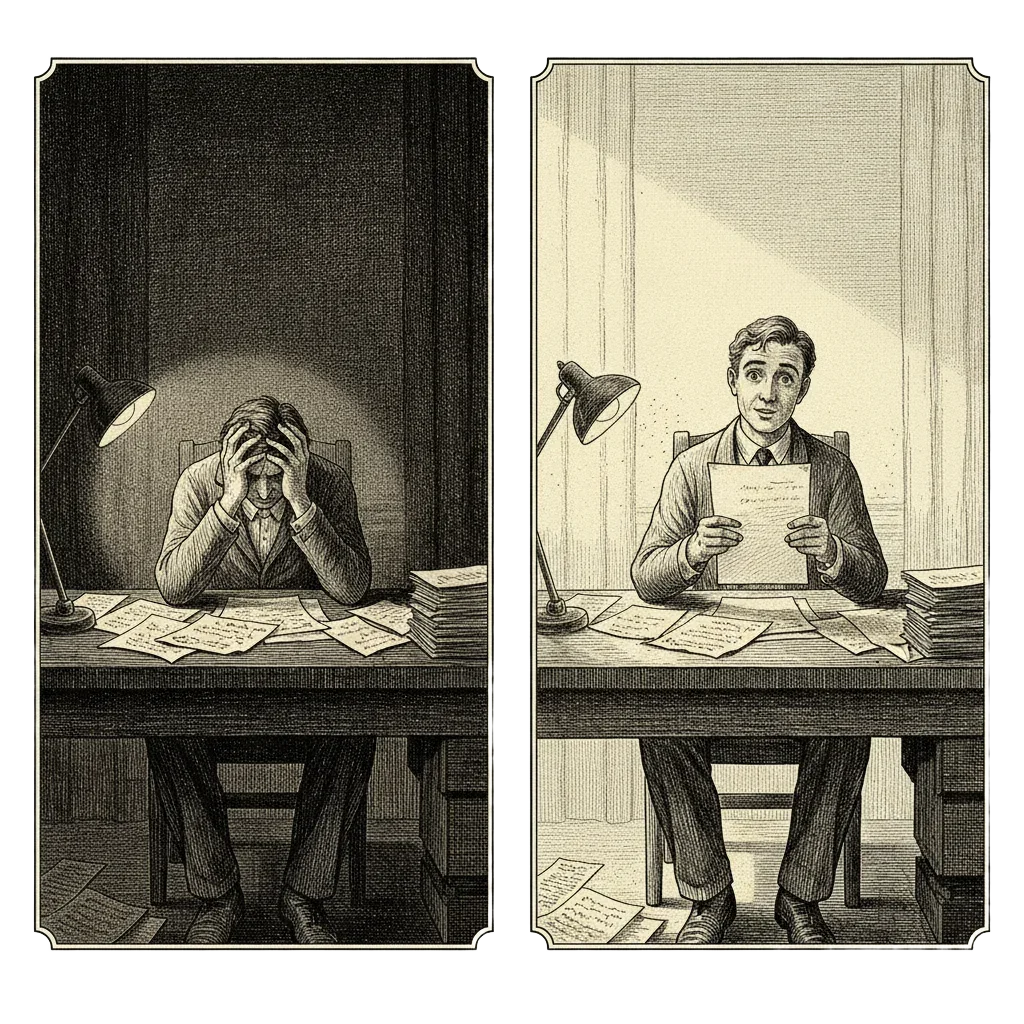
For more than a year, Wiles struggled to fix it, now in the full glare of the world's attention. He brought in a former student, Richard Taylor, to help. By September 1994, he was ready to admit defeat.

Then, on 19 September 1994, taking one last look at where it had gone wrong, he suddenly saw the answer.

Two-panel illustration: on the left, Wiles at a desk late at night with papers everywhere, head in hands; on the right, the same desk in morning light, Wiles staring at one page with quiet wonder

"It was so indescribably beautiful; it was so simple and so elegant, and I just stared in disbelief for twenty minutes."

The corrected proof - one paper by Wiles, and a second by Taylor and Wiles - was published in the journal Annals of Mathematics in May 1995.

Fermat's margin had finally been filled.

Section 7

How long is 358 years?

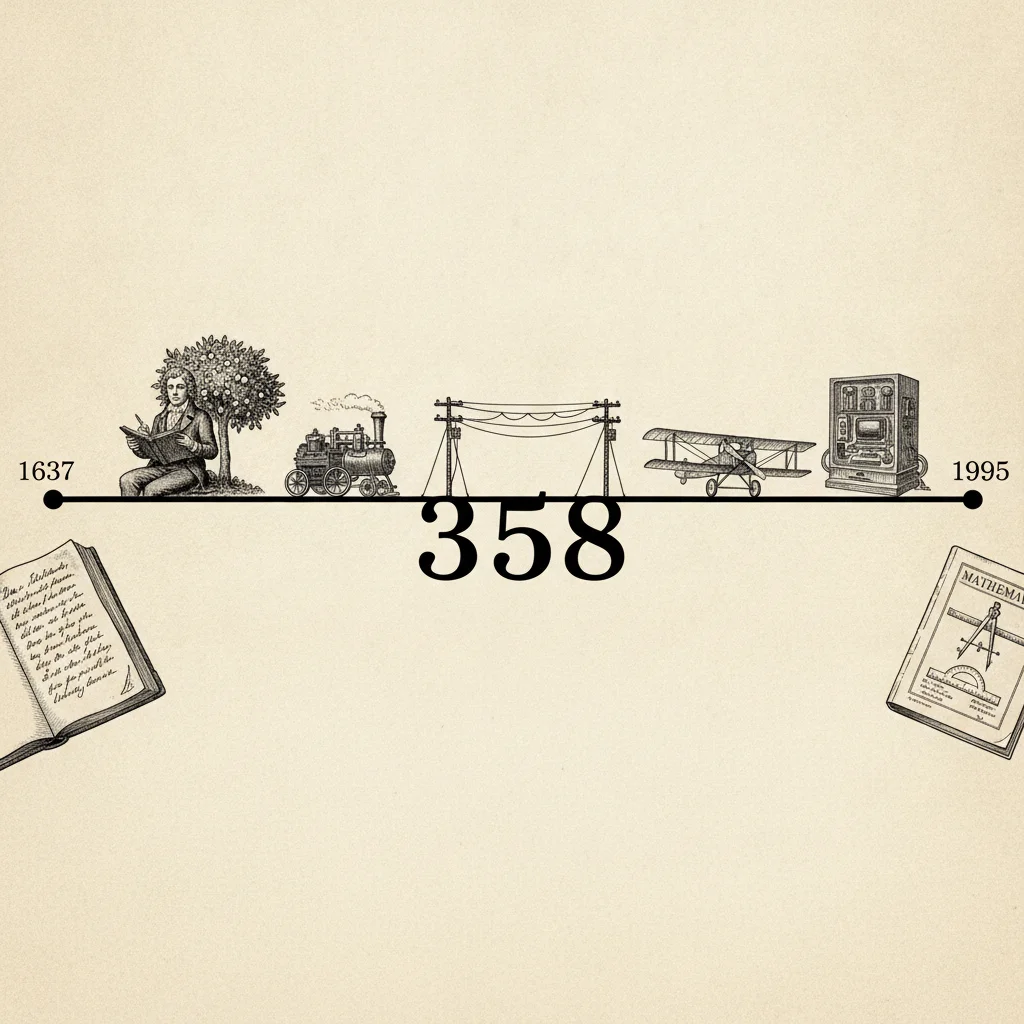
1637

Fermat's note

+ 358 =
1995

Proof published

Timeline ribbon from 1637 to 1995 with small icons - Newton, a steam engine, a telegraph, an aeroplane, an early computer - and the number 358 spanning the whole ribbon

When Fermat picked up his quill, Isaac Newton had not yet been born.

In those 358 years, the problem outlived kings, empires and revolutions. It watched the invention of the steam engine, the telegraph, the aeroplane and the computer.

Roughly fourteen generations of people lived and died while the margin stayed empty.

And the proof, when it came, needed mathematics that did not exist in Fermat's time. Wiles himself said that Fermat couldn't possibly have had this proof - it is a 20th-century proof.

So what did Fermat have? Perhaps an argument that seemed to work, with a hidden flaw. We will never know.

Section 8

Two worlds, one bridge

Here is the deepest surprise.

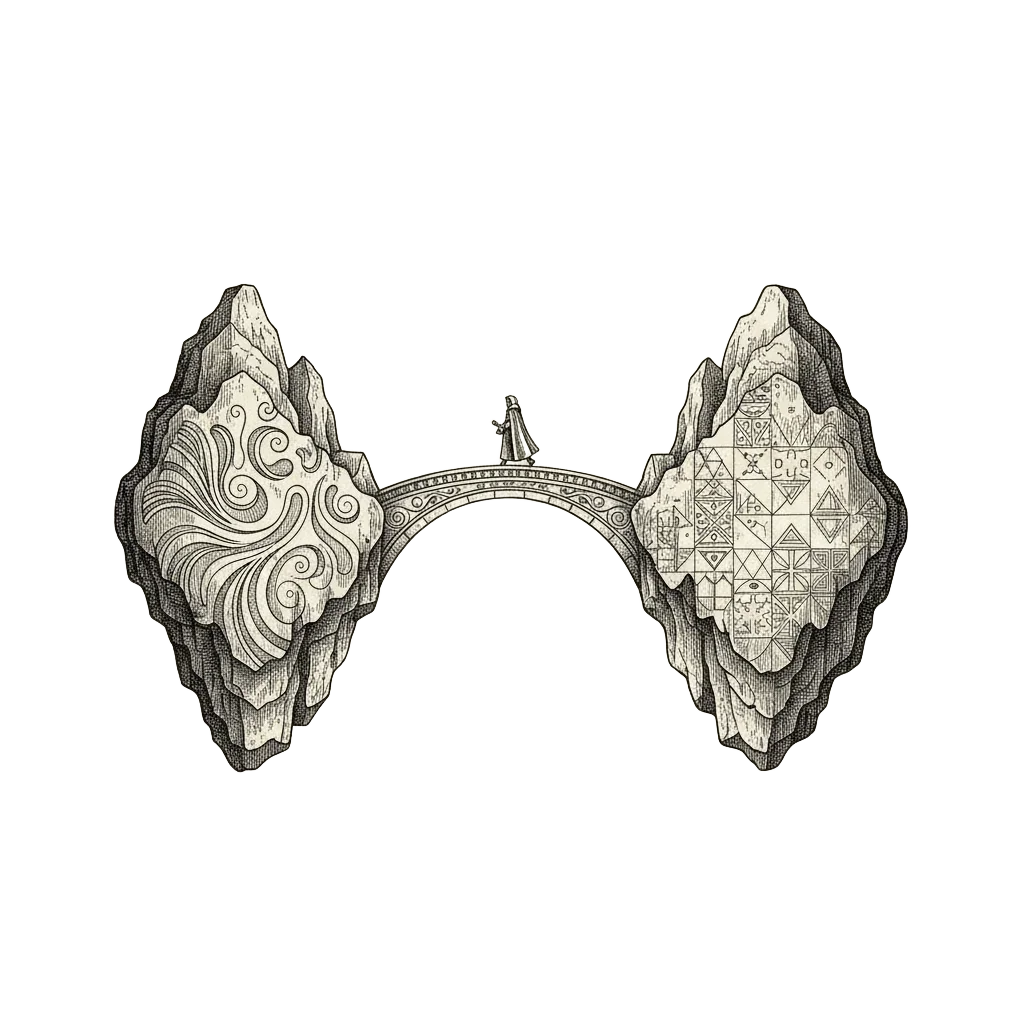
Wiles did not solve Fermat's puzzle by attacking it head on. Instead, he built a bridge between two whole areas of mathematics that had seemed to have nothing to do with each other - one about curves, and one about unusual kinds of symmetry.

Once that bridge was standing, Fermat's claim simply followed.

The bridge turned out to be far more important than the puzzle. It has become a central path for modern mathematics, and many new discoveries have travelled across it.

A single line in a margin ended up pushing mathematics to build something no one in Fermat's time could have imagined.

Two separate rocky islands connected by a graceful bridge - one island covered in flowing curves, the other in intricate symmetrical patterns - with a small figure crossing carrying a scroll
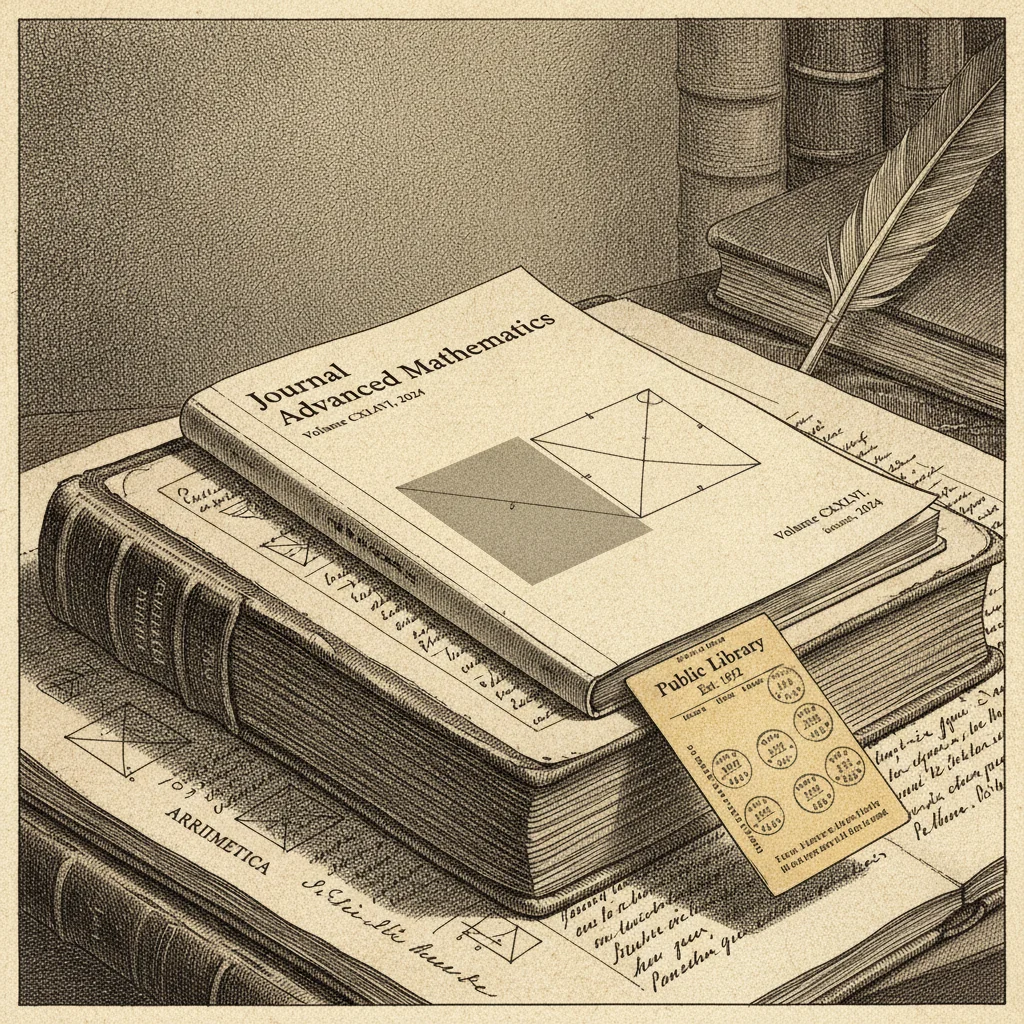
The old Arithmetica open at its margin note, a modern mathematics journal resting on top, a child's library card tucked between the pages as a bookmark

Section 9

Why we still remember it

In 1997, Wiles collected the Wolfskehl Prize - worth far less than it had been in 1908, but still a prize nearly a century in waiting. In 2000, he was knighted. In 2016, he received the Abel Prize, one of the highest honours in mathematics.

But the story lives on for simpler reasons.

Because it began with a note anyone can understand.

Because it held out for 358 years against some of the finest minds who ever lived.

And because the person who finally solved it first fell in love with it as a ten-year-old boy, reading a library book on his way home from school.

Section 10

358 in a nutshell

  • 1

    Around 1637, Pierre de Fermat wrote in the margin of his Arithmetica that he had a marvellous proof - but the margin was too narrow to contain it.

  • 2

    The claim: aⁿ + bⁿ = cⁿ has no whole-number solutions when n is bigger than 2.

  • 3

    It became the most famous unsolved problem in mathematics.

  • 4

    Andrew Wiles read about it at age ten in 1963, and announced a proof on 23 June 1993.

  • 5

    A gap was found; with Richard Taylor's help, Wiles fixed it on 19 September 1994.

  • 6

    The proof was published in May 1995.

  • 7

    1995 − 1637 = 358 years from margin to proof.

  • 8

    Ramanujan's 1729 is a famous near miss: 9³ + 10³ = 12³ + 1.

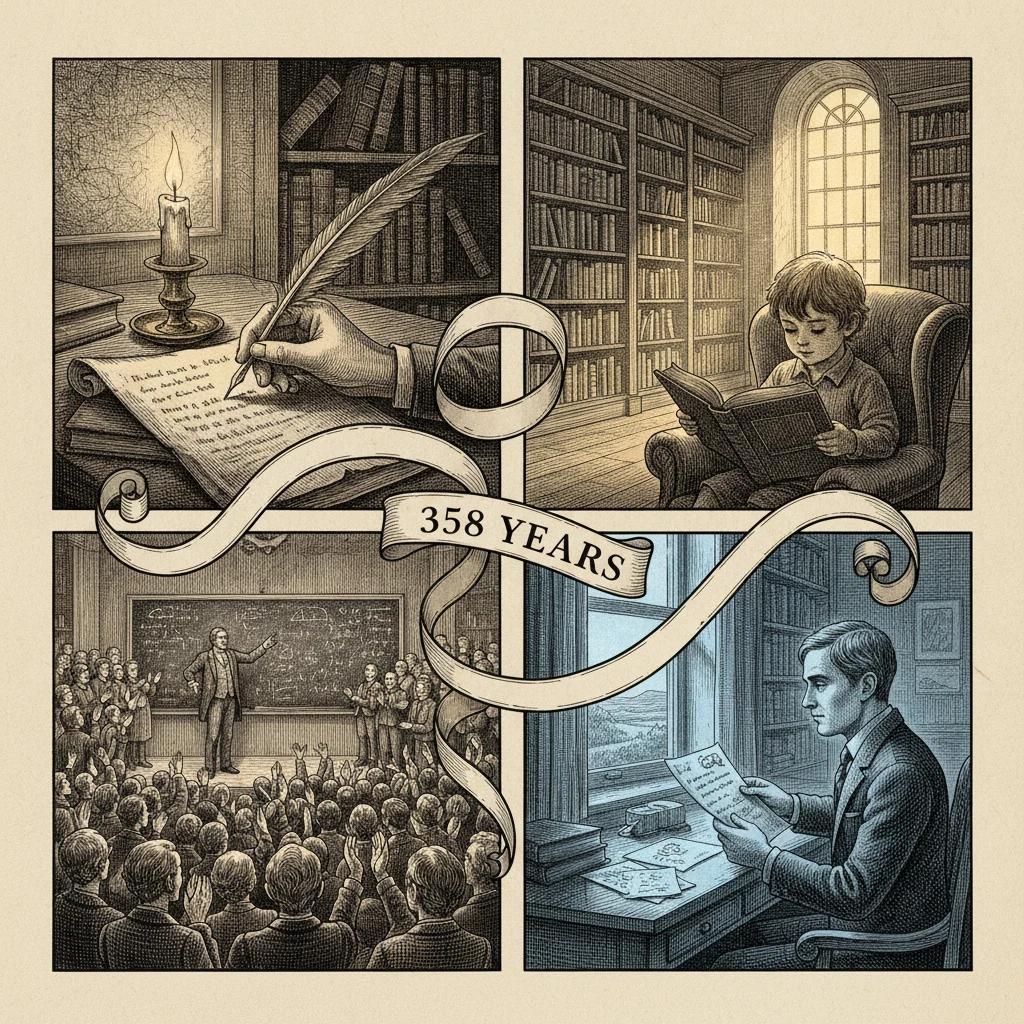
Final illustrated panel: Fermat's candlelit margin, the boy in the library, the packed lecture hall, and the morning of the revelation, all connected by a ribbon of 358 years

The margin was too narrow. The wait was 358 years.

Some promises take centuries to keep.

358

See a strange number.
Become curious.
Discover a story.

No syllabus. No signup. Just exhibits. Pull open a drawer, read a label, follow whichever footnote looks most suspicious, and let the collection take you somewhere you did not plan to go.

Your Cabinet Oddly Specific Numbers Of Curiosities
1729 · two cubes / two ways · most-read (+12%)
2,147,483,647 · signed 32-bit max · most-shared (+9%)
0.999… · equals 1 · most-argued (+31%)

Powered by DollarPageClub